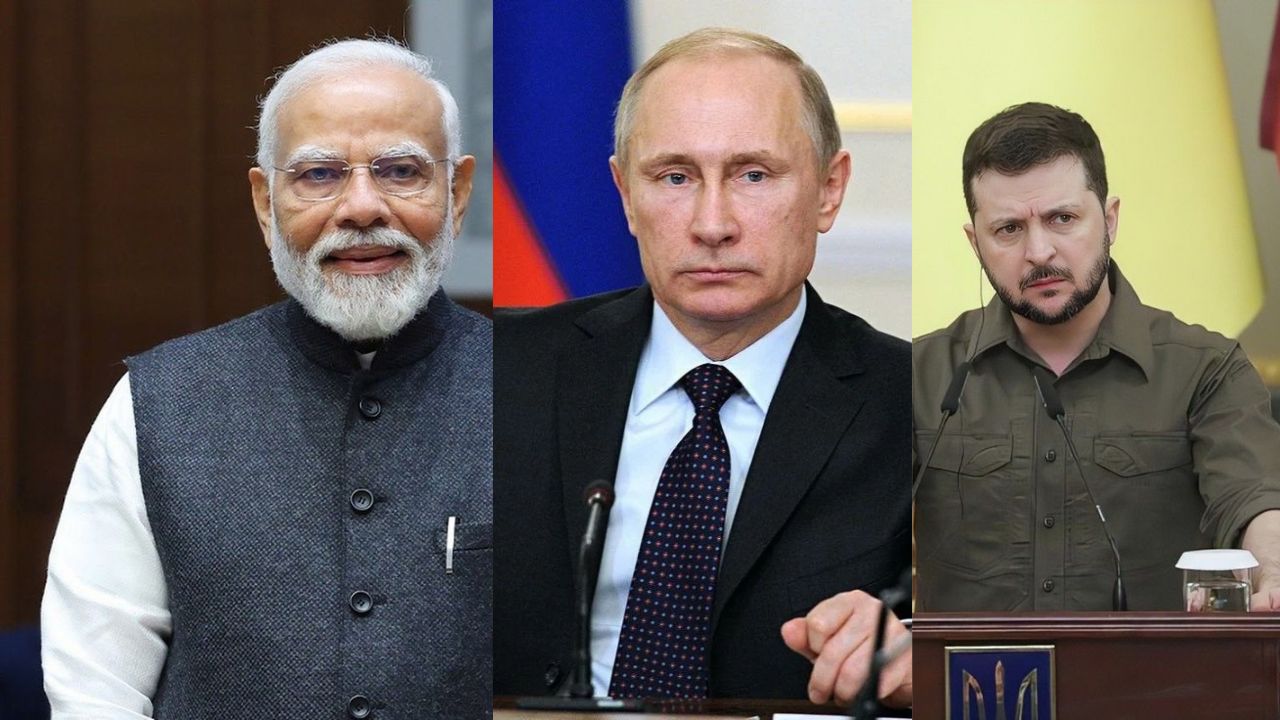
India’s reported three-part truce proposal seeks to halt energy infrastructure attacks, protect Black Sea shipping and maintain global grain and energy supplies amid the Russia-Ukraine war. (Images: Dynamite News)
New Delhi: India’s diplomatic efforts to help end the Russia-Ukraine war have drawn attention after a report described New Delhi’s proposed three-part truce as the broadest among several ceasefire initiatives under discussion. The proposal reportedly combines a halt to attacks on energy infrastructure, the protection of Black Sea trade routes and an end to strikes on commercial shipping. The initiative comes as attacks on energy facilities continue to affect both countries, while disruptions to maritime transport and commodity supplies threaten wider economic stability. According to a report by Geopolitical Monitor, India communicated its proposal to Ukrainian officials during External Affairs Minister S. Jaishankar’s visit to Kyiv in September.
Unlike approaches that concentrate on a single category of targets, the reported Indian plan seeks to connect infrastructure security with maritime stability and the continued movement of essential commodities. However, its prospects remain uncertain as Moscow and Kyiv continue to differ over the conditions required for a lasting settlement.
India’s reported initiative focuses on three interconnected areas that could reduce the immediate economic and humanitarian consequences of the conflict. The first element involves stopping attacks on energy facilities and other critical infrastructure. The second seeks to maintain the movement of grain and energy through Black Sea ports, which are important to international commodity markets. The third calls for an end to attacks on commercial vessels. Together, these measures would seek to protect essential services, reduce risks to maritime trade and limit disruptions to global food and energy supplies.
The proposal reflects the wider international consequences of the war. Damage to energy infrastructure can affect electricity generation, fuel availability and industrial production, while threats to commercial shipping can increase insurance costs, disrupt supply chains and raise commodity prices. India’s reported approach attempts to address several of these risks simultaneously rather than treating an energy ceasefire and maritime security as separate negotiations.
Ukrainian Foreign Minister Andrii Sybiha reportedly described India’s initiative as the broadest among four proposals being considered. According to the Geopolitical Monitor report, Sybiha indicated that Kyiv was prepared to consider an arrangement combining an energy ceasefire with a Black Sea ceasefire, rather than accepting the measures as isolated commitments.
The reported position suggests that Ukraine sees potential value in linking protection for energy infrastructure with maritime security and the continued flow of essential commodities. For Kyiv, a limited halt to energy attacks may not provide sufficient benefits if other parts of the economy remain exposed to military action. Combining several commitments could offer a more comprehensive framework for reducing immediate risks. Nevertheless, an expression of openness does not establish that a formal agreement has been reached or that both sides have accepted the same conditions.
Energy facilities have emerged as important targets in the Russia-Ukraine conflict, with attacks affecting power generation, fuel production and critical infrastructure. Russia has continued strikes on Ukrainian energy facilities, while Ukraine has carried out attacks on Russian oil infrastructure. Such operations can disrupt domestic supplies, damage industrial capacity and create economic pressure on the opposing side.
Ukraine’s attacks on Russian refineries have reportedly contributed to fuel supply difficulties, prompting Moscow to suspend fuel exports at various points and seek supplies from other countries. A ceasefire covering energy infrastructure could reduce the risk of further damage and help both countries stabilise essential services and fuel markets. However, defining the scope of such an arrangement would be complicated: negotiators would need to identify protected facilities, establish monitoring mechanisms and agree on how alleged violations would be handled. The effectiveness of any arrangement would depend on whether both sides were willing to observe its terms.
The Black Sea is a strategically important corridor for commercial shipping, including the movement of agricultural commodities and energy-related goods. Restrictions on shipping or attacks involving commercial vessels can affect transport costs, delay deliveries and introduce uncertainty into international markets. Grain exports are particularly important for countries that depend on imported food supplies. India’s reported proposal seeks to protect these commercial flows while reducing the danger faced by vessels operating in the region.
A maritime ceasefire could potentially improve shipping confidence and reduce some of the risks associated with transporting essential goods. However, implementation would require clarity over the geographical scope of the arrangement, the vessels covered and the procedures for responding to alleged violations. The initiative therefore involves not only military de-escalation, but also the practical challenge of safeguarding international trade during an active conflict.
Although the Kremlin has welcomed India’s diplomatic efforts, its public position, as described in the report, suggests that Moscow does not view the proposal as a comprehensive solution to the war. Kremlin spokesperson Dmitry Peskov reportedly characterised the initiative as addressing a specific aspect of a possible settlement. He also echoed US Secretary of State Marco Rubio’s assessment that prospects for a diplomatic resolution remained limited and that the conditions for negotiations were not yet in place.
Russia has repeatedly argued that it wants a durable settlement rather than a temporary pause in fighting. Moscow’s concern is that a ceasefire could allow Ukraine to regroup, replenish military supplies and prepare for further hostilities. This difference in priorities complicates efforts to secure an agreement even on limited measures intended to reduce immediate risks. For Ukraine, an energy-only arrangement may also be insufficient if attacks continue elsewhere or if there is no wider framework for addressing the conflict.
These competing calculations help explain why a proposal that appears practical in economic and humanitarian terms may still encounter political and military obstacles.
India’s approach is also shaped by its economic relationship with Russia and its exposure to global energy markets. Russia remains an important supplier of crude oil to India, while the reported analysis highlights a growing two-way dimension to their energy relationship, including Indian refined petroleum products reaching Russian markets. Such trade links underline the complexity of the global energy system, in which countries can be commercial partners even as geopolitical tensions affect supply chains and pricing.
For India, prolonged instability can create uncertainty around oil prices, shipping, insurance and the availability of essential commodities. Disruptions in global energy markets can affect transport costs, industrial activity and household expenditure. Reducing the risks associated with the war is therefore relevant to India’s economic interests, regardless of its continuing trade relationships with Moscow.
India’s diplomatic position is influenced by its broader economic priorities, including growth, energy security and access to international markets.The Geopolitical Monitor report points to the International Monetary Fund’s growth outlook for India as part of the economic context behind New Delhi’s interest in reducing the consequences of the conflict. A prolonged war can affect economies far beyond Europe through higher energy prices, uncertainty in food markets, disruptions to shipping and increased costs for businesses.
For a large, fast-growing economy, such pressures can complicate inflation management, trade planning and industrial expansion. India’s reported proposal also reinforces its attempt to contribute to diplomatic engagement while maintaining working relationships with both Russia and Ukraine. The challenge is to translate that diplomatic engagement into practical commitments that both sides consider acceptable.
India’s three-part initiative could provide a framework for discussing limited measures to protect infrastructure, shipping and essential commodity flows. Its broader significance lies in the attempt to connect several areas of concern within a single arrangement. Yet the proposal faces substantial obstacles. Russia and Ukraine continue to disagree over the purpose and scope of a ceasefire, while questions remain over monitoring, enforcement and the consequences of alleged violations. A limited truce would not by itself, resolve the political, territorial and security disputes at the heart of the war. It could, however, offer a way to reduce certain immediate risks if both sides agree to verifiable terms.
For now, the proposal remains a reported diplomatic initiative rather than a confirmed peace agreement. Its progress will depend on whether Moscow and Kyiv can move beyond their differing calculations and accept reciprocal commitments on energy infrastructure, maritime security and commercial trade. As the conflict continues to affect international markets, India’s effort highlights the growing importance of protecting critical infrastructure and global supply routes alongside the search for a lasting political settlement.

