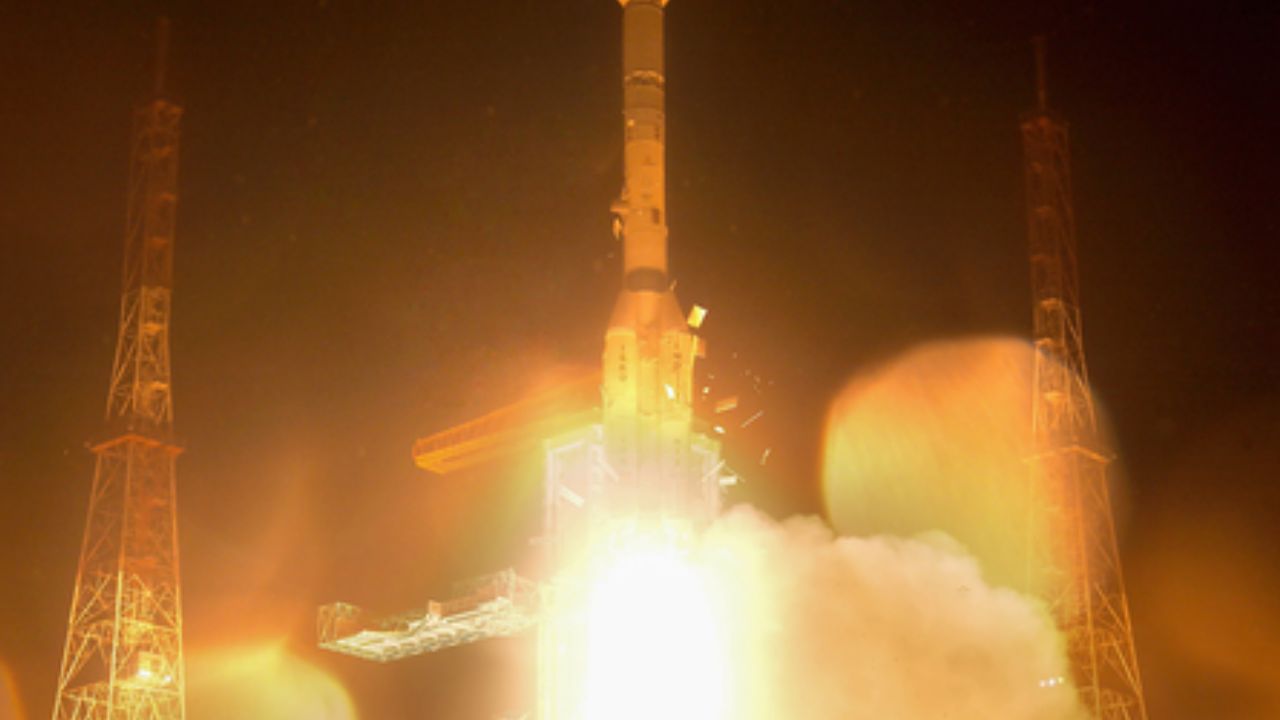
India-EU space ties gain momentum through EOS-05 (Img: IANS)
New Delhi: India's launch of geosynchronous satellite EOS-05 has added an important capability to the country's space sector. It is India's first imaging satellite designed to operate from an orbit synchronised with the Earth.
The satellite, positioned at an altitude of nearly 36,000 kilometres, can observe a much larger area and revisit the same region more frequently. The capability could support monitoring of cyclones, floods, fires, agricultural activity and developments in coastal areas.
According to an article by Javier Villamor in Brussels Signal, "for India, having its own satellites, domestic launch systems, and the ability to schedule its own observations means relying less on foreign providers to understand what is happening over its territory, along its borders and across the Indian Ocean. It is a question of technological sovereignty."
The article noted that India and the European Union are simultaneously expanding cooperation in space, while pursuing their respective strategic and industrial objectives. A sector that has historically been dominated by the US and Russia, with China emerging as another major space power.
Europe's space architecture is broader and more diversified. Its Copernicus programme includes several Sentinel satellites to monitor land, oceans and the atmosphere, with a support from multinational ecosystem that brings together radar, optical imaging, meteorology and atmospheric measurements.
India, meanwhile, is moving towards a more concentrated model aimed at ensuring that critical space capabilities are increasingly available domestically, the article said.
"Competition between the two can be beneficial precisely because neither needs to copy the other. India wants to develop launchers, Earth observation, navigation, crewed missions and a future space station. Europe needs to preserve its own industrial autonomy and its ability to maintain strategic assets without depending on third countries," it said.
The article also highlighted the growing record of cooperation between India and Europe. In December 2024, India launched the European Space Agency's Proba-3 solar observation mission aboard an ISRO PSLV-XL rocket.
The European Space Agency (ESA) and ISRO have also expanded cooperation covering human and robotic exploration, astronaut training, space operations and interoperability.
An exchange of letters signed in Paris on September 10 extended the existing cooperation framework until January 8, 2032. The expanded framework also includes areas such as space weather and the sustainability of outer space activities.
Since 2018, the European Commission and India's Department of Space have operated an agreement allowing the exchange of data between Europe's Copernicus programme and selected Indian civilian satellites.
Under the existing arrangement, New Delhi gets access to Sentinel satellite data, while Europe can use data from Indian missions. Commercial high-resolution imagery, however, is excluded from the arrangement.
The article identified disaster management as one of the most immediate areas where India-EU space cooperation could deepen. EOS-05 could provide persistent observation over South Asia and the Indian Ocean, while European systems could complement those observations through radar, emergency mapping, multispectral data and advanced processing capabilities.
During rapidly developing disasters such as cyclones and floods, combining information from multiple sources could help authorities assess situations and respond more quickly, the article observed.
The scope of cooperation also extends beyond satellite imagery. Modern economies increasingly rely on space-based systems for navigation, telecommunications, meteorology and logistics, while space-based capabilities also have implications for defence and security.
With the number of satellites in orbit continuing to increase, monitoring objects in space, preventing collisions and protecting critical infrastructure have become increasingly important.
The article noted that the India-EU agenda already includes cooperation in areas such as space surveillance, communications and security, creating further avenues for closer engagement between New Delhi and Brussels.

