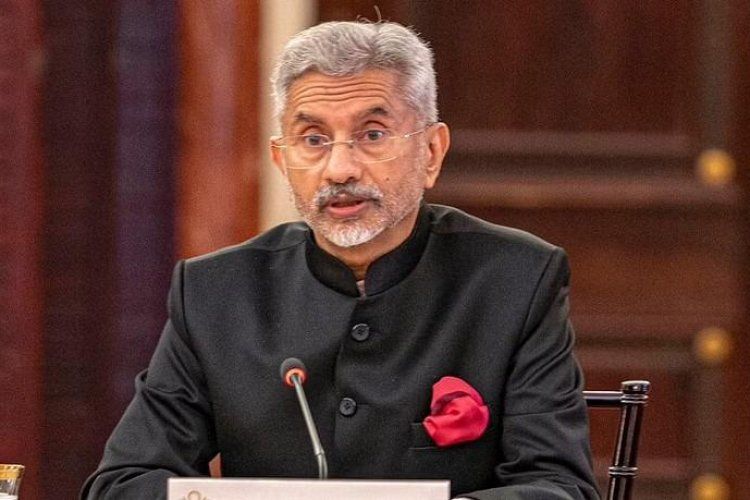
S Jaishankar at the Munich Security Conference as he outlines how US repositioning, China’s rise and middle-power self-reliance are reshaping the global order. (Images: X)
Munich: External Affairs Minister S Jaishankar has said the United States has “deliberately become a lonelier power”, arguing that Washington’s changing global posture and China’s rapid rise are reshaping the international order.
Speaking at the 62nd Munich Security Conference in Germany, Jaishankar said the global landscape was increasingly being defined by intense US-China competition, greater self-reliance among emerging and middle powers, and a growing push to diversify partnerships and reduce strategic risks.
Jaishankar described the changing US approach as one of the defining features of the current global landscape. He termed it a “radical repositioning” and said the shift was a deliberate choice rather than something imposed on Washington. According to Jaishankar, the changing US posture is taking place alongside broader transformations in the global balance of power, forcing other countries to reassess their own interests and partnerships.
The External Affairs Minister identified China’s growing economic and political influence as another major feature of the emerging global order. He highlighted China’s enormous manufacturing capacity and said its economic strength was increasingly translating into political influence. The resulting US-China rivalry, he noted, is no longer confined to the two powers themselves.
Jaishankar said the competition has created a situation in which countries are increasingly using whatever economic, technological, political or strategic leverage they possess. At the same time, the rivalry exists alongside what he described as the “complexity of interdependence” between nations.
Jaishankar said emerging and middle powers were becoming more conscious of their national interests and were moving towards greater self-reliance. He pointed to India’s concept of “Atmanirbhar” as an example of this broader trend. According to him, countries are increasingly evaluating what they can contribute to international discussions instead of simply aligning themselves with larger powers. The focus, he said, is also shifting towards diversification and de-risking. These efforts are expanding beyond economic and security concerns to cover supply chains, connectivity and wider strategic cooperation.
Jaishankar argued that countries do not necessarily need complete agreement on every issue to work together. He said emerging and middle powers can cooperate when there is a reasonable degree of convergence between their interests. The earlier expectation of complete alignment or an identical view on major issues he suggested is becoming less practical in today's international environment.
According to Jaishankar, sufficient common ground can provide the basis for cooperation, allowing countries to develop issue-specific partnerships without abandoning their other strategic relationships.
Jaishankar cited several existing arrangements as examples of this new approach to international cooperation. He referred to the Quad, connectivity initiatives such as the India-Middle East-Europe Economic Corridor and the International North-South Transport Corridor, as well as the Northern Sea Route. He also highlighted BRICS as an example of countries joining together when collective action can provide greater influence than individual efforts. The External Affairs Minister further mentioned the International Solar Alliance and the Coalition for Disaster Resilient Infrastructure, both initiatives associated with India's efforts to build broader international cooperation.
Jaishankar said countries were increasingly creating partnerships based on specific interests rather than relying only on traditional alliances or rigid blocs. He argued that nations can develop working arrangements, common agendas and institutions wherever their interests require cooperation. This approach, he said, is contributing to an evolving global architecture based on flexibility, resilience, diversification and strategic hedging.
His remarks at Munich come against the backdrop of growing US-China competition and a wider effort by emerging powers to protect their interests while maintaining relationships with multiple centres of global influence.

