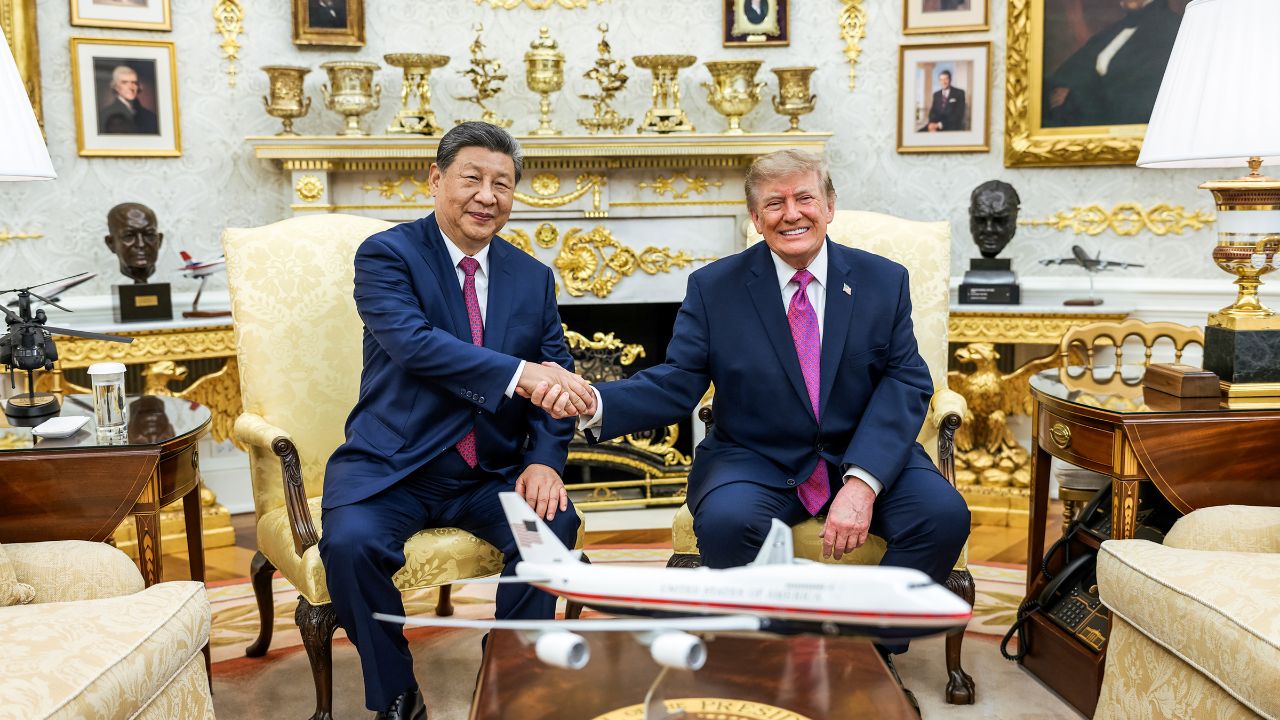
Trump-Xi Talks Focus On Trade, Taiwan And AI (Img: IANS)
Washington: Amid tensions over Taiwan, trade, tariffs and artificial intelligence, US President Donald Trump hosted Chinese President Xi Jinping to the White House on Thursday for talks that covered a range of bilateral and global issues.
The meeting took place during Xi’s state visit to the United States with trade, technology and the broader strategic rivalry between Washington and Beijing among the key issues in focus.
The US and China extended their trade truce, but only for a limited period. US Treasury Secretary Scott Bessent said the two sides had agreed to extend by two months an agreement that brought an end to last year’s trade war and was due to expire in November.
The extension is intended to give both sides “more time to see what we can do on the economic front,” Bessent said.
However, the this leaves several major issues unresolved, including tariffs, Chinese purchases, rare-earth supplies and technology restrictions, which are expected to remain part of future negotiations.
Bessent said that Beijing was meeting its commitment under the earlier agreement to purchase 25 million tons of soybeans but was behind on its pledge to buy $17 billion worth of other agricultural products.
US officials have also said rare-earth deliveries were falling short of agreed levels, highlighting the differences that remain between the two sides.
For businesses, the arrangement provides some relief from higher tariffs for now, but leaves companies operating against an uncertain policy environment.
Xi’s White House visit featured elaborate ceremonial events, with Trump using the occasion to showcase Washington in a distinctly different style.
After Xi hosted Trump in Beijing with a tour of a Ming dynasty temple and a walled garden retreat rarely opened to foreign visitors, Trump offered a different spectacle in Washington.
Troops wearing wigs and tricorner hats marched in formation and performed music in the Rose Garden, which had been redesigned to resemble a Trump golf club.
Fighter jets and bombers also flew overhead during ceremonies on Wednesday and Thursday. One of the flyovers was so loud that Trump appeared to flinch.
When White House reporters were brought in to cover the leaders, they were shown the Marine One helicopter and the recently redesigned South Lawn, including a large helipad bearing the presidential seal.
Asked about the discussions between the two leaders, Trump played down questions about the substance of their talks.
“He loves good granite,” Trump said of Xi. “Great meeting.”
Taiwan was another major issue during the their talks, with Xi urging US to exercise caution over the sensitive question.
According to China’s official news agency, Xi said Beijing hoped the United States would "handle the Taiwan question with prudence."
The agency’s English-language service also reported that Xi hoped the US would oppose Taiwan independence.
That wording goes beyond Washington’s longstanding position that it does not “support” Taiwan independence. There was no indication that US planned to alter its established formulation.
The White House did not immediately release its own account of the exchange.
Xi also referred to the “Thucydides Trap”, an academic theory suggesting that tensions between a rising power and an established power can increase the risk of conflict.
While Xi said the risk “can be overcome”, his reference highlighted the continuing concerns surrounding a potential military confrontation between the world’s two largest powers.
Xi said both countries could benefit from cooperation and face losses through confrontation. He also called for regular military dialogue and stronger mechanisms to prevent crises from escalating.
Trump, meanwhile, pointed to the shared history of the two countries, particularly their wartime alliance against Japan, as an example of how common interests could provide a basis for cooperation.
Artificial intelligence was another area where the two leaders presented different approaches.
Trump, who has said AI should be referred to as “super intelligence”, or SI, said in a social media post that he wanted “to leave it exactly where it is" and rely on the US Department of Justice rather than introduce new guardrails. He also said China shared the same position.
Xi, however, stressed the need for the two countries to manage the development of AI.
“We have both the capability and responsibility to develop and manage AI for good, and ensure that the development of AI is always under human control and serves the well-being of the people,” Xi said.
Several prominent figures from the global technology industry were also expected to attend the White House state dinner for Xi, including Alphabet’s Sundar Pichai, OpenAI’s Sam Altman and Nvidia’s Jensen Huang.

