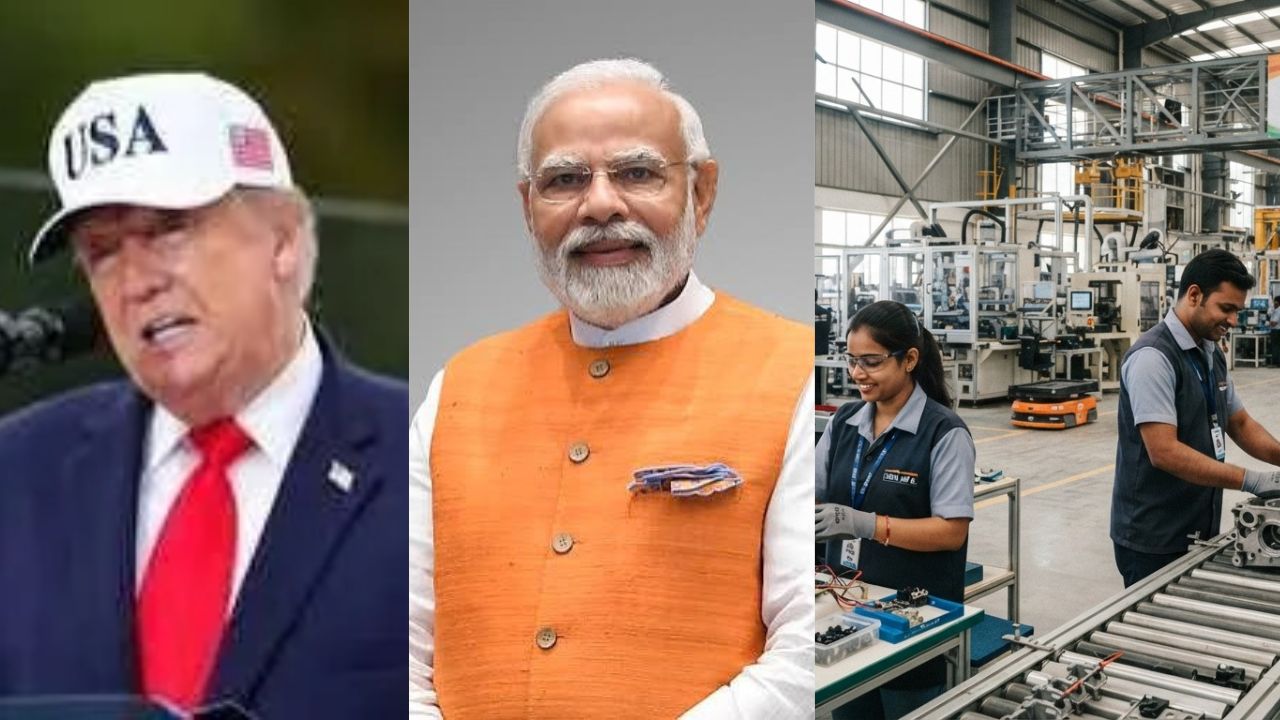
Trump administration's proposed 25% tariff puts India's Make in India and Atmanirbhar Bharat initiatives under scrutiny. (Img: X)
New Delhi: India's ambitious manufacturing expansion has come under fresh scrutiny after the Donald Trump administration proposed tariffs of up to 25 per cent on Indian goods, accusing New Delhi of encouraging structural excess manufacturing capacity through government-backed industrial policies.
The move places flagship initiatives such as Make in India, Atmanirbhar Bharat and the Production Linked Incentive (PLI) scheme at the centre of an escalating India-US trade dispute.
On November 25, the Office of the United States Trade Representative (USTR), headed by Jamieson Greer, determined that India's industrial and trade policies were unreasonable and restricted American commerce under Section 301 of the Trade Act of 1974.
Washington has proposed tariffs of up to 25 per cent on Indian imports, subject to exemptions. However, the rate could be reduced to 17 per cent if India concludes a qualifying reciprocal trade agreement addressing US concerns. New Delhi has rejected the allegations, maintaining that India does not have structural excess manufacturing capacity in any sector.
At the heart of the dispute is structural excess capacity, a situation in which manufacturing production exceeds what market demand would ordinarily justify. The US argues that government subsidies, financial incentives and production targets encourage companies to manufacture beyond domestic demand. The resulting surplus can enter international markets through exports, intensifying competition and putting pressure on prices.
Launched in 2014, Make in India aims to attract investment, generate employment, strengthen industrial infrastructure and increase manufacturing's contribution to GDP to 25 per cent. While India views manufacturing expansion as essential for economic development and reducing import dependence, Washington argues that government-backed production growth can distort international competition.
The PLI scheme is another major target of the investigation. It provides financial incentives to eligible companies based on incremental production and sales, encouraging investment in electronics, pharmaceuticals, automobiles, telecommunications equipment and solar manufacturing.
The USTR argues that such incentives could contribute to excess production when manufacturing capacity expands faster than market demand. Similarly, Atmanirbhar Bharat seeks to strengthen domestic industries, reduce import dependence and build resilient supply chains.
Washington contends that import-substitution policies and export-oriented industrial expansion can disadvantage American manufacturers. The investigation also identifies the India Brand Equity Foundation (IBEF), which promotes Indian products and services in international markets.
The USTR has identified five broad concerns: government-led industrial expansion, inadequate labour protections, financial repression policies, market-access barriers and India's approach to global excess capacity, including imports and foreign investment from non-market economies.
The investigation particularly highlights steel, solar equipment, pharmaceuticals, medical devices and information and communications technology. Washington has raised concerns about India's reliance on Chinese industrial inputs and components, arguing that relatively inexpensive imports can give Indian manufacturers a cost advantage.
Labour standards are another contentious issue. The USTR cites India's manufacturing labour share of 28.6 per cent of GDP in 2022, approximately 19 percentage points below the US figure, while questioning labour-law enforcement and collective bargaining protections. The US has also criticised Indian tariffs, import restrictions and regulatory barriers, arguing that they restrict American companies' access to the Indian market.
The investigation, launched in March 2026, allows Washington to examine foreign trade practices considered harmful to American commerce under Section 301 of the Trade Act. The proposed 25 per cent tariff is not final. The USTR has invited written submissions until January 5, 2027, and scheduled a public hearing for January 25.
A qualifying trade agreement could bring the proposed rate down to 17 per cent. This could improve India's competitive position against manufacturing rivals, including Vietnam, Bangladesh, Thailand, Indonesia and Malaysia.

