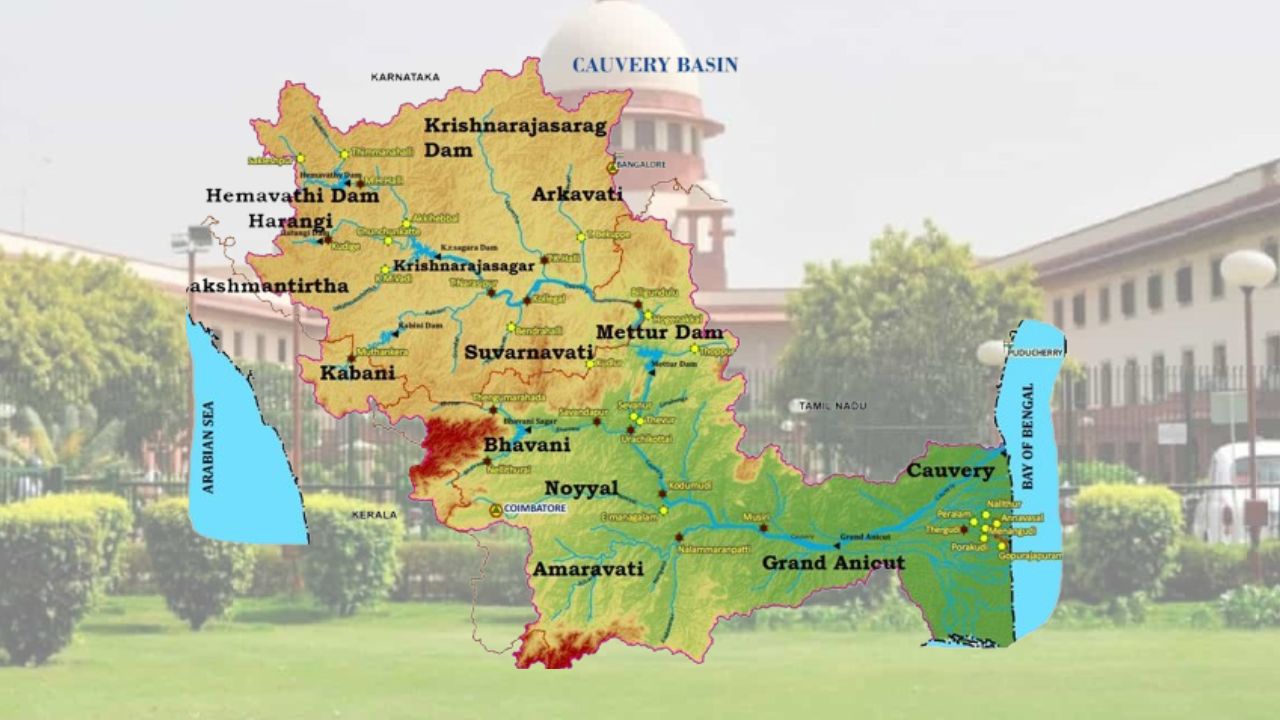
Tamil Nadu has alleged that Karnataka has failed to comply with the CWMA’s order, which was issued under the Cauvery Water Management Scheme, 2018, and has sought Supreme Court intervention to ensure implementation of the statutory authority’s directions. According to the petitioner, Karnataka was required to release around 4.536 TMC of water, equivalent to 3,500 cusecs daily for 15 days, with the flow reaching the Biligundulu inter-state monitoring point. However, the state claimed that the actual water flow remained far below the mandated level.
New Delhi: The Supreme Court will hear on Thursday, an urgent petition filed by the Tamil Nadu government seeking directions to ensure the release of its allocated share of 3500 cusecs of Cauvery water from Karnataka reservoirs.
Chief Justice of India (CJI) Surya Kant agreed to list the plea following an urgent mention by senior advocate CS Vaidyanathan, who appeared for the state government. A similar plea filed by the ruling DMK seeking directions against Karnataka is also likely to be heard on the same day.
The dispute revolves around the Cauvery Water Management Authority’s (CWMA) July 30 decision, which approved the recommendation of the Cauvery Water Regulation Committee (CWRC) directing Karnataka to release 3,500 cusecs of water per day for 15 days from the Kabini and Krishna Raja Sagara (KRS) reservoirs.
Tamil Nadu has alleged that Karnataka has failed to comply with the CWMA’s order, which was issued under the Cauvery Water Management Scheme, 2018, and has sought Supreme Court intervention to ensure implementation of the statutory authority’s directions.
According to the petitioner, Karnataka was required to release around 4.536 TMC of water, equivalent to 3,500 cusecs daily for 15 days, with the flow reaching the Biligundulu inter-state monitoring point. However, the state has claimed that the actual water flow remained far below the mandated level.
Tamil Nadu has informed the court that between July 29 and August 2, the recorded flow at Biligundulu ranged between 158 cusecs and 530 cusecs, against the required 3,500 cusecs per day. The state has alleged that Karnataka’s failure to maintain the prescribed flow has affected Tamil Nadu’s rightful share under the Cauvery water-sharing mechanism.
Seeking further relief, the state demanded that Karnataka compensate for the accumulated shortfall and release an additional 26.954 TMC of water. The state has claimed that this quantity represents its pro-rata entitlement between June 1 and August 12 under the distress-sharing formula applied during periods of inadequate rainfall.
Tamil Nadu has argued that the limited 3,500 cusecs release ordered by the CWMA would provide only around 4.5 TMC of water, which is insufficient compared to its claimed requirement during the current agricultural season.
The state government has also challenged Karnataka’s water scarcity argument, stating that recent rainfall has improved storage levels in Karnataka’s reservoirs. Tamil Nadu has cited data on four major reservoirs, including Krishna Raja Sagara, Kabini, Harangi and Hemavathy, claiming that Karnataka had a combined storage of 77.537 TMC as of August 3.
According to Tamil Nadu, the available water reserves indicate that Karnataka can comply with the CWMA order without causing significant impact on its own requirements.
The state has requested the Supreme Court to direct the Cauvery Water Management Authority to closely monitor Karnataka’s reservoir levels and ensure strict compliance with daily and monthly water release schedules.
The latest legal battle has emerged at a critical point for farmers in Tamil Nadu’s Cauvery Delta region, where irrigation activities depend heavily on timely water inflows. The availability of Cauvery water is considered crucial for the Kuruvai paddy crop and preparations for the upcoming Samba cultivation season.
Tamil Nadu has warned that any further delay in water release could impact standing crops and create difficulties for thousands of farmers dependent on the river system.
The DMK has separately approached the Supreme Court, seeking enforcement of the apex court’s 2018 Cauvery judgment and subsequent directions issued by the CWRC and CWMA. The party has argued that immediate intervention is required to protect the interests of farmers in the Cauvery Delta.
In its plea, the DMK has sought directions for Karnataka to implement the CWRC’s July 28 recommendation, which was later approved by the CWMA, and ensure the release of 3,500 cusecs per day at Biligundulu. It has also requested daily monitoring of water releases and compliance reports from the CWMA.
Tamil Nadu has further highlighted Karnataka’s annual water release obligation under the Cauvery allocation framework. The state has claimed that Karnataka is required to release 167.25 TMC of water at Biligundulu between June and January, including 123.14 TMC during June-September and 44.11 TMC between October-January.
The state has also referred to an additional 10 TMC environmental flow requirement, taking the total annual water requirement under its calculation to 177.25 TMC.
The Cauvery dispute is one of India’s most prolonged interstate river water conflicts involving Karnataka, Tamil Nadu, Kerala and Puducherry. Following the Supreme Court’s 2018 verdict, the Centre established the Cauvery Water Management Authority and Cauvery Water Regulation Committee under the Cauvery Water Management Scheme to oversee implementation of the water-sharing arrangement.
The August 13 hearing is expected to decide whether Karnataka must immediately comply with the CWMA’s direction, release the pending water quantity and follow the regulatory framework created for equitable distribution of Cauvery river water.
With farmers, political parties and both state governments closely watching the proceedings, the Supreme Court’s order could become a significant development in the decades-old Cauvery water dispute.

