
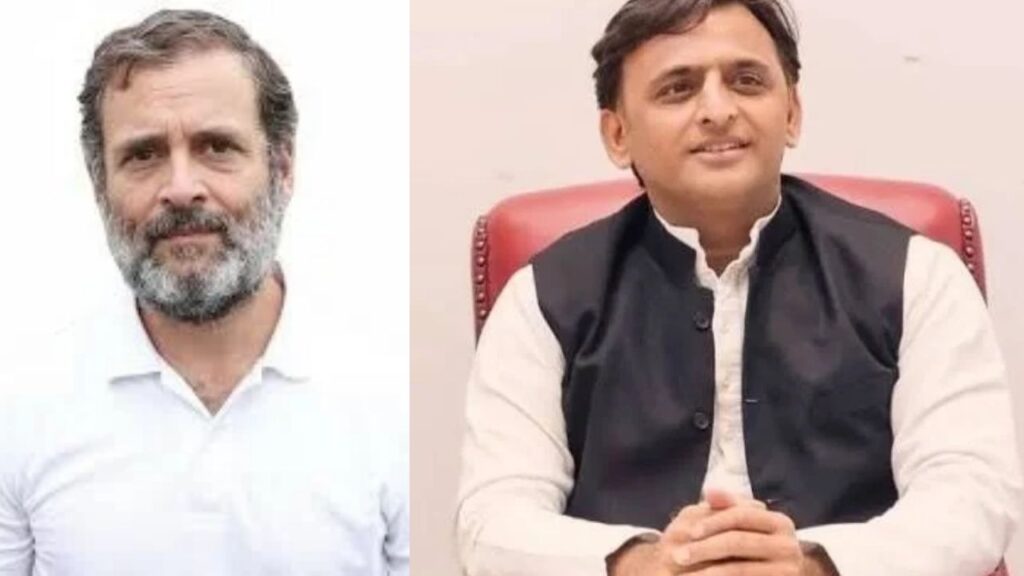
Akhilesh Yadav and Rahul Gandhi face a significant alliance challenge as differences over seat allocation emerge ahead of the UP elections. (Img: X)
New Delhi: The political battle over seat-sharing within the INDIA bloc has gathered momentum ahead of the 2027 Uttar Pradesh Assembly elections, with the Congress leadership stepping up organisational preparations while simultaneously preparing for crucial negotiations with the Samajwadi Party (SP).
Congress president Mallikarjun Kharge chaired a high-level strategy meeting in New Delhi on Monday, bringing together senior national and Uttar Pradesh leaders to assess the party's electoral position, organisational preparedness and campaign roadmap. The discussions assume significance as the Congress seeks a substantially larger share of Assembly constituencies, potentially setting the stage for difficult negotiations with its principal regional ally, the Samajwadi Party.
The Congress is reportedly seeking approximately 181 seats in the 403-member Uttar Pradesh Assembly, while the SP is believed to be willing to accommodate the party in roughly 80-90 constituencies. The substantial gap between the two sides' expectations could emerge as a major challenge for the Opposition alliance.
The meeting was chaired by Congress president Mallikarjun Kharge and attended by Leader of the Opposition in the Lok Sabha Rahul Gandhi, Congress general secretary Priyanka Gandhi Vadra and general secretary in charge of organisation K.C. Venugopal.
Other prominent participants included Uttar Pradesh Congress in-charge Rajendra Pal Gautam, state Congress president Aradhana Mishra-Mona and working president Imran Masood, besides other senior party representatives.
The deliberations focused on the prevailing political situation in Uttar Pradesh, the Congress organisation's grassroots strength, election preparedness and the proposed campaign strategy. The central leadership also reportedly asked state leaders to accelerate preparations and begin the electoral campaign in December, indicating that the party intends to move into an active election mode well ahead of the Assembly polls.
Following the meeting, Kharge expressed confidence that the Congress, together with its INDIA bloc partners, would emerge as a credible political alternative in Uttar Pradesh. He assessed that the forthcoming Assembly elections could influence the broader direction of national politics, particularly amid public expectations surrounding social justice, equal opportunities and the political and economic empowerment of marginalised communities.
The immediate political challenge for the INDIA bloc revolves around the distribution of Assembly constituencies between the Congress and the Samajwadi Party. SP president Akhilesh Yadav had recently indicated that the Congress had sought 181 seats out of the state's total 403 constituencies. While he did not disclose the precise number of seats the SP was prepared to offer, political indications suggest that the regional party may prefer limiting the Congress's allocation to approximately 80-90 seats.
The Congress, however, is understood to be seeking between 150 and 200 constituencies, with its improved electoral performance in the 2024 Lok Sabha elections forming a key part of its argument for a larger share. The negotiations are expected to test the political bargaining power of both parties and determine the framework of Opposition coordination in India's most politically significant state.
For the Congress, a larger seat allocation would provide an opportunity to rebuild its organisational footprint and strengthen its independent political identity. For the Samajwadi Party, the challenge will be to accommodate its national ally without compromising its own electoral calculations and regional political influence.
The Congress leadership is also working towards launching a structured election campaign in December, with organisational restructuring and the formation of campaign committees emerging as important priorities.
Uttar Pradesh Congress president Aradhana Mishra-Mona indicated that the meeting examined organisational issues and preparations for the proposed December campaign. Discussions also covered the committees expected to be constituted to oversee different aspects of the election exercise.
Working president Imran Masood said the party was developing its campaign architecture and assessing how preparations could be translated into a coordinated statewide mobilisation programme. The emphasis on early campaigning suggests that Congress wants to strengthen its political visibility, reconnect with voters and expand its grassroots network before the formal election schedule is announced.
(Img: X)
The Congress faces a formidable challenge in Uttar Pradesh, where its traditional political dominance has steadily weakened over approximately three decades. The emergence and consolidation of Mandal politics, centred on caste-based social justice and the political mobilisation of backward communities, alongside Kamandal politics associated with Hindutva mobilisation, fundamentally transformed the state's electoral landscape.
The rise of the Samajwadi Party and the Bahujan Samaj Party, coupled with the BJP's expanding political influence, significantly reduced the Congress's traditional support base. The party is now attempting to revive its fortunes through a combination of social justice messaging, organisational consolidation, alliance politics and a renewed engagement with marginalised communities.
Its improved performance in the 2024 Lok Sabha elections has provided fresh confidence to the state leadership, although converting that momentum into a stronger Assembly-level presence remains a major electoral challenge.
Also Read: Sonia Gandhi’s Heartbreaking Revelation in Belonging: Firstborn Died Hours After Birth
The seat-sharing exercise is unfolding against the backdrop of changing political alignments in Uttar Pradesh. The emerging understanding between Chandrashekhar Azad's Azad Samaj Party and Asaduddin Owaisi's All India Majlis-e-Ittehadul Muslimeen (AIMIM) has introduced another dimension to the state's Opposition politics.
The possibility of additional political formations influencing caste-based and community-level voting patterns could complicate electoral calculations for the Congress and the Samajwadi Party.
The Opposition parties will therefore have to balance constituency-level considerations, social coalitions and their respective organisational strengths while negotiating an arrangement that avoids unnecessary electoral fragmentation.


