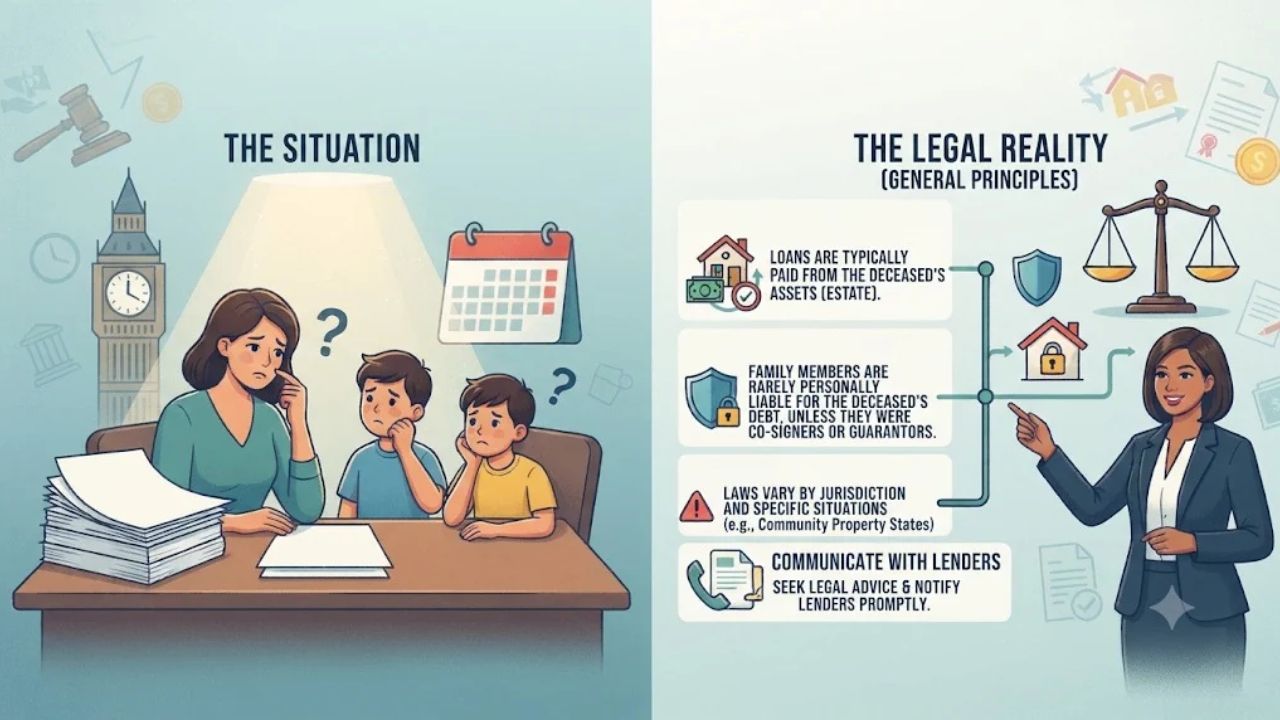
Can banks demand loan repayment from a deceased borrower's family? Indian law distinguishes between personal liability and responsibility arising from inherited assets. (Img: AI Generated)
New Delhi: A borrower's death does not automatically make their spouse, children or other family members personally responsible for repayment of outstanding loans. While banks are entitled to initiate recovery proceedings against the deceased person's estate, the liability of legal heirs is ordinarily restricted to the assets they inherit, unless they had independently undertaken an obligation as co-borrowers or guarantors.
The legal position assumes significance for families who receive repayment demands or notices from banks and recovery agencies following the death of a borrower. Clarifying the distinction between inheritance and personal liability, Company Secretary Suman Kumar Jha, Founding and Managing Partner of Corp Legex, explained that legal representatives do not automatically become personally answerable for the financial obligations of the deceased.
Under Section 37 of the Indian Contract Act, 1872, contractual obligations are generally binding on the representatives of a deceased contracting party, subject to the nature of the obligation. However, Section 50(2) of the Code of Civil Procedure, 1908, restricts the liability of legal representatives in execution proceedings to the property of the deceased that has come into their possession and has not been duly disposed of.
Consequently, a bank cannot ordinarily compel family members who were neither co-borrowers nor guarantors to discharge the outstanding loan from their independent income or personal assets. Their responsibility, where they inherit property or money from the deceased, is limited to the estate received, in accordance with the applicable legal provisions.
Although family members are not automatically personally liable, the deceased borrower's outstanding financial obligations do not disappear upon death. Banks can pursue recovery against the estate left behind by the borrower, subject to the nature of the loan and the applicable recovery framework.
In the case of secured loans, lenders may enforce their security interest over mortgaged or hypothecated assets in accordance with the Securitisation and Reconstruction of Financial Assets and Enforcement of Security Interest (SARFAESI) Act, 2002, wherever its provisions apply.
For unsecured loans, banks may seek recovery from the deceased borrower's estate through appropriate civil proceedings or proceedings before the Debt Recovery Tribunal, as applicable. However, the independent assets and earnings of legal heirs cannot ordinarily be attached merely because of their relationship with the deceased.
The legal position changes where another person had signed the loan agreement as a co-borrower or guarantor.
A co-borrower remains contractually responsible for repayment, with Section 43 of the Indian Contract Act providing for contribution between joint promisors. Depending on the loan agreement, co-borrowers may be jointly and severally liable for the outstanding amount.
Similarly, the liability of a guarantor is governed by Section 128 of the Indian Contract Act, 1872, which provides that the surety's liability is co-extensive with that of the principal debtor, unless the contract provides otherwise.
The death of the principal borrower, therefore, does not by itself extinguish the guarantor's contractual responsibility. Banks may proceed against the guarantor in accordance with the terms of the guarantee.
Banks and their recovery agents are not permitted to use intimidation, abusive language, public humiliation or coercive methods to recover outstanding dues from a deceased borrower's relatives.
The Reserve Bank of India's Fair Practices Code and guidelines governing recovery agents prohibit harassment, threatening conduct, public shaming and calls at inappropriate hours. Such conduct may also attract legal consequences under the Bharatiya Nyaya Sanhita, 2023, depending on the circumstances, including provisions relating to criminal intimidation.
Aggrieved family members can raise complaints through the bank's grievance redressal mechanism and, where appropriate, approach the RBI's Integrated Ombudsman Scheme, 2021.
Legal heirs receiving a repayment demand following the borrower's death should first establish the precise nature of the liability being asserted by the lender. They should communicate with the bank in writing, submit the death certificate and clarify whether they had signed the loan documents as co-borrowers or guarantors.
They may also seek a detailed statement of the outstanding loan amount and examine whether the deceased borrower had obtained loan-protection insurance that could cover the liability. If the bank or its recovery agents continue to demand payment from individuals who have no independent contractual responsibility, the family can approach the bank's grievance redressal officer and subsequently escalate the complaint to the RBI Ombudsman, subject to the applicable requirements.
Seeking legal advice may also help families determine the extent of the inherited estate, the nature of the lender's security interest and the remedies available against unlawful recovery practices. The fundamental legal distinction remains that inheritance may carry liability to the extent of the estate received, but kinship alone does not make a person responsible for another individual's loan.

