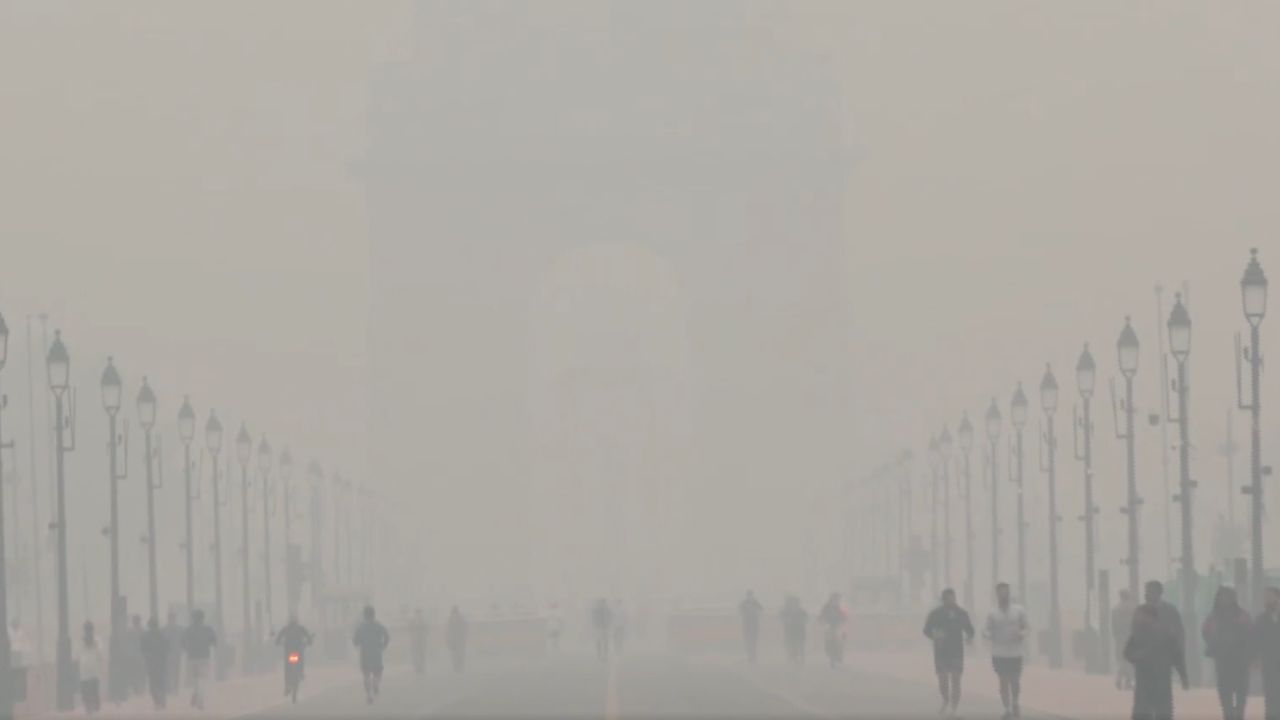
Delhi Remains Under Thick Smog As Pollution Levels Rise (Img: IANS)
New Delhi: The National Capital continues to grapple with hazardous air pollution on Sunday, November 15, as several parts of the national capital remained under a thick layer of smog.
The deteriorating air quality raised concerns over public health, with multiple monitoring stations recording alarming pollution levels.
Delhi: Pollution-induced haze blankets the area around India Gate https://t.co/aNZiQUGKAx
— IANS (@ians_india) November 15, 2026
According to the Central Pollution Control Board (CPCB), Anand Vihar recorded an Air Quality Index (AQI) of 365 on Sunday morning, placing it in the ‘very poor’ category. Several other locations had reported ‘severe’ air quality in recent readings, while dense smog continued to reduce visibility across the city.
Also Read: IMD Weather Alert: Rain, Snowfall and Strong Winds to Hit Several States
CPCB data showed that Delhi's average AQI stood at 367 on Saturday, November 14, slightly lower than Friday's reading of 373. However, the marginal improvement did little to ease concerns, as 17 of the capital's 59 monitoring stations recorded air quality in the ‘severe’ category.
North Campus reported the highest AQI of 421 on Saturday morning. IIT Delhi followed closely at 419, while ITO recorded 415 and Burari Crossing registered 410. Chandni Chowk and Jawaharlal Nehru University (JNU) recorded AQI readings of 392 and 390, respectively.
Real-time PM2.5 source-apportionment data from the Air Quality Early Warning System and the Integrated Decision Support System (DSS) identified vehicular emissions as the biggest contributor to Delhi's pollution, accounting for 31.5 per cent of PM2.5 emissions.
Secondary organic aerosols contributed 24.7 per cent to the pollution load. Domestic solid biofuel and dung-cake burning, along with biomass and stubble burning, accounted for another 20.8 per cent. Waste burning contributed 5.6 per cent, while firecrackers were responsible for 2.2 per cent.
Amid worsening air quality, the Commission for Air Quality Management (CAQM) had enforced Stage 3 of the Graded Response Action Plan (GRAP) across Delhi-NCR on November 6.
The Delhi government has also stepped up efforts to control particulate pollution by deploying water sprinklers at various locations. Environment Minister Manjinder Singh Sirsa had earlier said that cloud-seeding trials were being conducted under the supervision of IIT Kanpur.
Under the CPCB's classification system, AQI readings between 301 and 400 fall under the ‘very poor’ category, while readings ranging from 401 to 500 are classified as ‘severe’.

