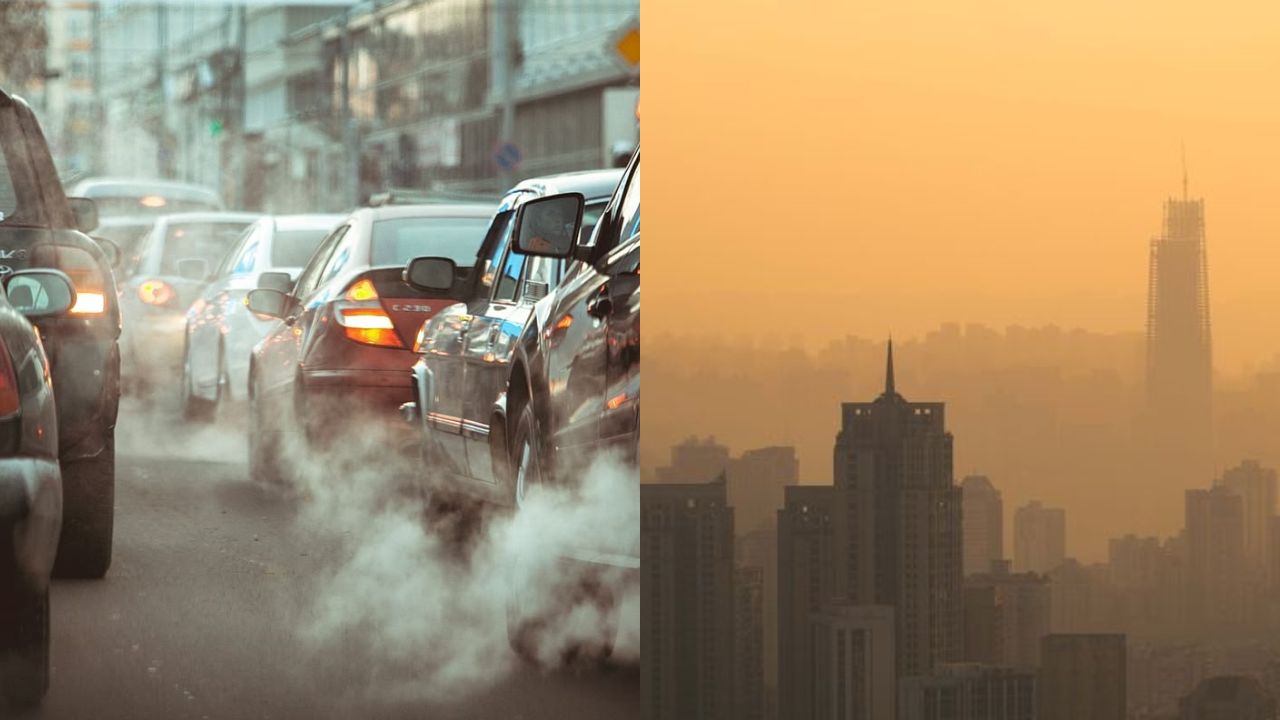
On the morning of Diwali, air quality was recorded as severe monitoring stations across Delhi (Img: Pinterest)
New Delhi: On the morning of Diwali, air quality was recorded as severe monitoring stations across Delhi. Concerns have mounted due to adverse weather conditions, pollution, and festival-related activities, even as Stage III of the 'Graded Response Action Plan' (GRAP) remains in effect. According to the Central Pollution Control Board (CPCB), Delhi's air quality on Diwali morning was 'very poor,' with an Air Quality Index (AQI) of 384.
Pollution levels have reached dangerous heights in several parts of the capital. At 11 monitoring stations, the AQI was recorded above 400, placing it in the 'severe' category.
The highest AQI, 450, was recorded in Punjabi Bagh.
At 6:00 AM, AQI in the vicinity of Anand Vihar was 328, which falls into the very poor category.
Of the 23 monitoring stations included in the 6:00 AM update, 11 recorded an AQI above 400 placing them in the 'severe' category. At the remaining 12 stations, the AQI ranged between 301 and 400, indicating very poor air quality.
Also Read: Gold Prices Today: Gold and Silver Rates Remain Stable on Diwali
The highest AQI was recorded in Punjabi Bagh at 450, followed by 449 in RK Puram and 446 at IIT Delhi. Other locations also reported significantly high AQI levels, such as 444 in Dwarka, 425 at CRRI Mathura Road, and 423 at Siri Fort. An AQI of 423 was recorded at both Delhi University’s North Campus and Chandni Chowk. The AQI was 415 in Pusa, 411 at Burari Crossing, and 409 at NSUT Jafarpur. In other areas, an AQI of 399 was recorded in Narela, 396 at ITO, and 393 at Mandir Marg. Both Talkatora Garden and Aya Nagar recorded an AQI of 369, while it was 370 in Burari. In Uttam Nagar, the AQI was 373.
In Vasundhara Enclave, the AQI was 356, while it stood at 349 in both Tikri Kalan and Badarpur. An AQI of 337 was recorded in Karala, and 333 on Lodhi Road.
Meteorology and air quality experts believe that several factors are contributing to the deteriorating air quality in Delhi including adverse weather conditions, Diwali-related celebrations, vehicular emissions, and a seasonal rise in stubble burning incidents in neighboring states.
The 'Air Quality Early Warning System' has cautioned that low wind speeds (less than 10 km/h) prevent pollutants from dispersing effectively, causing them to accumulate in the atmosphere. On Saturday, PM10 emerged as the primary pollutant in Delhi.
According to the Delhi government's 'Decision Support System' (DSS), the transport sector was the largest contributor to the city's pollution on Saturday, accounting for 21.4 percent of the total. Stubble burning contributed approximately 1.7 percent to Delhi's pollution on Saturday.
According to the reports, the figure is expected to rise to 5.4 percent on Sunday. Satellite data from Friday revealed 589 incidents of crop residue (stubble) burning across six states. Of these, 357 incidents were recorded in Punjab, 139 in Madhya Pradesh, and 58 in Rajasthan. Additionally, 23 incidents were reported in Uttar Pradesh, 9 in Haryana, and 3 in Uttarakhand. Between September 15 and November 6, a total of 6,226 incidents of stubble burning were recorded across these six states.
These figures were provided in a bulletin released by the 'Consortium for Research on Agroecosystem Monitoring and Modeling from Space' (CREAMS) lab, which operates under the Indian Agricultural Research Institute (IARI).
In view of deteriorating air quality ahead of Diwali, the 'Commission for Air Quality Management' (CAQM) implemented Stage III of the GRAP in Delhi-NCR on Friday. These restrictions have been imposed as a precautionary measure, taking into account pollution forecasts.
Under Stage III of GRAP, non-essential construction and demolition activities have been prohibited, as they generate significant amounts of dust. Furthermore, restrictions have been placed on stone crushers and mining-related operations.
These measures also include a ban on BS-III petrol and BS-IV diesel-powered light motor vehicles in Delhi and the adjoining NCR districts Gurugram, Faridabad, Ghaziabad and Gautam Buddh Nagar. Certain categories of diesel powered goods vehicles have also been subjected to restrictions. Schools up to class 5 have been given the option to conduct classes in a hybrid mode meaning they can teach students through a combination of in person attendance and online sessions. Authorities may also consider allowing 50 percent of staff in government and private offices to work from home.
Moreover, People have been advised to use public transport, opt for carpooling, and walk or cycle for short distances.

