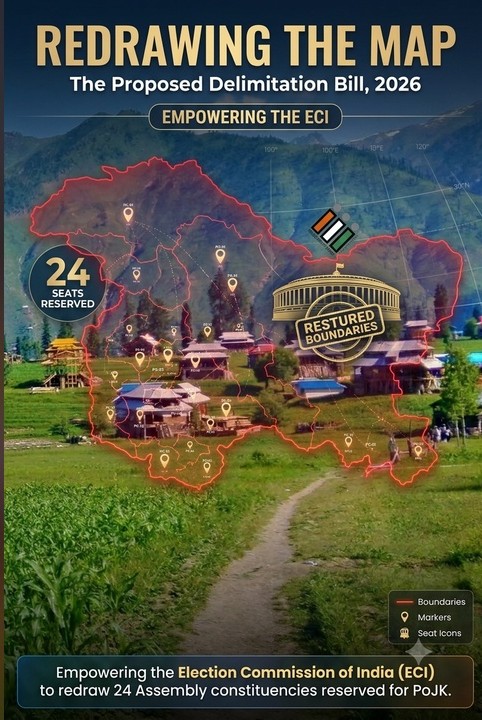
Delimitation proposal puts vacant PoK seats in focus. (Img: X)
New Delhi: The proposed Delimitation Bill, 2026, could empower the Election Commission of India (ECI) to redraw 24 Assembly constituencies reserved for Pakistan-occupied Jammu and Kashmir (PoK), should the territories cease to remain under Pakistan's control. The provision brings the future electoral status of these vacant seats into focus as the Centre prepares a wider restructuring of India's parliamentary and legislative framework.
The Union government is expected to introduce the proposed legislation in Parliament on Monday, November 30. The initiative forms part of a broader reform agenda encompassing constituency delimitation, women's reservation and an expansion of elected representative institutions.
The proposed Bill provides for the Election Commission to facilitate delimitation of constituencies in the Jammu and Kashmir Legislative Assembly falling within territories currently under Pakistan's occupation, whenever those areas cease to remain under such control.
The provision establishes a framework for determining electoral boundaries in these territories if circumstances change in the future. It also addresses the question of their potential representation within the legislative structure of the Union Territory.
Under the existing arrangement, the Jammu and Kashmir Legislative Assembly has 90 elected seats, while another 24 seats have been earmarked for Pakistan-occupied Kashmir. These constituencies remain vacant, and elections are not conducted for them under the prevailing arrangement.
The proposed provision would enable the Election Commission to undertake the necessary constituency demarcation if the territories cease to remain under Pakistan's control. This would bring the currently unrepresented constituencies within the scope of a future electoral exercise.
The proposed Delimitation Bill is part of the Centre's broader legislative initiative, which also seeks to advance 33 per cent reservation for women in the Lok Sabha and state Legislative Assemblies.
The developments come ahead of a special sitting of Parliament next week, during which the government is expected to pursue constitutional amendments concerning legislative representation, the strength of elected institutions and women's participation in politics.
On Friday, the Union Cabinet, chaired by Prime Minister Narendra Modi, approved the Constitution (One Hundred and Thirty-Second Amendment) Bill, 2026. The proposed amendment seeks to facilitate changes in the numerical strength of Parliament and state legislatures while advancing the constitutional framework for women's reservation.
A major feature of the proposed amendment is the expansion of the maximum permissible strength of the Lok Sabha to 850 members. It also envisages increasing the strength of state Legislative Assemblies by up to 650 members, providing scope for a substantial expansion of elected representation.
The constitutional amendment Bill seeks to modify Article 334A, which deals with women's reservation in legislative institutions. A proposed additional proviso provides for increasing the number of Lok Sabha seats allocated to each state and Union Territory by 50 per cent of its existing strength.
The proposal also envisages a corresponding 50 per cent increase in the strength of their respective Legislative Assemblies. The changes seek to accommodate expanded legislative representation alongside the proposed implementation of women's reservation.
The proposed arrangement also addresses concerns raised by several regional political parties over the possible consequences of delimitation and the redistribution of parliamentary seats. Their principal concern centres on protecting the relative representation of individual states while allowing the overall strength of legislatures to increase.
The proposed expansion is intended to provide a framework for accommodating these concerns through an increase in the total number of legislative seats rather than relying exclusively on redistribution within the existing numerical limits.
The two proposed legislative measures bring together several significant aspects of India's constitutional and electoral framework, including constituency reorganisation, women's political representation, parliamentary expansion and the federal distribution of legislative strength.
The Delimitation Bill addresses the future possibility of redrawing 24 vacant PoK Assembly constituencies, while the constitutional amendment proposes a wider expansion of Parliament and state legislatures.
The forthcoming parliamentary proceedings will determine how these proposals are examined and advanced. Their eventual implementation could have far-reaching implications for the composition of elected institutions, the distribution of political representation and Jammu and Kashmir's future electoral framework.

