 English
 English

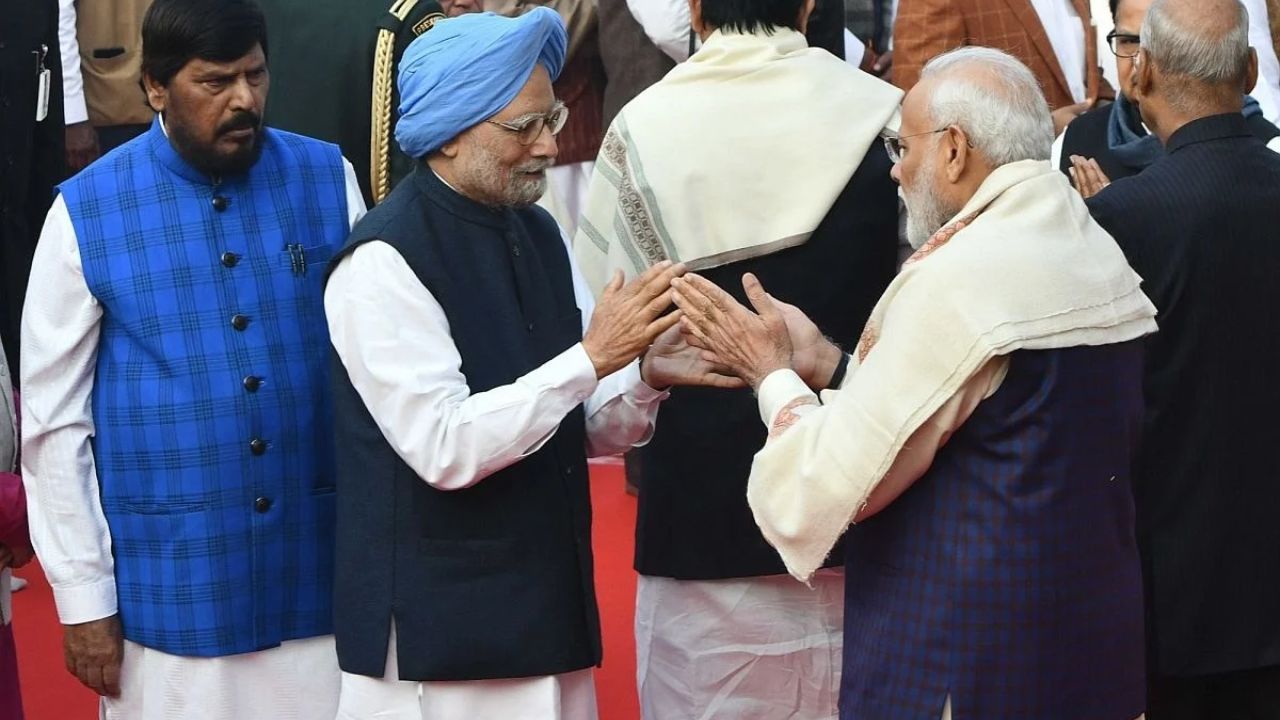
Former Prime Minister Dr Manmohan Singh (Img: Pinterest)
New Delhi: Twenty-six years after presenting the historic Union Budget that changed the direction of India’s economy, Dr Manmohan Singh continues to be remembered as the economist who stepped into politics at a defining moment in the country’s history.
Born on September 26, 1932, in Gah village of undivided Punjab, now in Pakistan, Singh’s journey took him from academic institutions and global economic organisations to the corridors of power in New Delhi. He served as India’s Finance Minister from 1991 to 1996 and later became the country’s 13th Prime Minister, holding office from 2004 to 2014.
His career reflects one of the most significant phases of India’s economic transformation — from a tightly controlled economy facing a severe financial crisis to one of the world’s fastest-growing major economies.
In 1991, India faced one of its worst economic challenges since independence. Foreign exchange reserves had dropped sharply, leaving the country with barely enough funds to finance essential imports. The government was forced to take emergency measures, including pledging gold reserves to secure financial assistance.
Amid this crisis, Prime Minister P.V. Narasimha Rao brought Dr Manmohan Singh into the government as Finance Minister. At the time, Singh was known more as an economist and policymaker than as a politician.
A former Reserve Bank of India Governor, Singh had spent years in academia, including teaching positions at Punjab University and the Delhi School of Economics. His experience in economic policy and administration made him a key figure in addressing the country’s financial emergency.
The Union Budget presented by Singh in 1991 marked a historic shift in India’s economic approach. The government began dismantling the licence-permit system, reduced trade barriers, opened sectors to foreign investment and introduced measures aimed at increasing competition and private participation.
The reforms faced criticism from sections of society, with opponents raising concerns over inequality and the impact of global competition on domestic industries. However, supporters argued that the changes helped stabilise the economy and created the foundation for decades of growth.
The 1991 reforms became a turning point, moving India towards a more open and market-oriented economic framework.
After leaving the Finance Ministry in 1996, Singh remained active in public life and continued to play an important role in economic and political discussions.
His return to executive power came in 2004 when the Congress-led United Progressive Alliance (UPA) formed the government. Following Sonia Gandhi’s decision not to take the Prime Minister’s post, Singh was chosen to lead the government.
He became India’s first Sikh Prime Minister and went on to serve two consecutive terms from 2004 to 2014.
During Singh’s tenure as Prime Minister, India witnessed a period of strong economic growth. The economy recorded some of its highest growth rates during this period, supported by earlier reforms, rising domestic demand and favourable global conditions.
His government also signed the India-US Civil Nuclear Agreement, a major diplomatic development that changed India’s strategic relationship with the United States and ended decades of restrictions on nuclear cooperation.
However, Singh’s second term faced several challenges, including slower economic growth, allegations of corruption involving members of the coalition government and criticism over decision-making within the administration.
Despite political debates over his leadership style, Singh’s supporters and critics alike have acknowledged his expertise in economic policy and his reputation for personal integrity.
Dr Manmohan Singh passed away in December 2024 at AIIMS, New Delhi, at the age of 92.
Over the years, his birth anniversary has become an occasion to revisit the legacy of a man whose career spanned universities, international institutions, the Reserve Bank of India, the Finance Ministry and the Prime Minister’s Office.
While opinions may differ on his political record, the economic reforms introduced under his leadership in 1991 remain one of the most important chapters in India’s modern economic history.