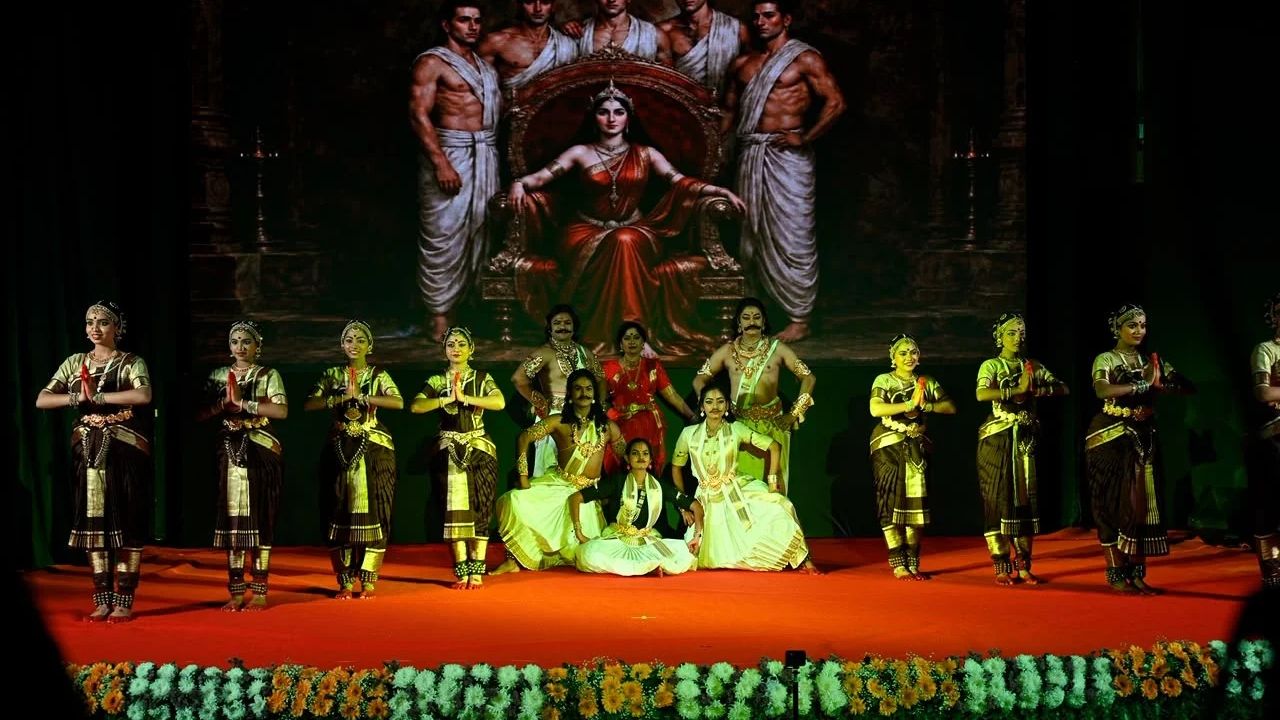
Swathy Somanath performs the title role in Draupadi, a Kuchipudi dance drama exploring women’s dignity, injustice and resistance in New Delhi. (Img: X)
New Delhi: The national capital witnessed a powerful retelling of Draupadi’s story through Kuchipudi, as a dance drama explored women’s dignity, injustice, resistance and the courage to question authority. Presented by Sampradaayam Cultural Trust, the production brought a timeless question from the Mahabharata into contemporary focus: what happens when those responsible for delivering justice remain silent?
A story from the Mahabharata became a reflection on women’s dignity and accountability as Sampradaayam Cultural Trust presented Draupadi, a Kuchipudi dance drama, at the BHIM Auditorium of the Dr. Ambedkar International Centre in New Delhi on October 22, 2026.
Conceived and choreographed by Swathy Somanath, a top-grade Doordarshan artiste and Director and Principal of Sampradaayam Kuchipudi Gurukulam, the production placed Draupadi’s voice at the centre of the narrative. The script was written by Telugu author Volga, who received the Sahitya Akademi Award in 2015 and is widely known for her feminist writing.
Rather than simply recreating familiar episodes from the Mahabharata, the production examined Draupadi as an embodiment of Shakti—the feminine force that endures suffering, challenges injustice and refuses to be silenced. Through classical dance, music and storytelling, it explored the relationship between power, dignity, accountability and a woman’s right to question the world around her.
At the heart of the performance was one of the most troubling questions in Draupadi’s story. After Yudhishthira lost himself in a game of dice and then staked Draupadi, she questioned the royal assembly: if he had already lost himself, how could he stake her?
The elders, teachers and kings present failed to provide a satisfactory answer. The production used this moment to examine not only Draupadi’s humiliation but also the silence of those who had the authority to intervene.
That silence gave the story its contemporary resonance. The question raised on stage was not simply about an episode from an epic, but about what happens when institutions and people in positions of power fail to challenge injustice.
Speaking about the production, Swathy Somanath said the team wanted to shift attention from what was done to Draupadi to what she herself did: question the most powerful men of her time and refuse to stop asking questions. She also highlighted the significance of bringing the work to a Delhi audience alongside students from a village in Srikakulam.
The dance drama unfolded through five thematic episodes: Mother Earth, Birth of Draupadi, Draupadi Vastraharan, Draupadi’s Revenge and Mahaprasthanam. Together, they traced the character’s journey through love, suffering, humiliation, faith, anger, resistance and detachment.
The opening episode presented Draupadi as Vasundhara, or Mother Earth, enduring suffering while sustaining the Pandavas. The narrative then moved to her birth from the sacred fire of King Drupada’s yajna, establishing her connection with divine power and destiny.
In Draupadi Vastraharan, the public humiliation in the royal court became a turning point. Draupadi turned to Krishna in faith and was divinely protected, yet the production also emphasised her willingness to speak against the injustice unfolding before her.
Draupadi’s Revenge explored how humiliation transformed into a vow, with anger becoming determination and a pursuit of justice. The final episode, Mahaprasthanam, followed her last journey towards the Himalayas, where she was the first to fall. Her death served as a reminder of mortality while underscoring the enduring force of her spirit.
The production brought together classical dance and a feminist interpretation of a well-known epic character. Swathy Somanath led the concept and choreography while also performing the title role. Volga’s script provided the narrative framework for examining Draupadi’s agency and resistance.
The creative team included Garimella Gopalakrishna, who composed the music and holds a record for 37 hours of continuous violin playing, and N. Suresh Prasad, a tabla player and composer who served as music director.
The performance also featured D. Mehar Prabhakar, a classical dancer and actor who performed at Kartavya Path on Republic Day 2023; Loka Chandra Shekhar Reddy, an Andhra Natyam and Kuchipudi exponent trained under Padma Shri Dr. Nataraja Ramakrishna; Uppada Geethika, who has trained under Somanath for more than eight years; and Korra Balaram, a senior disciple and teaching assistant at Sampradaayam who has performed in the UK, the US and Malaysia.
The event also highlighted the work of Sampradaayam Cultural Trust in preserving Kuchipudi through a traditional residential Gurukul system. Based in Srikakulam district of Andhra Pradesh, the organisation runs Sampradaayam Kuchipudi Gurukulam on a 12-acre campus along the River Nagavali.
Students receive theoretical, practical and academic education in the classical dance form. According to the Trust, many come from modest rural backgrounds and receive free or subsidised tuition, accommodation and training, helping reduce financial barriers to pursuing an artistic career.
The institution’s work reflects a broader challenge facing classical art forms: sustaining rigorous training and passing knowledge from one generation to the next while making opportunities accessible to students who may lack financial resources. The production brought this mission into the spotlight by connecting a performance in the national capital with the training and aspirations of students from rural Andhra Pradesh.
Draupadi’s story continues to provoke debate because it brings together questions of dignity, power, gender and the responsibility to speak against wrongdoing. In this interpretation, her significance lies not only in the suffering she endured but also in her refusal to accept injustice without question.
By bringing the story to the Delhi stage through Kuchipudi, Sampradaayam Cultural Trust connected classical performance with issues that remain relevant to contemporary audiences. The production also underscored the importance of supporting the institutions, teachers and students who keep India’s classical traditions alive.
Ultimately, Draupadi offered a reminder that respect for women’s dignity is tested not only by the actions of those who commit injustice, but also by the response of those who witness it—and whether they choose to speak.

