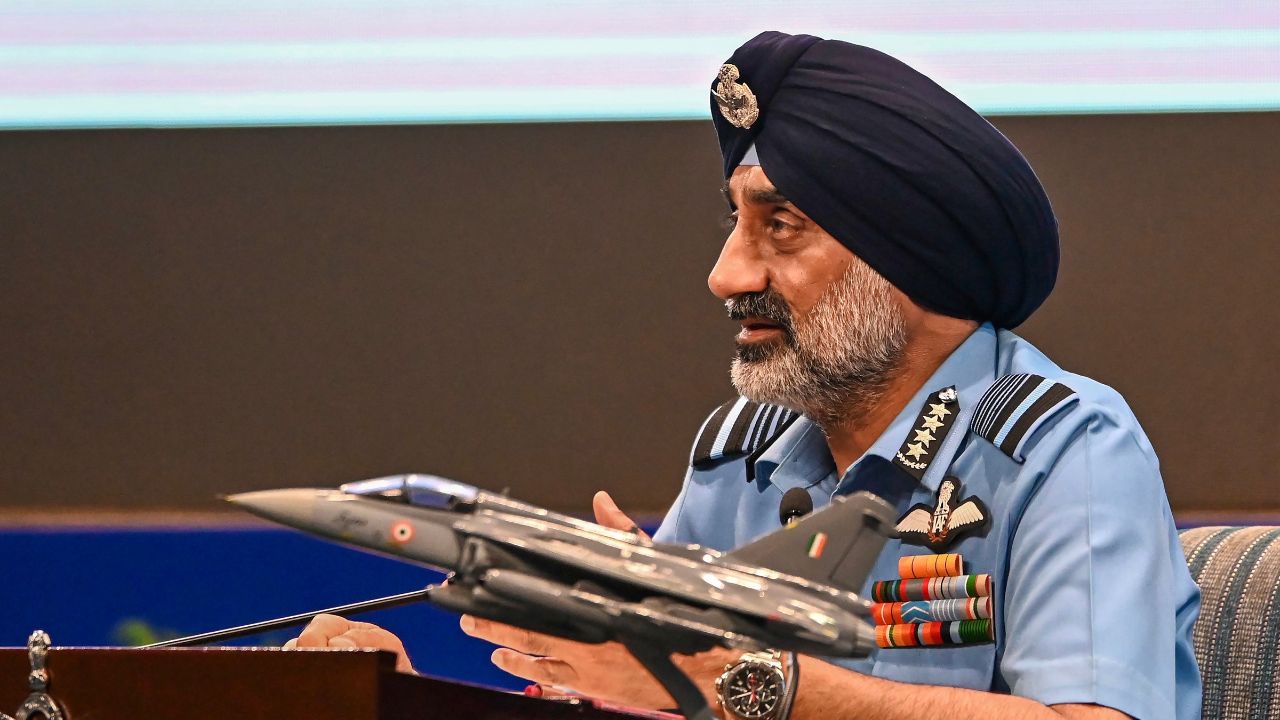
IAF expands drones but rejects separate force plan (Img: IANS)
New Delhi: Air Chief Marshal A.P. Singh ruled out the need for a separate drone force in the Indian Air Force. He also said that drones are an established capability and it must evolve alongside conventional weapons rather than operate in isolation.
During a presss conference ahead of Air Force Day, Singh acknowledged the growing role of drones and loitering ammunition in modern warfare but said their expanding use does not represent a fundamental shift for the IAF.
“As far as a separate drone force is concerned, in the Indian Air Force, these things have existed for decades. These capabilities have been with us for decades. So, if I can say, drones are not revolutionary to the Indian Air Force. Yes, they are evolutionary.”
Singh said the IAF is increasing the number and variety of drones and associated munitions, but does not see a need to establish a separate drone force.
“We are growing in drones; the number of drones, the number of munitions, and the types of drones and ammunition are increasing. Whether we need a separate drone force, I don’t think so.”
He said drones need to be integrated with other weapons and capabilities to achieve the desired operational effect rather than being employed independently.
“These have to be together along with other weapons so that they bring in that effect. We cannot operate one type of weapon separately somewhere and another type of weapon separately. So, we have not thought of having a separate force, not at all,” he said.
While ruling out a separate force, the Air Chief acknowledged the need for specialised units dedicated to drone operations.
“We already have them. If needed, we need to increase the number of units for that force," he said.
Singh was also asked about the effectiveness of loitering ammunition. He acknowledged that such systems can help create disruption and neutralise some adversary capabilities, while stressing that they need to be employed as part of a broader military setup.
Turning to the ongoing multilateral air exercise Tarang Shakti Phase 2, Singh said such exercises are intended to improve cooperation, interoperability and mutual learning among participating countries.
“The whole idea of any multilateral exercise, international-level exercise is to generate bonhomie and to have interoperability and to learn from each other's experiences and each other's way of working.”
He said the exercise provides an opportunity for participating air forces to observe different operational approaches and work with newer platforms.
“So, there will be outcomes. Every time you operate, every time a new thing, you will see, you know, them operating differently. This time we have new aircraft also which have joined us; F-35s are operating for the first time in a multilateral exercise in India. So, there are some new countries which have brought in their assets. There are some observers, observer countries, which are coming in for the first time,” he said.
Singh also underlined the importance of establishing common communication procedures between participating forces, saying interoperability goes beyond simply speaking the same language.
“And then to be able to have a joint kind of communication setup where you can talk to each other in a common language. I'm not talking about just the English language as such, but they should understand each other. So, that is how the outcomes are in all these exercises, and I'm sure this Tarang Shakti Phase 2, or second version of Tarang Shakti, will also bring in a lot of lessons for us so that we can improve ourselves, and I'm sure they also will take back," he said.
Tarang Shakti Phase 2 is being held at Jodhpur airbase from September 26 to October 12, with more than 80 aircraft and over 2,000 personnel from 40 nations taking part.

