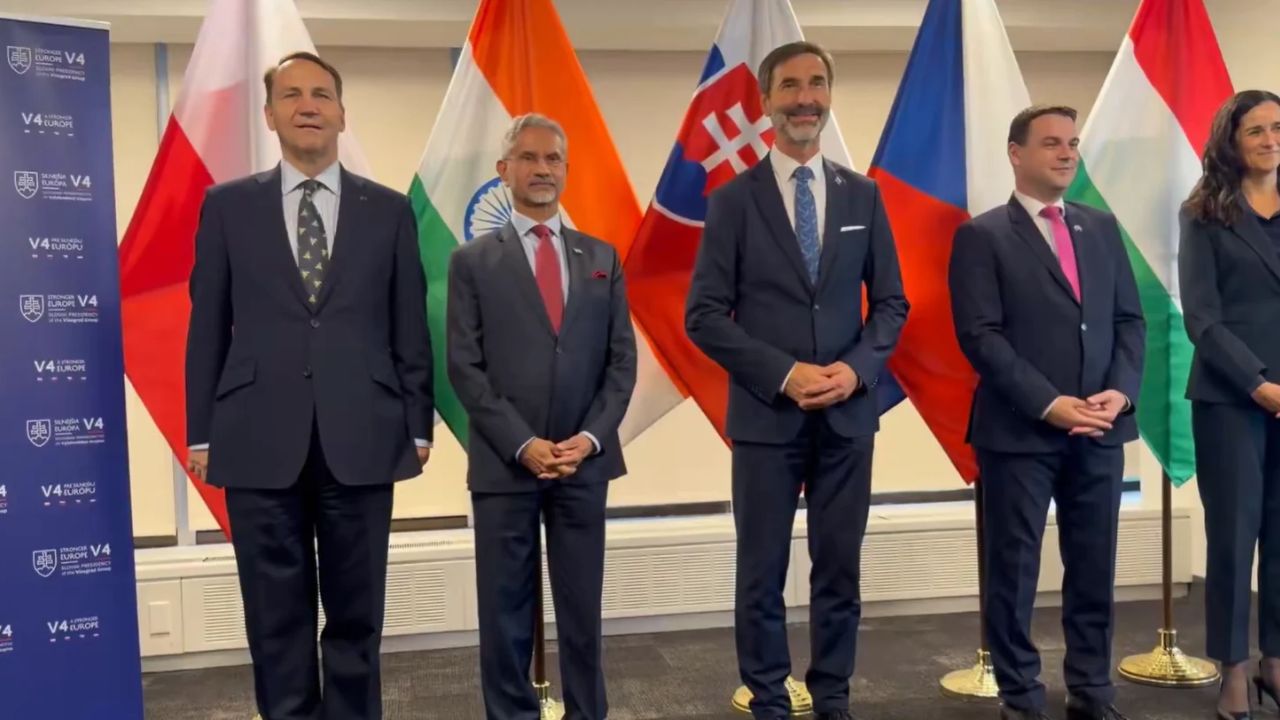
Jaishankar with V4 foreign ministers as Europe voices support for India’s permanent UNSC seat campaign. (Img: X)
New Delhi: India’s decades-long campaign for a permanent seat at the United Nations Security Council received fresh diplomatic momentum after four European nations backed New Delhi’s demand for a bigger role in global decision-making. Poland, Hungary, Slovakia and Czechia supported India’s inclusion as a permanent UNSC member during the first Visegrád Group (V4) plus India foreign ministers’ meeting held alongside the 81st United Nations General Assembly in New York.
The development has gained attention because the UN Security Council remains one of the world’s most influential platforms, where decisions on international peace, conflicts and global security are taken. India has been pushing for reforms, arguing that the current structure does not represent today’s economic, demographic and geopolitical realities.
The support came from the four members of the Visegrád Group, a Central European cooperation platform comprising Poland, Hungary, Slovakia and Czechia. During discussions with External Affairs Minister S Jaishankar, the countries highlighted India’s growing importance as a major voice of the Global South and an emerging power in the Indo-Pacific region.
Slovakia’s Foreign Minister Juraj Blanár indicated that the V4 nations believe India should have a permanent place at the UN’s top security body. The statement comes at a time when New Delhi is intensifying diplomatic efforts to gain wider international support for Security Council reform.
The United Nations Security Council currently has five permanent members — the United States, Russia, China, France and the United Kingdom — who hold veto powers. India, along with several other countries, has argued that the council needs expansion to reflect the changing global order.
External Affairs Minister S Jaishankar described the first V4+India ministerial meeting as an important milestone in India’s engagement with Central Europe. The meeting focused on strengthening cooperation across multiple sectors, including defence, trade, technology, innovation, space, connectivity, education and cultural exchanges.
Both sides agreed to create an annual business forum and continue regular meetings between foreign ministers to deepen strategic ties. The discussions also explored opportunities in emerging technologies, research partnerships and innovation-driven industries. India and V4 nations discussed ways to expand cooperation between companies, universities, startups and scientific institutions.
India’s demand for permanent UNSC membership is based on its argument that the global institution must reflect the realities of the modern world. The Security Council was created in 1945 after World War II when global power structures were significantly different. Since then, countries such as India have witnessed major economic growth, population expansion and increased diplomatic influence.
New Delhi has repeatedly highlighted its role in UN peacekeeping missions, contribution to international security efforts, fight against terrorism and participation in multilateral initiatives as part of its case. India has also been part of the G4 group along with Brazil, Germany and Japan, which supports expansion of the Security Council and permanent representation for emerging economies.
India’s campaign for a permanent UNSC seat has received support from several major countries, including France, the United Kingdom, the United States and Russia.
However, changing the structure of the Security Council requires approval through the UN reform process and amendments to the UN Charter. The issue involves discussions among nearly all UN member states and the existing permanent members.
China remains a significant factor in the debate as it has not formally supported India’s permanent membership proposal. Other major questions include the number of new permanent members, regional representation and whether new members would receive veto powers.
The V4+India meeting was not limited to UNSC reforms. Ministers also discussed global security challenges, including the Ukraine conflict and developments in the Gulf region. Defence cooperation remained an important area of discussion, with India looking to strengthen existing partnerships with Central European nations.
Technology sharing, space cooperation and connectivity projects were also highlighted as future areas of collaboration. People-to-people relations, including student exchanges and cultural partnerships, were also discussed during the meeting.
The backing from four European countries provides additional diplomatic support to India’s campaign, but permanent membership of the UN Security Council remains dependent on a broader reform agreement.
India is expected to continue engaging with global partners to build support for changes in the structure of international institutions. The latest V4 endorsement adds another regional voice to India’s argument for a more representative global governance system.
As debates over UNSC expansion continue, India’s growing partnerships with countries across Europe, Asia and other regions are expected to remain a key part of its diplomatic strategy.

