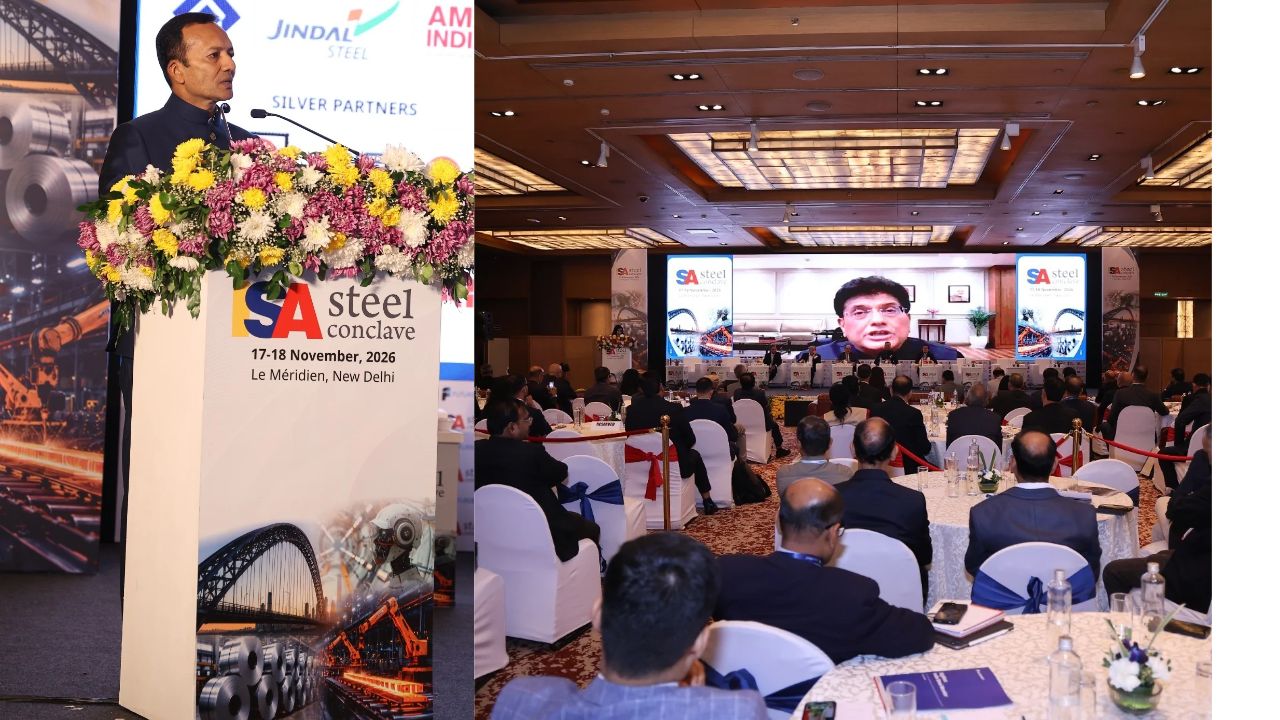
Commerce Minister Piyush Goyal assures industry of protection against unfair trade practices; Centre to examine non-GST levies affecting domestic steelmakers. (Img: Dynamite News)
New Delhi: Union Commerce and Industry Minister Piyush Goyal has called upon India's steel industry to shift its focus from expanding production volumes to establishing the country as a globally trusted supplier of high-quality steel, stressing that quality, innovation and reliability must define India's emergence as a major manufacturing power.
Addressing the concluding session of the seventh edition of the Indian Steel Association's (ISA) Steel Conclave 2026 through a video message, Goyal said the country's steel sector must evolve from being a supplier of conventional products to a provider of specialised solutions catering to advanced manufacturing, shipbuilding and modern infrastructure.
The Minister also assured domestic steelmakers of government support against unfair trade practices, while highlighting the need to strengthen the industry's export competitiveness.
"Every day, steel builds homes, highways and factories. More than that, it builds a nation's strength and its aspirations. Our ambition must now extend beyond producing more steel to producing the world's most trusted steel," Goyal said.

Naveen Jindal flags additional cost burden arising from royalties, auction premiums and electricity duty; ISA to take conclave recommendations to government. (Img: Dynamite News)
Referring to India's export performance, he noted that the country's exports had reached USD 863 billion in FY 2025-26 and were expected to touch USD 1 trillion in the current financial year. He said the steel sector would have to contribute meaningfully to this expansion by moving towards value-added products and integrated solutions rather than merely supplying raw steel.
Emphasising the importance of international credibility, Goyal said Indian steel must be recognised for its quality and consistency, ensuring that global customers choose domestic manufacturers on the strength of their products.
He also highlighted the Centre's Rs 25,000-crore Export Promotion Mission, saying it would help enterprises, including smaller steel manufacturers, address challenges relating to export procedures, certification and regulatory compliance.
The conclave also brought into focus the additional cost burden arising from levies that remain outside the Goods and Services Tax (GST) framework, with Commerce Secretary Rajesh Agrawal indicating that the government would examine the industry's concerns.
Addressing the valedictory session, Naveen Jindal, Lok Sabha MP, Chairman of Jindal Steel Limited and President of the Indian Steel Association, said domestic steel producers faced a cost disadvantage because of multiple statutory charges that were not subsumed under GST. He pointed to royalty on raw materials, substantial premiums paid during coal and iron ore auctions, and electricity duty as significant components of the industry's cost structure.
Jindal said Indian steelmakers were often required to pay auction premiums exceeding 100 per cent for iron ore, pushing the effective cost of domestic raw material close to that of imported supplies. He further explained that since these levies fell outside the GST framework, manufacturers were unable to claim corresponding input tax credits when exporting their products.
"Indian companies pay several levies that are not subsumed under GST, such as royalty on raw materials, high premiums on coal and iron ore auctions, and electricity duty. On iron ore, most of our companies have paid premiums of more than 100 per cent, which makes it almost as costly as imported ore," Jindal said.
Drawing attention to the international cost disadvantage, he said such charges accounted for approximately 1-2 per cent of production costs in several other countries, compared with nearly 10-12 per cent in India. He said the ISA would consolidate the recommendations emerging from the conclave and take them forward to the government for consideration.
Responding to the concerns, Commerce Secretary Rajesh Agrawal acknowledged that levies outside GST added to the industry's cost burden and said the government would explore possible interventions.
"Naveen Jindal has spoken about certain taxes that are not subsumed under GST and add to the cost of the industry. I take this message very strongly," Agrawal said.
He cautioned that addressing the issue would require coordination because the levies involved fell within both the Central and State taxation frameworks. Nevertheless, he said he would work within the government to identify ways to make Indian steel production more cost-efficient and internationally competitive.
Agrawal also observed that international trade was increasingly being shaped by geopolitical considerations, with supply-chain resilience, reliability and strategic partnerships becoming as important as conventional economic efficiencies.
He encouraged Indian steel companies to explore emerging opportunities in Africa, Latin America, ASEAN countries and Oceania to diversify their export markets and strengthen international supply networks.
The conclave deliberations also examined India's ambition of achieving 300 million tonnes of steel capacity by 2031, with discussions centred on the availability of raw materials, infrastructure, logistics and the emergence of new industrial clusters.
Jindal said the domestic industry remained committed to achieving the capacity target but cautioned that dependence on imported coking coal and the pressure of competitively priced imports continued to affect Indian manufacturers.
A dedicated session on emerging steel growth centres examined the potential of regions beyond the country's traditional steel-producing belt. A presentation by McKinsey identified significant opportunities for capacity expansion in Vidarbha, Andhra Pradesh and Karnataka, estimating potential steel capacity of around 50 million tonnes in Vidarbha, 17.8 million tonnes in Andhra Pradesh and 10.5 million tonnes in Koppal.
Alok Sahay, Secretary General and Executive Head of the Indian Steel Association, highlighted Gadchiroli in Maharashtra's Vidarbha region as an example of how access to mineral resources, logistics infrastructure and supportive government policies could facilitate the emergence of new industrial centres.
He said a substantial portion of the capacity planned for 2030 was expected to come up outside the established steel belt, making collaboration with State governments essential for addressing infrastructure and policy-related bottlenecks.
Sahay said the ISA would work with State administrations to facilitate the development of these emerging hubs and address the constraints affecting their growth.
The conclave's concluding day also featured the fourth edition of the ISA Coking Coal Summit, organised alongside the main event, with EY-Parthenon as its Knowledge Partner. The discussions examined India's continued dependence on imported coking coal, a critical raw material in conventional steelmaking, and the challenges associated with securing reliable supplies amid changing global trade dynamics and the transition towards lower-carbon production.
Two knowledge reports prepared by EY-Parthenon in consultation with the ISA were released during the summit. Titled Steel: The Backbone of the Indian Economy and Coking Coal: Fuelling India's Steel Ambition in a Carbon Priced World, the reports examine the strategic importance of steel to India's economic development and the raw-material challenges confronting the sector.
The seventh ISA Steel Conclave brought together policymakers, domestic steel producers and international stakeholders for deliberations on raw-material security, trade competitiveness, emerging manufacturing clusters and decarbonisation. The ISA said it would take the recommendations emerging from the two-day deliberations to the government, with the objective of addressing structural cost disadvantages, strengthening domestic manufacturing and supporting India's ambition to emerge as a globally competitive steel-producing nation.


