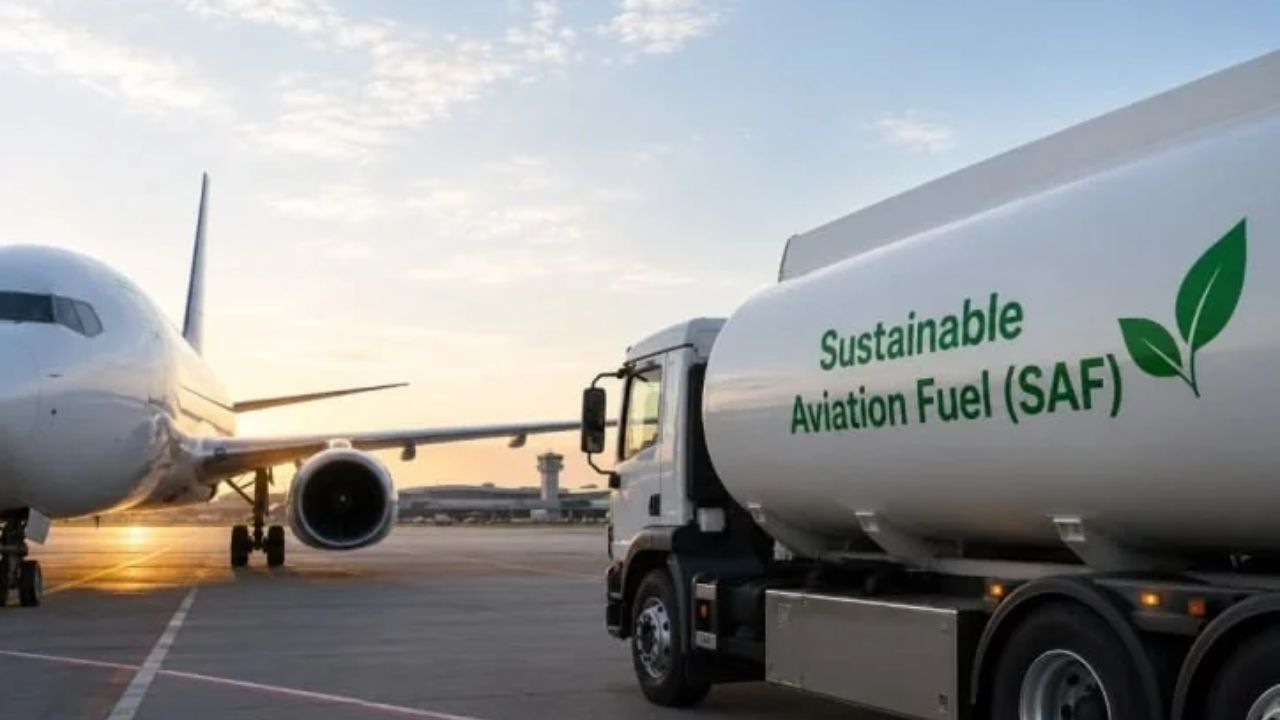
India's aviation sector prepares for a greener future with IOC's Panipat SAF facility. (Img: X)
New Delhi: India is set to take a significant step towards decarbonising its aviation sector, with Indian Oil Corporation (IOC) ready to commence commercial production of sustainable aviation fuel (SAF) at its Panipat refinery in Haryana.
The country's first commercial-scale SAF manufacturing facility has received the necessary regulatory clearances, including approval from the Directorate General of Civil Aviation (DGCA), and has already produced its first batch of the alternative aviation fuel.
IOC Chairman Arvinder Singh Sahney said the facility was ready to begin commercial operations ahead of the proposed blending requirements for international flights from January 2027. He also underlined India's potential to emerge as a major global manufacturing hub for sustainable aviation fuel as international demand gathers momentum.
The Panipat refinery unit has an installed production capacity of 30,000 tonnes of SAF annually. It uses used cooking oil as its primary feedstock, converting discarded oil into an alternative fuel suitable for aviation.
According to Sahney, the facility's production capacity would be sufficient to cater to almost the entire domestic requirement of SAF in 2027 under the government's proposed blending targets. The project is particularly significant as it establishes domestic commercial-scale production capability at a time when the aviation industry is under increasing pressure to reduce its carbon footprint. IOC's initiative is also expected to provide a foundation for developing a wider supply chain involving the collection and processing of waste-based feedstock.
The government has outlined indicative targets for blending sustainable aviation fuel with conventional aviation turbine fuel (ATF) on international flights. The proposed roadmap envisages SAF accounting for 1 per cent of aviation fuel from 2027, increasing to 2 per cent in 2028 and 5 per cent by 2030.
The targets are aligned with international efforts to reduce emissions from civil aviation. The International Civil Aviation Organization's Carbon Offsetting and Reduction Scheme for International Aviation (CORSIA) is also entering its mandatory implementation phase in 2027.
Under the framework, airlines will be required to address the growth in carbon dioxide emissions from international flights beyond the 2020 baseline. Greater adoption of sustainable aviation fuel is among the important mechanisms available to the industry to meet its emission-reduction obligations. A comprehensive national policy framework for SAF is also being worked upon.
Sustainable aviation fuel is produced using renewable and waste-based resources rather than relying exclusively on conventional fossil fuels. Used cooking oil, agricultural residues and other sustainable feedstocks can be processed to manufacture the alternative fuel.
Its chemical characteristics are broadly comparable to conventional jet fuel, allowing it to be blended with ATF and used in existing aircraft engines without requiring fundamental modifications to aircraft. The aviation sector considers SAF an important component of its decarbonisation strategy, particularly because the transition to battery-powered aircraft remains challenging for long-distance commercial aviation.
Industry estimates suggest that sustainable aviation fuel could contribute more than 60 per cent of the global aviation industry's efforts to reduce carbon emissions. However, the relatively high cost of production remains a major obstacle to its widespread adoption. SAF currently costs around two to three times as much as conventional jet fuel, largely because manufacturing capacity, feedstock availability and distribution networks are still developing.

Green aviation gets a major boost ahead of the 2027 blending requirements. (Img: X)
IOC is not the only public sector oil company pursuing commercial production of sustainable aviation fuel. Bharat Petroleum Corporation Limited (BPCL) is in the advanced stages of establishing a 41,000-tonne-per-annum SAF manufacturing facility at its Mumbai refinery. The company expects the unit to become operational for commercial production in December.
IOC and BPCL together account for more than 90 per cent of jet fuel sales for international flights originating from India, making their investments particularly important for the country's initial blending requirements. The expansion of domestic manufacturing capacity could also reduce India's dependence on imported sustainable aviation fuel as blending obligations increase.
Despite the promising outlook, the economics of sustainable aviation fuel remain a concern for producers and airlines. Sahney has emphasised the need to address the price difference between SAF and conventional jet fuel to ensure that the transition does not impose an excessive financial burden on the aviation industry.
The availability of sustainable feedstock will also determine how rapidly production can be expanded. While used cooking oil offers an established route for manufacturing SAF, another potential pathway involves converting ethanol into aviation fuel.
India's substantial ethanol production capacity could offer an advantage in this area. However, international sustainability requirements, particularly restrictions in Europe on using ethanol derived from food crops, have complicated the prospects of exporting or supplying such fuel to certain markets. Consequently, Indian producers are adopting a cautious approach towards investments in ethanol-based SAF facilities.
Also Read: ‘Khao, Piyo, Mauj Karo’ Is Not India’s Culture: PM Modi’s Strong Message On Saving Money
Sahney views the emergence of sustainable aviation fuel as more than a regulatory requirement, arguing that it could open up a substantial new opportunity for India's energy sector. With airlines worldwide expected to progressively increase their reliance on lower-emission aviation fuels, India could leverage its refining infrastructure, biofuel capabilities and access to different feedstocks to establish itself as a significant producer.
The commissioning of the Panipat facility marks an important beginning in that direction. However, the long-term success of the transition will depend on making SAF commercially viable, securing reliable supplies of sustainable raw materials and building sufficient production capacity to meet the aviation industry's growing requirements.


