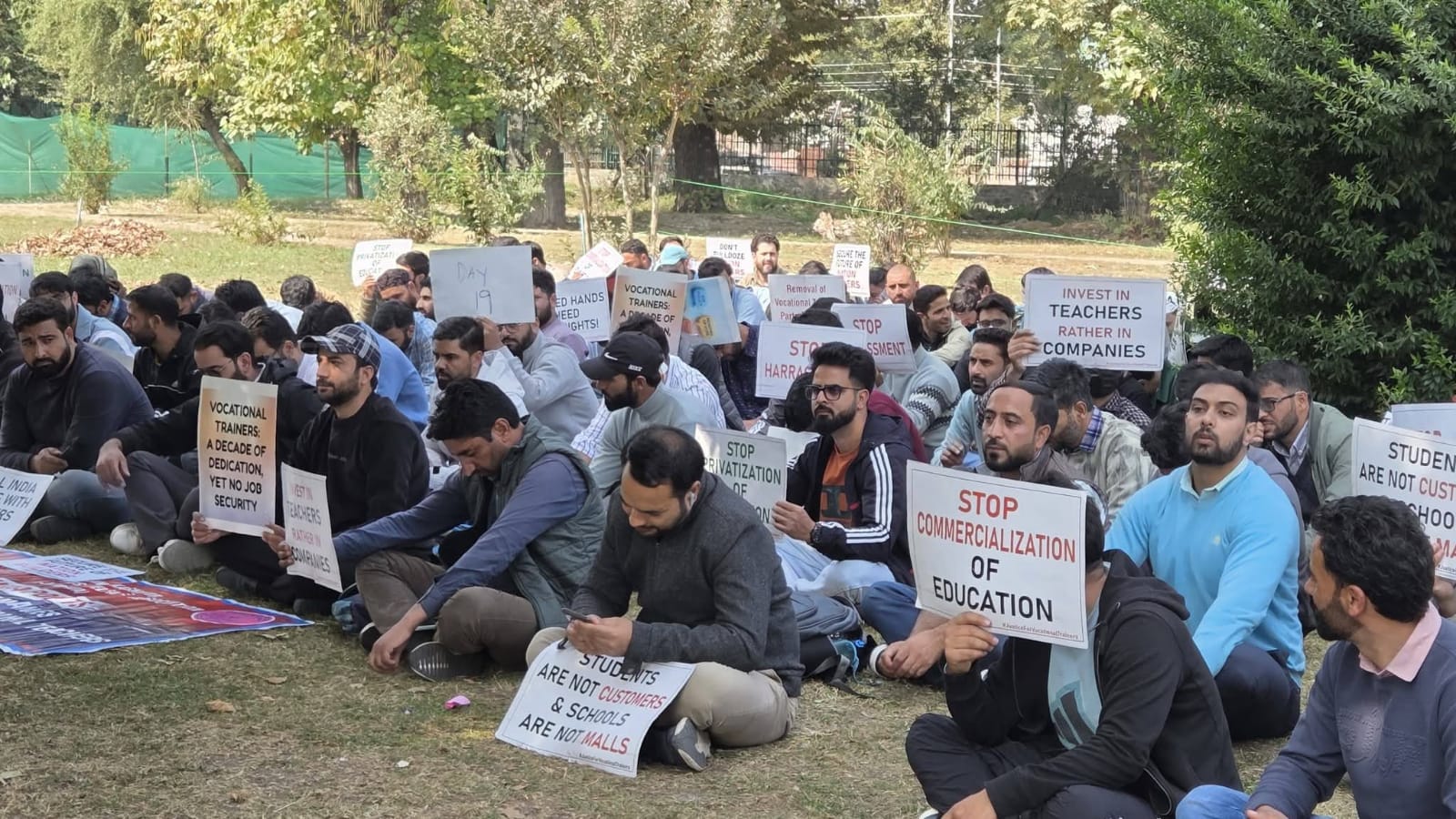
J&K vocational trainers’ protest enters its 21st day as JKESWA demands job security and a clear service policy. (Img: Dynamite News)
Srinagar: The fight for job security among Jammu and Kashmir’s vocational trainers has entered its 21st day, with the Jammu and Kashmir Employees Social Welfare Association (JKESWA) stepping up its demand for a lasting solution to their employment concerns. JKESWA President and educator Asiya Iqbal has urged the government to end the outsourcing system, frame a clear service policy and provide workers with greater certainty about their professional future.
The continuing agitation has brought attention to the working conditions of vocational trainers, who help students develop practical and career-oriented skills. Iqbal has also raised concerns over retirement benefits for employees covered by the New Pension Scheme (NPS), calling for meaningful discussions on pension-related demands and the possibility of relief under the Old Pension Scheme (OPS), subject to applicable laws and policies.
Why Are Vocational Trainers Protesting in Jammu and Kashmir?
The protest has centred on demands for employment stability, better working conditions and an end to dependence on private outsourcing agencies. As the agitation reaches its third week, JKESWA has called on the Jammu and Kashmir administration and the Education Department to engage with the trainers and work towards a policy that addresses their concerns.
According to Iqbal, vocational trainers who have spent years working in the education sector deserve respect, fair treatment and clarity about their employment arrangements. She argued that workers responsible for helping students acquire practical skills should not have to remain uncertain about their own professional futures.
The association has called for a review of the existing arrangement under which vocational training services are linked to outsourcing agencies. It wants the government to consider a framework that provides greater employment security and allows trainers to work without continued dependence on private intermediaries.
The immediate challenge for the administration is to address these demands through discussions and policy decisions. The duration of the protest has made the issue increasingly difficult to overlook, although the government’s response and the outcome of any negotiations will determine the next steps.
Expressing solidarity with the protesting employees, Iqbal said the people responsible for delivering vocational education should not be treated as less deserving of dignity or security than other workers.
She emphasised that the trainers’ demands go beyond individual employment concerns. In her view, uncertainty over jobs and working conditions also raises questions about how the education system supports the people responsible for delivering skill-based learning to students.
Iqbal has asked the Jammu and Kashmir Government and the Education Department to examine the trainers’ grievances, reconsider the existing service arrangement and develop a clear policy governing their employment.
The association’s demand is for a decision that provides long-term clarity rather than leaving trainers dependent on arrangements that they consider insecure. However, any change to the current system would require the administration to assess the applicable contractual, financial and policy provisions.
Alongside the vocational trainers’ protest, Iqbal has highlighted the concerns of employees covered by the New Pension Scheme and renewed the call for serious consideration of demands linked to the Old Pension Scheme.
She argued that employees who have spent decades serving public institutions should receive fair consideration of their retirement needs. According to her, pension-related concerns should not be dismissed simply because employees entered service under a different pension framework.
Iqbal has called for consultations between the government and employee associations to examine possible policy options for NPS-covered workers. She has also urged the administration to assess whether any OPS-related benefits could be extended to current employees within the limits of the law and existing government policies.
The issue remains sensitive because pension arrangements involve long-term financial commitments, legal provisions and different service conditions. Any change would therefore require a formal policy decision rather than an assurance made during discussions.
For employees, the debate is about financial security after retirement and whether years of public service will translate into adequate support in later life. For the government, the challenge is to consider these demands alongside the legal and financial implications of any proposed changes.
Iqbal has also criticised what she described as a gap between assurances and concrete action on employees’ concerns. She said improving education standards would be difficult if workers at the grassroots level continued to struggle for basic employment security and acceptable working conditions.
Her appeal to the administration is to initiate dialogue with the protesting vocational trainers, hear their demands and work towards a practical resolution.
The association has stressed that employee welfare should be treated as an important part of the wider public interest. It argues that people working in education need stable conditions to perform their responsibilities effectively.
The message is particularly relevant for vocational education, where trainers help students gain practical knowledge and employment-oriented skills. Prolonged uncertainty among staff can raise concerns about workforce morale and continuity, although the direct impact on classes and students would need to be established separately.
Iqbal has urged the government to move beyond verbal assurances and take decisions that could bring the agitation to an end. Whether the administration responds with formal talks or a policy initiative remains a key question as the protest continues.
The dispute highlights a broader challenge facing education systems: ensuring that workers responsible for delivering training have clear employment conditions and a stable professional environment.
Vocational education is intended to connect classroom learning with practical skills that can help students prepare for employment. Trainers working in this area therefore occupy an important position in the education system. Their demands for secure employment and better working conditions have implications for workforce stability as well as individual livelihoods.
For employees, the central concerns are job continuity, fair treatment and confidence in their future. For students and their families, the wider concern is whether vocational training programmes can maintain consistent delivery when the people providing instruction remain involved in prolonged employment disputes.
The protest also brings attention to the relationship between outsourcing arrangements and public-sector service delivery. Any decision to change the current system would need to account for existing contracts, the financial position of the government, staffing requirements and the legal framework governing recruitment and employment.
The association is pressing for the government to address the issue through dialogue and a defined policy. The eventual outcome will depend on the administration’s response and whether the parties can agree on a workable solution.

