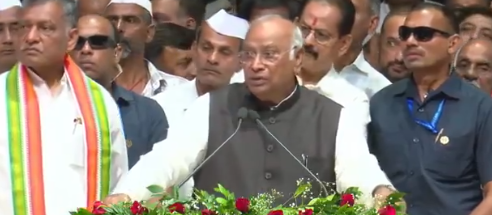
Mallikarjun Kharge’s remark at a Patna event triggers a fresh political confrontation between the Congress and the BJP. (Img: X)
New Delhi: A fresh political confrontation erupted between the Bharatiya Janata Party (BJP) and the Congress on Sunday after Congress president Mallikarjun Kharge made a controversial remark about Prime Minister Narendra Modi’s late father during a public event in Patna. Union Home Minister Amit Shah, BJP national president Nitin Nabin, Union Ministers Giriraj Singh and Dharmendra Pradhan, and Piyush Goyal strongly criticised Kharge, accusing him of crossing the boundaries of political decorum and turning public debate into personal attacks.
The controversy unfolded during a programme marking the 139th birth anniversary of Dr Shri Krishna Singh, Bihar’s first Chief Minister. According to reports, an audience member interrupted Kharge’s address with a remark suggesting that Modi would not leave power. Kharge responded with a comment referring to the Prime Minister’s father, triggering a commotion at the venue and a wave of condemnation from BJP leaders.
The episode has added a new flashpoint to the BJP-Congress confrontation, bringing political rhetoric, public conduct and the treatment of dissent at political events into focus. The dispute also comes amid a wider battle over electoral processes, the Special Intensive Revision (SIR) of voter lists and the independence of constitutional institutions.
## Amit Shah Accuses Congress of Resorting to Personal Attacks
Union Home Minister Amit Shah launched a sharp attack on Kharge, alleging that the Congress had repeatedly crossed the limits of political propriety by targeting Modi and his family. In a public statement, Shah described the Patna remark as a breach of basic standards of civility and argued that political criticism should not extend to personal attacks against family members.
Shah also cited earlier controversies involving remarks about Modi’s mother, the description of the Prime Minister as a merchant of death during a previous political campaign, and references to his background as a tea seller. He presented these episodes as evidence of what he characterised as a recurring pattern within the Congress.
The Home Minister further alleged that repeated electoral defeats over the past 12 years had left the Congress frustrated and without a substantive political agenda. According to Shah, the party was increasingly relying on personal criticism rather than offering policy alternatives or engaging in issue-based debate. He also claimed that previous attacks on Modi and his family had drawn a negative response from voters.
Shah’s remarks positioned the controversy as part of a broader political argument over leadership, campaign rhetoric and public accountability. His claims about the Congress’s electoral standing and political strategy represent the BJP’s assessment of its principal national rival.
## Nitin Nabin Calls the Remark a Sign of Ideological Bankruptcy
BJP president Nitin Nabin also condemned Kharge’s statement, describing the language used at the Patna event as inappropriate for a public representative addressing a political gathering. Nabin argued that bringing deceased family members into political speeches crossed an important boundary in democratic discourse.
He accused the Congress of resorting to personal attacks because, in his view, it lacked substantial issues on which to challenge the government’s development agenda, policies and welfare programmes. Nabin further argued that the controversy reflected a wider problem within the Congress leadership rather than an isolated lapse by its president.
The BJP chief’s response reinforced the party’s central line of criticism: that political opposition should be expressed through policy scrutiny, governance comparisons and ideological debate rather than remarks involving relatives of political leaders.
## Giriraj Singh, Dharmendra Pradhan and Piyush Goyal Join the Attack
Union Minister Giriraj Singh also criticised Kharge, accusing Congress leaders of prioritising political loyalty and personal attacks over substantive debate. Singh suggested that the Patna episode reflected frustration within the opposition and argued that the Prime Minister’s family should not be drawn into political exchanges.
Singh also made a political prediction that Modi would remain in power for decades, while claiming that the Congress had lost much of its political relevance. These assertions formed part of his response to Kharge and should be understood as political claims rather than established outcomes.
Union Minister Dharmendra Pradhan described the remark as unfortunate and argued that public figures should preserve the dignity of political institutions, including the office of the Prime Minister. He accused the Congress of choosing personal criticism over a contest based on policies and ideas.
Piyush Goyal, meanwhile, emphasised that India’s democratic system was not a forum in which political leaders could make personal attacks without accountability. He defended the electorate’s ability to judge political parties and presented Modi’s development agenda as central to India’s future. His response framed the controversy as a question of democratic responsibility and respect for voters.
BJP spokesperson Tuhin A Sinha also criticised Kharge’s language, adding to the party’s coordinated response. The succession of statements from senior BJP figures turned the Patna incident into a broader political confrontation, with the two parties offering sharply different assessments of the standards expected from public representatives.
## What Happened at the Patna Event?
The incident occurred during Kharge’s address at a programme commemorating the 139th birth anniversary of Dr Shri Krishna Singh. Reports said an audience member, identified as Santosh Kumar, made a remark suggesting that Modi would not leave power. Kharge responded with a comment about the Prime Minister’s late father, which prompted a disturbance at the venue.
Kumar later said that his original statement had been misunderstood. He claimed he had meant that Modi would not leave office unless there was a revolt, arguing that only part of his sentence had been heard. His explanation added another dimension to the controversy over how the exchange began.
Media reports also alleged that Kumar was surrounded, assaulted and removed from the hall by people identified as Congress supporters. The reported incident has raised separate questions about the treatment of audience members who challenge speakers at political events. The circumstances of the alleged assault and the responsibility of those involved require independent verification.
The episode highlights the importance of distinguishing between the political dispute over Kharge’s remark and the separate allegations concerning the treatment of the audience member. Both raise questions about public conduct, the management of political gatherings and the need to prevent verbal disagreements from escalating into physical confrontations.
## Kharge’s Criticism of the BJP, RSS and Electoral Processes
Kharge’s controversial remark came during a broader political address in which he criticised the BJP and the Rashtriya Swayamsevak Sangh (RSS), while raising concerns about the conduct of elections and the revision of electoral rolls. The Congress president called for the Special Intensive Revision of voter lists to be stopped and advocated the use of paper ballots for elections.
Kharge alleged that the SIR exercise could lead to the removal of eligible voters from electoral rolls, raising concerns about electoral inclusion and the integrity of voter registration. His demand for a halt to the exercise formed part of the Congress’s wider criticism of the Election Commission and the electoral process.
He also levelled allegations against Chief Election Commissioner Gyanesh Kumar, claiming that the official was favouring the BJP and suggesting that senior officials were being facilitated in securing party tickets and ministerial positions. Kharge referred to claims attributed to a former Kerala chief secretary and accused the BJP of betraying the country. These remain allegations made by the Congress president and should not be treated as established findings without supporting evidence.
The dispute over SIR reflects a larger political debate about voter-list accuracy, the inclusion of eligible electors, institutional independence and public confidence in elections. Electoral roll revision is an important administrative process, while allegations of deliberate exclusion or political bias require evidence and a response from the institutions concerned.
Kharge’s criticism of the BJP and RSS, alongside his comments on electoral reforms, provided the broader political backdrop to the Patna controversy. The BJP’s response, however, has centred on the personal nature of his remark about Modi’s father and what it considers a breach of political decorum.
## BJP Plans Nationwide Protests
The controversy has also prompted the BJP to plan protests across the country against Kharge’s remark. The proposed demonstrations signal that the party intends to extend its response beyond statements by senior leaders and make the issue part of its wider political campaign against the Congress.
The planned protests could further intensify the confrontation between the two parties, particularly as disagreements over electoral rolls, the Election Commission and political rhetoric continue to shape the national discourse. The BJP is framing the controversy as a matter of respect for the Prime Minister and standards of public speech, while Kharge’s wider address focused on the Congress’s allegations concerning electoral processes and the government.
The two sides are therefore contesting both the immediate incident and its wider political meaning. The BJP has condemned the remark as a personal attack, while the Congress’s broader criticism concerns electoral transparency and institutional accountability.
The Patna episode has once again placed the tone of political debate under scrutiny. While robust criticism of public officials and government policies is a central feature of democracy, personal remarks, allegations of misconduct and reports of violence at political gatherings need to be assessed separately, on the basis of verified facts and due process.
## Excerpt
Congress president Mallikarjun Kharge’s remark about Prime Minister Narendra Modi’s late father has triggered a political storm, with Amit Shah, Nitin Nabin, Giriraj Singh and other BJP leaders condemning the comment. The row has also intensified debate over political decorum, alleged electoral irregularities and the proposed nationwide BJP protests.

