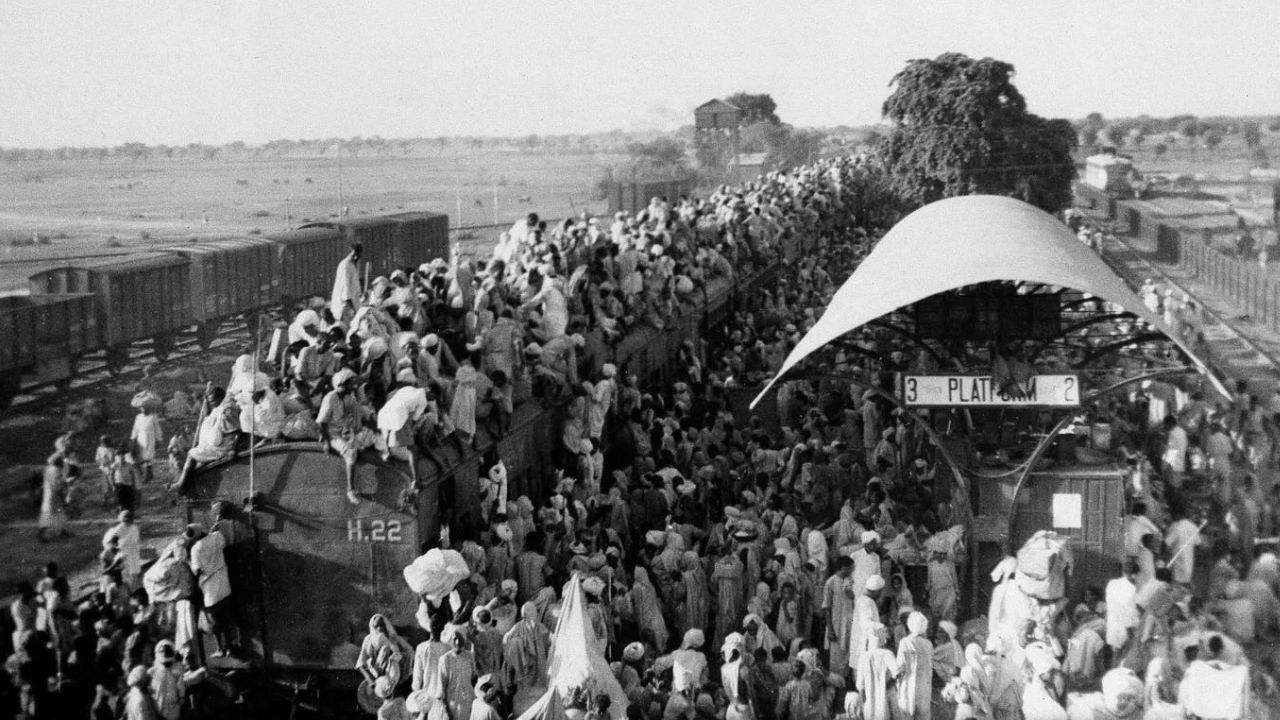
Train Journey That Defined Partition (Img: X)
New Delhi: Somewhere on the tracks between Khewra and Kamoke, a mother held her infant son and waited. She did not know it yet, but the train she was boarding would become one of the last of its kind and one of the last mornings her family would ever see.
There is a particular kind of silence that history remembers wrong. We remember Partition as a line on a map, redrawn overnight by men in Whitehall who had never walked the villages they were dividing. We rarely remember it as a woman named Lajwanti, eighteen months into motherhood, being loaded onto a convoy of trucks with her husband, her uncle, and a handful of relatives, not knowing whether the tracks ahead led home or nowhere at all.
On September 24, 1947, a group of non-Muslim refugees from Khewra were brought by truck to Pind Dadan Khan, in what was now Pakistan, to board a train bound for India. Among them was Lajwanti, travelling with her small son, her husband, and members of her extended family. The train left with a military escort of fifteen soldiers of the Pakistan Army but escort was no promise of safety. There was no food on board. No water. Just heat, fear, and the low, constant hum of not knowing.
By the time the train reached Kamoke, in Gujranwala district, it had already become something else: not a passenger service, but a target. Police ordered everyone off. Men were disarmed, told their weapons would be returned once the search was finished. It was a promise that, for many families on that platform, would never be kept.
By late September 1947, the railway line between Lahore and Amritsar had turned into one of the deadliest stretches of track in the subcontinent. Just two days after the Kamoke incident, a Muslim refugee train pulling into Amritsar was attacked, and thousands of its passengers were killed in a single evening. A massacre answered, days later, by a reprisal attack on a Hindu and Sikh refugee train near Lahore. Two communities, mirrored acts of slaughter, and railway platforms that had once meant departure now meant dread.
This was the season of what came to be known as the ghost trains carriages that crossed the new border not full of the living, but of the dead. A train would pull in on schedule, brakes hissing, and the platform would go quiet before anyone even opened the doors. People already understood, before they looked inside, what the silence meant.
Survivors' accounts from that autumn describe scenes almost too brutal to set down in full: compartments where the wounded and the dead lay together, where families searched carriage by carriage not for their relatives, but for any sign of who they had once been. It is the kind of history that resists being softened, and perhaps it shouldn't be.
Not every train ended this way. Some survived only because of quiet, private acts of courage of the station master, a stranger, someone willing to risk their own life for people who, on any other day, might have simply been fellow passengers. Accounts from that period describe railway staff hiding children in locked washrooms as mobs searched train compartments at each stop, and lying calmly, repeatedly, at platform after platform to protect people they had never met before that journey began. It's a detail worth sitting with: in a season defined by cruelty between neighbours, it was also a season of strangers who chose, at real risk to themselves, to be kind.
Between mid-August and early September 1947 alone, roughly 700,000 refugees are estimated to have crossed the new border by train. Every one of those journeys carried its own version of Lajwanti's family boarding a train they hoped would simply take them home, unsure if home even existed anymore on the other side.
There was no single, official "last train" from Pakistan to India, the migration by rail stretched on for months, its horror and its heroism repeating themselves at station after station, on both sides of a border that was, in truth, barely a border yet. But for thousands of families, each of them experienced their own last train: the one journey that ended a life they had known and began one they hadn't chosen. For some, it ended in a joyful, exhausted arrival on a familiar platform. For others, it never ended at all.
Nearly eighty years later, the tracks between Lahore and Amritsar still exist, still carry trains, still cross the same fields. What they carried in the autumn of 1947 is harder to leave behind not because India and Pakistan haven't tried to move past it, but because some griefs are too large to be laid down. They can only be carried, generation to generation, the way a mother once carried her son onto a train and simply hoped.

