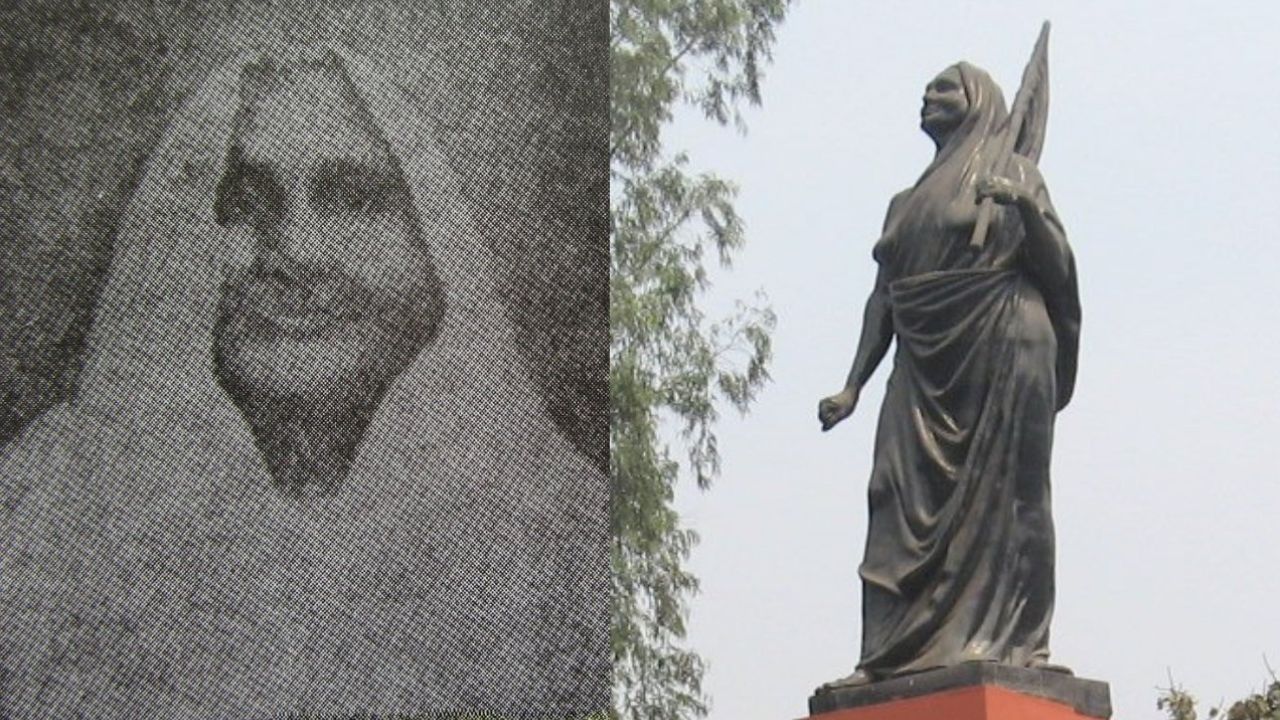
Gandhi Buri aka Matangini Hazra (Img: Pinterest)
New Delhi: She was 73, a frail woman who could barely see, but she stood taller than the empire trying to silence her. What does courage look like when the body is failing, but the will refuses to bend? On September 29, 1942, as the Quit India Movement shook the country, Matangini Hazra, the frail widow Bengal lovingly called "Gandhi Buri," led a thousand heads toward the Tamluk police station in Midnapore.
When British rifles rose to meet her, she did not step back. A bullet found its way to her neck. She kept walking. A second struck her on the chest. She kept walking. It took a third, aimed at her forehead, to finally stop her feet, but even then the flag in her hands never touched the ground and Vande Mataram never left her tongue. History remembers empires by their armies. It should remember this one by the old woman who outwalked its bullets.
Dynamite News fondly remembers "Gandhi Buri" aka Matangini Hazra, who proved that patriotism arises above age and gender.
India's freedom struggle is filled with stories of extraordinary bravery, but few are as moving as that of Matangini Hazra, an elderly widow from Bengal who transformed herself into one of the fiercest faces of the independence movement. At an age when most people seek comfort and rest, Hazra stepped onto the streets with a mission to see India free.
Born on October 19, 1870, in a modest farming family in present-day West Bengal, Matangini Hazra was married at a young age and became a widow while still in her teens. Despite immense personal hardships and little formal education, she refused to let life define her limitations.
Inspired by Mahatma Gandhi's message of non-violence and self-rule, she actively participated in the Civil Disobedience Movement and later the Quit India Movement. She was arrested more than once for defying British rule, yet every imprisonment only strengthened her resolve.
Hazra joined the Indian National Congress and threw herself into local resistance, including a movement against the hated Chowkidari tax that funded British-appointed village spies. In 1933, she was jailed for six months after waving black flags at the British governor. Villagers began calling her Gandhi Buri, old lady Gandhi in Bengali, for her quiet but unshakeable devotion to his principles.
On September 29, 1942, during the Quit India Movement, Hazra led thousands of protesters towards the Tamluk police station in Midnapore. British police ordered the crowd to disperse. When they refused, firing began.
Even after being hit by bullets, Hazra continued marching with the Indian national flag in her hands. Eyewitness accounts recall that she kept chanting "Vande Mataram" as she moved forward. She was struck multiple times but never allowed the Tricolour to touch the ground.
She died on the spot at the age of 73, turning an ordinary protest into an extraordinary chapter in India's struggle for independence.
Police opened fire. Hazra was hit once, then twice, and still she did not let go of the national flag in her hands. A third bullet struck her in the forehead, and she fell where she stood, reportedly still chanting Vande Mataram as she died.
Despite her extraordinary courage, Hazra never became a household name the way many male leaders of her generation did. Historians point to a pattern: women's contributions to the freedom struggle were often left out of official records, and regional figures who did not go on to hold political power after 1947 rarely received sustained recognition. As India marks another Independence Day, her story is a reminder that the fight for freedom was carried as much by ordinary villagers as by famous leaders, and that some of its bravest moments happened far from the history books.

