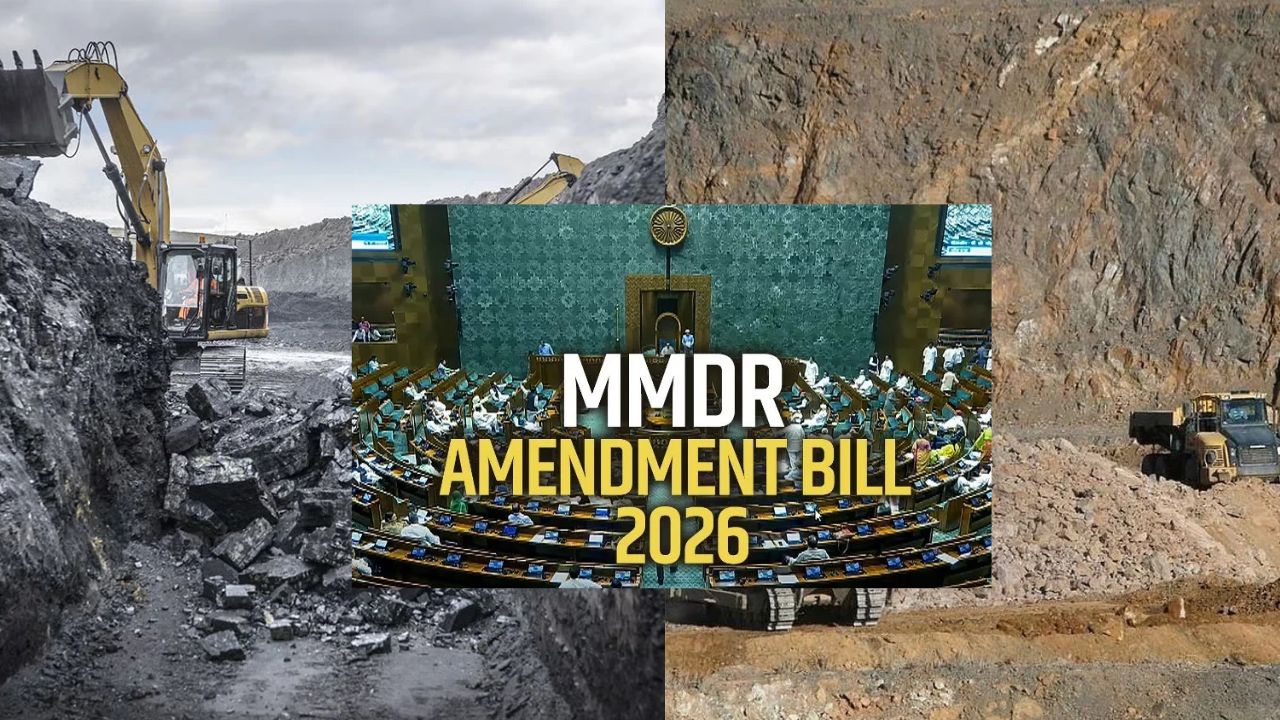
MMDR Amendment Bill 2026 changes India's Mining future (Img: Dynamite News)
New Delhi: India's mining industry is set to have significant change after Parliament approved the Mines and Minerals (Development and Regulation) Amendment Bill, 2026. The Amendment seeks to make mineral exploration easier, giving mining companies greater operational flexibility and strengthen India's access to minerals that are becoming increasingly important for the country's manufacturing and energy ambitions.
The Lok Sabha passed the Bill on August 12, followed by the Rajya Sabha on August 13. It will come into force after receiving the President's assent.
The amendments to the Mines and Minerals (Development and Regulation) Act, 1957 are particularly significant at a time when India is trying to expand domestic supplies of critical minerals used in electric vehicles, batteries, electronics, renewable energy and other advanced industries.
A key focus of the new law is the exploration and development of critical and strategic minerals. Resources such as lithium, cobalt, nickel and graphite have become increasingly important because of their use in batteries, EVs, clean-energy systems and modern manufacturing.
India has traditionally depended on imports for several of these minerals. Expanding domestic exploration could help the country build a more secure supply chain and reduce its exposure to fluctuations in international markets.
The reform is therefore closely linked to India's larger push for greater mineral security and self-reliance.
The Bill introduces greater flexibility for companies that already hold mining leases. If another mineral is discovered within an existing lease area, the leaseholder can approach the state government to include that mineral in the lease instead of having to start an entirely separate process.
For several critical and strategic minerals, the amendment provides for their addition without an additional payment. For other minerals, the applicable royalty and, where relevant, auction premium would apply.
The change could make it easier for companies to turn new discoveries into commercially useful resources while making better use of existing mining infrastructure.
The rules for governing captive mines have also been changed. Captive mines are generally operated by companies to meet the raw-material requirements of their own industrial units. Earlier, after meeting their end-use requirements, such mines could sell only up to 50% of their annual mineral production.
The amendment removes this ceiling. Companies will now have greater freedom to sell their surplus mineral production after meeting their own requirements. This could improve the utilisation of resources and provide mining companies with greater commercial flexibility.
The Act also provides a framework for states to permit the sale of certain mineral dumps lying within leased areas, subject to the conditions and timeline prescribed by the Centre.
The reform also expands the role of the National Mineral Exploration Trust. It will be renamed the National Mineral Exploration and Development Trust, with responsibilities extending beyond exploration to mine development.
This is important because finding a mineral deposit does not automatically translate into production. Significant investment is required to develop mines, build supporting infrastructure and bring deposits into commercial operation.
By widening the trust's mandate, the government aims to provide greater support across the journey from discovering a resource to developing it.
India also hopes to unlock mineral resources that are located deep below the surface. The amendments provide for a one-time extension of mining areas for deep-seated minerals, referring to deposits located more than 200 metres underground.
Such deposits can be technically challenging and expensive to explore. Additional flexibility could encourage companies to take up exploration in areas that may otherwise be considered commercially difficult.
Another important part of the Bill concerns the taxation of mineral rights and mineral-bearing land.
The amendment introduces Section 9D, which places restrictions on states imposing new taxes, cess or other levies on mineral rights or mineral-bearing land, except under conditions prescribed by the Central Government.
The government has argued that the provision will bring greater certainty to mining companies and reduce the possibility of different states imposing additional charges that could affect the economics of long-term projects.
For an industry that often requires substantial investment before a mine starts generating returns, greater predictability can make financial planning easier.
The Act also provides for a framework for regulated mineral exchanges. The objective is to create a more organised system for mineral trading and bring greater transparency to transactions.
If effectively implemented, such a mechanism could help create a more structured marketplace for mineral resources and improve the efficiency of mineral trade.
The impact of the Bill could extend well beyond companies directly involved in mining. India's plans for electric mobility, battery manufacturing, renewable energy, electronics and advanced manufacturing all depend on reliable access to key mineral resources.
A stronger domestic mining and exploration ecosystem could support these industries by improving the availability of raw materials and reducing dependence on overseas supply chains.
The reforms could also become important for India's semiconductor and high-technology ambitions, where secure access to strategic resources is increasingly viewed as an economic priority.
For mining companies and investors, the combination of easier mineral additions to existing leases, greater flexibility for captive mines and a more predictable fiscal framework could improve the attractiveness of the sector.
The reforms could also encourage companies to look more seriously at exploration, particularly for minerals that India is currently seeking to source from abroad.
However, the actual effect on investment will depend on the rules framed after the legislation comes into force and how efficiently the new provisions are implemented.
The MMDR Amendment Bill 2026 comes at a time when minerals have become much more than a source of industrial raw material.
They are now closely connected to India's energy transition, manufacturing ambitions and strategic interests.
By encouraging exploration, supporting mine development, giving existing leaseholders greater flexibility and seeking a more predictable regulatory environment, the government is attempting to prepare India's mining sector for the demands of a changing economy.
For India, the larger objective is clear: discover more minerals, develop them faster and build a stronger domestic supply chain.
With Parliament having cleared the legislation, attention will now shift to the President's assent and the detailed rules that will determine how the new provisions work on the ground.
If implemented effectively, the reforms could give India's mining sector a fresh push while strengthening the country's drive towards critical mineral security, industrial growth and greater self-reliance.

