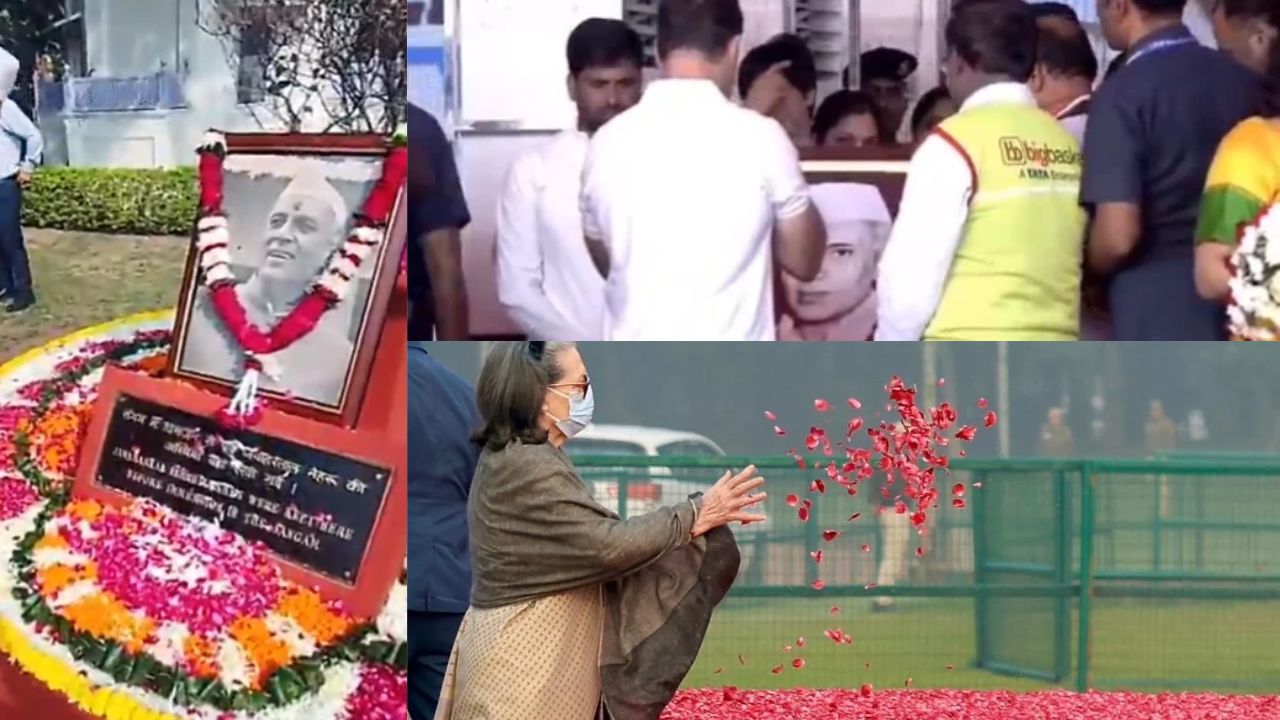
Political leaders across party lines remember Jawaharlal Nehru's contribution to India's freedom struggle and nation-building. (Img: X)
New Delhi: India on Saturday commemorated the 137th birth anniversary of Pandit Jawaharlal Nehru, the country's first Prime Minister, with political leaders across party lines paying homage to his contribution to the freedom struggle and his role in shaping independent India's democratic foundations. The occasion also marked Children's Day, celebrated nationally in recognition of Nehru's affection for children and his emphasis on their education and welfare.
Prime Minister Narendra Modi, Defence Minister Rajnath Singh, Congress Parliamentary Party chairperson Sonia Gandhi, Congress president Mallikarjun Kharge and Leader of Opposition Rahul Gandhi were among those who paid tribute to the former Prime Minister.
Prime Minister Narendra Modi paid homage to Nehru through a post on social media platform X, stating, "Paying tribute to former PM Pandit Jawaharlal Nehru on his birth anniversary."
Defence Minister Rajnath Singh also remembered Nehru's contribution to India's freedom movement and his leadership during the formative years of the Republic, acknowledging his role in shaping the country's early political and institutional landscape.
Congress leaders, including Sonia Gandhi and party president Mallikarjun Kharge, offered floral tributes at Nehru's memorial, Shanti Van, in New Delhi. Party leaders and workers participated in the commemorative programme, remembering his contribution to the freedom struggle and his vision for a democratic India.
Rahul Gandhi also paid homage to Nehru, recalling his commitment to democracy, pluralism and a progressive nation. Describing him as a 'Jewel of Hind', he emphasised the continuing relevance of Nehru's vision of an India founded on equality, scientific temper and constitutional values.
Kharge remembered Nehru as a principal architect of modern India, highlighting his commitment to democratic institutions, secularism, social justice and scientific advancement. He also stressed the importance of safeguarding the constitutional principles and democratic traditions that Nehru championed.
Floral tributes were also offered at Nehru's portrait in the Central Hall of Samvidhan Sadan, the former Parliament building, as leaders recalled his contribution to parliamentary democracy and institution-building.
November 14 is observed as Children's Day across India to commemorate Nehru's special bond with children. Affectionately known as 'Chacha Nehru', he believed that children represented the country's future and that their education, development and well-being were fundamental to nation-building.
Schools and educational institutions across the country marked the occasion through cultural performances, competitions, sports activities and special programmes. The celebrations also brought attention to issues concerning children's rights, access to quality education, healthcare, safety and equal opportunities.
India initially observed Children's Day on November 20, in keeping with the international observance, before shifting the national celebration to November 14 following Nehru's death in 1964.
Born on November 14, 1889, in Allahabad, now Prayagraj, Jawaharlal Nehru became India's first Prime Minister after Independence on August 15, 1947. He remained in office until his death on May 27, 1964.
A prominent leader of the freedom movement and a close associate of Mahatma Gandhi, Nehru played a defining role in establishing India's democratic institutions and shaping its approach to education, scientific research, industrial development and international relations.
His birth anniversary, coinciding with Children's Day, serves as an occasion to revisit his vision of a modern, inclusive and progressive India, while reaffirming the importance of investing in the country's younger generations.

