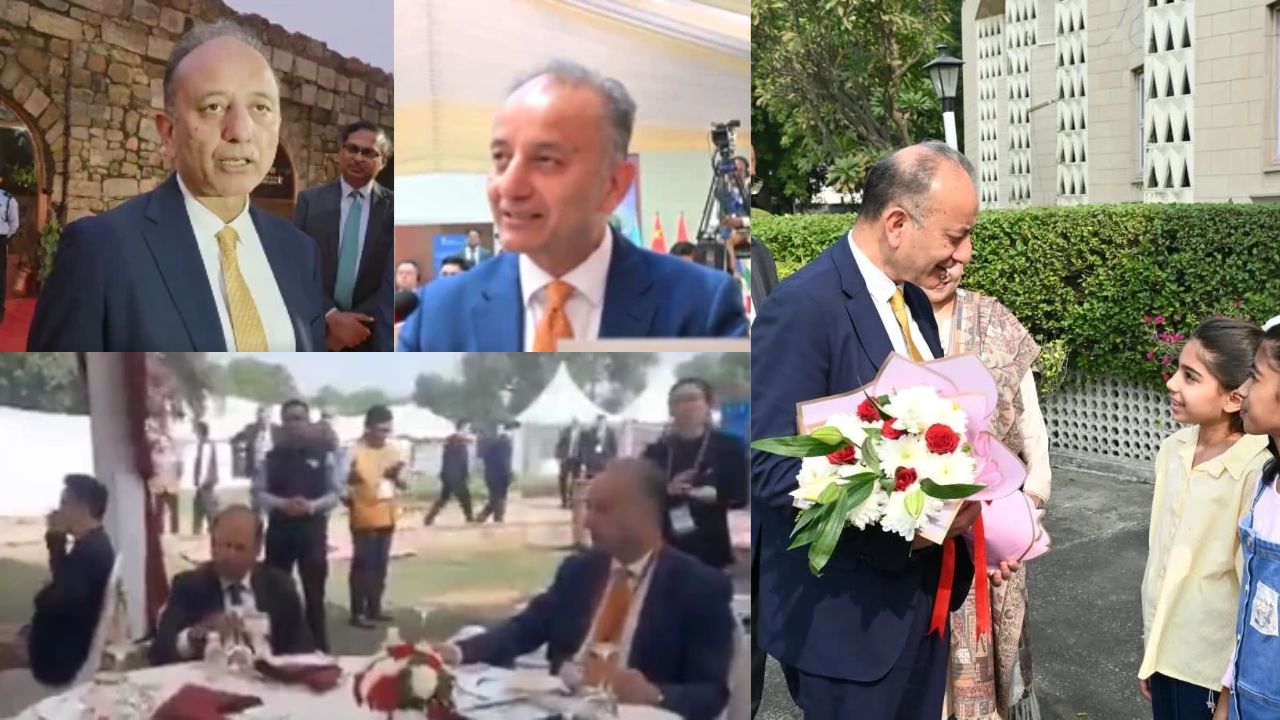
Pakistan's Federal Minister Musadik Masood Malik attends the SCO Civilisational Dialogue Forum in New Delhi amid continuing diplomatic tensions between India and Pakistan. (Img: X)
New Delhi: Amid continuing diplomatic tensions between New Delhi and Islamabad and the absence of a formal bilateral dialogue following Operation Sindoor, Pakistan's Federal Minister for Climate Change and Environmental Coordination, Musadik Masood Malik, has emphasised the importance of intercultural engagement, mutual respect and dialogue among civilisations at a high-profile Shanghai Cooperation Organisation (SCO) forum in New Delhi.
Addressing the ongoing SCO Civilisational Dialogue Forum on Sunday, Malik underlined the significance of recognising distinct cultural identities while acknowledging the historical, social and civilisational connections that bind South Asia and Central Asia. His intervention brought a significant diplomatic and cultural dimension to the multilateral gathering, particularly against the backdrop of strained India-Pakistan relations.
The Indian Ministry of Culture prominently highlighted the visiting Pakistani minister's observations in an official statement issued on Saturday. The statement outlined Malik's emphasis on pluralism, cultural coexistence and the need to facilitate meaningful exchanges between societies with different historical experiences and identities.
During his interaction with Union Culture Minister Gajendra Singh Shekhawat on the opening day of the forum on Friday, Malik reflected on the deep historical connections that have shaped the region over thousands of years. He emphasised that cultural diversity should be recognised as an intrinsic feature of the subcontinent's collective heritage, with different identities retaining their individual significance while participating in constructive dialogue.
The Pakistani minister also stressed the importance of bringing together diverse voices, perspectives and intellectual traditions. According to the Ministry of Culture, he regarded the free exchange of ideas as a central objective of the SCO Civilisational Dialogue Forum, highlighting the value of acknowledging differences while building common ground.
Drawing attention to Delhi's architectural and archaeological heritage, Malik referred to the historical significance of Purana Qila and the multiple cultural influences reflected in its construction. He observed that the monument represented successive layers of political authority, architectural traditions and cultural interactions. The foundation of the fort was associated with Mughal emperor Humayun, who belonged to the Timurid dynasty and had Central Asian ancestry, while its construction was subsequently advanced by Sher Shah Suri, whose origins were in Afghanistan.
Malik's reference to the monument highlighted how different ruling dynasties and cultural traditions contributed to the architectural identity of the Indian subcontinent. The historical structure, therefore, served as an illustration of the region's interconnected past and the influence of successive civilisations on its built heritage.
He also welcomed the forum's description as Tehzeeb Ki Guftagu, reflecting the idea of a dialogue among civilisations. The expression underscored the importance of celebrating cultural plurality, historical continuity and the exchange of traditions across geographical and political boundaries.
In another significant observation, Malik highlighted Delhi's ability to absorb and integrate successive waves of cultural influences. Speaking in Urdu, he conveyed that the arrival of people, traditions and civilisations from outside the region had strengthened the capital's cultural identity rather than diminished it.
His remarks drew attention to Delhi's historical evolution as a centre of political power, intellectual exchange, architecture, literature and cultural synthesis. Over centuries, the city has witnessed the influence of several dynasties, communities and artistic traditions, contributing to its distinctive multicultural character.
The Pakistani minister also invoked the literary legacy of Mirza Ghalib and the archaeological significance of Taxila, Gandhara and Mohenjodaro to highlight the extensive cultural connections linking South Asia with Central Asia.
These historical references brought the region's shared civilisational legacy into focus, particularly the contributions of ancient urban settlements, Buddhist heritage, classical art, literature and transregional cultural exchanges.
Extending the cultural outreach beyond the conference proceedings, Malik invited delegates participating in the SCO forum to visit the archaeological sites of Harappa and Mohenjodaro in Pakistan.
Both sites are internationally recognised as major centres of the Indus Valley Civilisation, one of the world's earliest urban civilisations. Their archaeological remains offer important insights into ancient urban planning, trade networks, craftsmanship, civic infrastructure and the development of organised settlements across the northwestern Indian subcontinent.
The invitation added an archaeological and heritage-focused dimension to Malik's address, highlighting the importance of preserving and showcasing historically significant sites that form part of the region's shared past.
He also emphasised the significance of sustained engagement between civilisations, suggesting that future generations should be able to look back at the present period as one marked by communication and constructive interaction rather than prolonged disengagement.
The Ministry of Culture's decision to prominently document Malik's observations gave his intervention considerable visibility within the official proceedings of the New Delhi forum. The development is particularly noteworthy because India and Pakistan have yet to restore normal bilateral engagement following the military escalation associated with Operation Sindoor.
Relations between the neighbouring countries remain strained, with terrorism, cross-border security concerns and regional stability continuing to dominate the diplomatic landscape. Malik's participation in the SCO gathering and the Indian government's acknowledgement of his cultural and civilisational observations nevertheless demonstrated the continuing relevance of multilateral platforms in facilitating engagement among regional stakeholders.
The Pakistani minister also expressed optimism about the future of relations across the subcontinent, indicating that countries in the region could benefit from adopting a broader perspective on their interconnected political, economic and social challenges.
The SCO Civilisational Dialogue Forum provided an opportunity to place cultural diplomacy, historical understanding and people-to-people engagement alongside wider regional conversations. While the minister's remarks do not signal any immediate breakthrough in India-Pakistan bilateral relations, they have brought renewed attention to the potential role of cultural exchanges and shared heritage in sustaining regional communication.
The broader significance of the forum lies in its emphasis on civilisational dialogue as a means of recognising historical diversity, encouraging intellectual engagement and strengthening mutual understanding across national boundaries.

