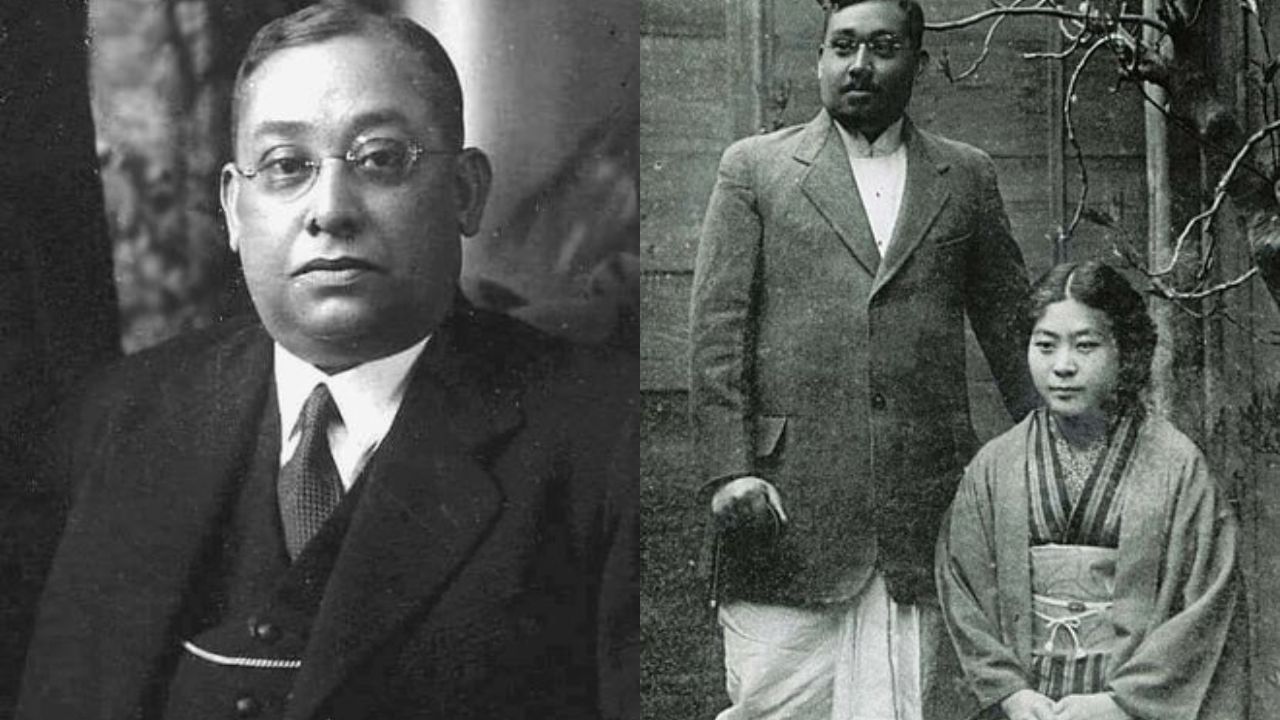
Rash Behari Bose (Img: X)
New Delhi: Ask most Indians to name a Bose from the freedom movement, and one name arrives instantly, Subhas Chandra Bose, Netaji, the legend who raised an army and vanished into thin air. Almost no one reaches for the other Bose: Rash Behari, the man who quietly built the very foundation Netaji would later stand on, and who spent the last 30 years of his life in exile, disguised, stateless, and for long stretches utterly alone.
He masterminded a bomb attack on a Viceroy. He evaded the British empire's intelligence network for years. He founded the movement that became the Indian National Army. For decades, he was barely a footnote in his own country.
Rash Behari Bose was born on 25 May 1886 in Subaldaha, a village in Bengal's Bardhaman district, to Binod Behari Bose and Bhubaneswari Devi. He wanted, more than anything, to be a soldier, however the British Indian Army turned him away. So he became a clerk instead, a small cog in the colonial machine he later almost destroyed. It was at Dupleix College in French-run Chandernagore that the ideas of the French Revolution first took root in him, and through his friendship with the revolutionary Jatin Mukherjee aka Bagha Jatin that Bose was drawn fully into the underground.
What he lacked in rank, he made up for in nerve.
On 23 December 1912, Delhi was dressed for a celebration: the capital of British India was formally shifting from Calcutta, and Viceroy Lord Hardinge was to ride through the old city in state. As his elephant procession moved through Chandni Chowk, a homemade bomb was hurled into his howdah. Hardinge survived, badly shaken and injured. The boy who threw it, 16-year-old Basant Kumar Biswas, was later caught and hanged. The man who had built the bomb and planned the attack, quietly returned to his government desk that same evening, in a piece of nerve almost unimaginable today, helped organise an official reception for the very Viceroy he had tried to kill.
It became known as the Delhi Conspiracy Case. For years, the British hunted for its architect without success and Bose by every account, was a master of disguise. He shifted identities and hideouts constantly to stay a step ahead of the CID, and pulled off what may be the boldest sleight of hand in the entire freedom movement: on one train journey, he spent the ride chatting amiably with the very police officer who had been sent to arrest him, the man never once suspecting he was sitting across from his target. With a bounty of a lakh of rupees on his head, Bose simply hid in plain sight.
His most audacious disguise, though, was the one that got him out of the country altogether. In 1915, with the net closing in, Bose fled India posing as Priyanath Thakur — a supposed relative of Rabindranath Tagore, complete with forged papers to match. He carried the alias all the way to Japan, and for three years afterward kept changing names and addresses as the British pressed Tokyo to extradite him, staying just far enough ahead of a manhunt to become, in effect, a man who no longer officially existed.
By 1915, after a planned countrywide mutiny linked to the Ghadar movement collapsed before it could begin, the net was closing. Bose fled India disguised as a relative of Rabindranath Tagore, and reached Japan, a country then allied with Britain, which meant London could, and did, ask Tokyo to hand him over.
He should have been finished was it mot for a Tokyo family that shealtered him for months.
Aizo and Kokko Soma, who ran a small, well-loved bakery called Nakamuraya in Shinjuku, took Bose in and sheltered him for months in the cramped quarters behind their shop, fully aware of what harbouring a wanted fugitive could cost them. Only close family were told he was there. It was a strange, tender arrangement: a hunted revolutionary from Bengal, hiding in the back room of a Japanese bakery, slowly becoming part of the family that risked everything to protect him. He would go on to marry the Somas' eldest daughter, Toshiko, in 1918, and take Japanese citizenship in 1923. Toshiko died of tuberculosis in 1925, leaving Bose to raise their two children alone in a country that was not his own, fighting for a country he could not return to.
It was in that same bakery kitchen that Bose, homesick for the taste of home, began cooking Indian curry for the Somas. They loved it. Nakamuraya put it on the menu. It is still there today, in the same Shinjuku spot, still one of the bakery's best-selling dishes, reportedly served some six billion times since. In Japan, Rash Behari Bose is a household name for this alone: the man who gave Tokyo its curry. Few who order it know he was also a man on the run.
That's the quieter tragedy of his story. In Japan, Bose was never idle. Young Japanese nationalists called him "Sensei." He wrote, organised, and built connections across Pan-Asian networks for nearly three decades, laying political groundwork the British could not touch. When the Second World War gave the independence movement its opening, it was Bose who founded the Indian Independence League in 1942 to unite Indians abroad behind the cause the very structure that would shelter and grow the Indian National Army.
Then, in a gesture history rarely credits him for, he stepped back. At the League's second conference that June, Bose himself proposed that Subhas Chandra Bose younger, more charismatic, freshly arrived from Europe — take over as its president. The INA that the world remembers, the one that marched under Netaji's command, was built on a framework Rash Behari Bose had spent thirty years quietly assembling.
He did not live to see independence. Tuberculosis, the same disease that had taken his wife, killed him in Tokyo on 21 January 1945, at the age of 58. Japan honoured him with the Order of the Rising Sun. India, for a long time, barely remembered him at all.
There is something quietly devastating about a man who gave up a normal life, a name, a country, and very nearly his safety — and whose most visible legacy today is a bowl of curry in a Tokyo bakery. Rash Behari Bose was never chasing recognition; everything about his three decades in hiding suggests a man who had made peace with disappearing. But eighty years after his death, as India's freedom movement is retold again and again through its most photogenic figures, his story is a reminder of how much of that struggle was carried by people history simply stopped looking for.
The bomb in Chandni Chowk. The years underground. The family that risked itself to hide him. The friendship, the marriage, the grief, the curry, the quiet handover of a movement to a younger man who would become immortal in his place. It is, by any measure, one of the most extraordinary lives to come out of India's fight for freedom — unsung not because it lacked drama, but because the man at its centre spent it, almost entirely, out of sight.

