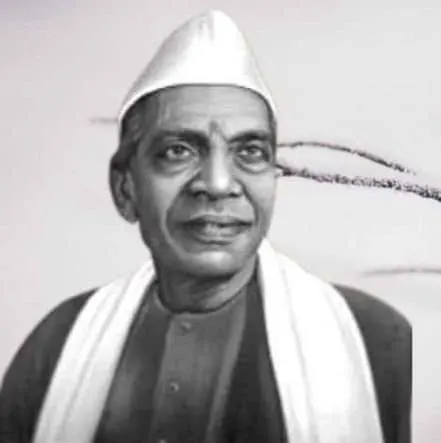
New Delhi: When the nation looks back at its journey to independence, it often turns to the revolutionaries who faced bullets, the leaders who shaped movements, and the soldiers who stood on the front lines of history. But behind the nation’s awakening was another powerful force: the world of ideas, emotions and words.
As India prepares to celebrate its 80th Independence Day, the nation remembers Rashtrakavi Maithili Sharan Gupt on his 140th birth anniversary - the poet whose pen became a silent weapon against British colonial rule. Through verses that touched the hearts of ordinary Indians, Gupt transformed simple Hindi into a powerful voice of resistance, awakening national pride and giving millions the courage to dream of a free India. His poetry did not fire bullets, but it ignited something equally powerful — the spirit of a nation determined to break its chains.
Empires are usually challenged by armies, revolutions and political uprisings. But history has witnessed another kind of rebellion too — one fought through ideas, emotions and words. At a time when British rule restricted political expression and controlled voices of dissent, Maithili Sharan Gupt used poetry as a force of national awakening. His verses reminded Indians of their forgotten strength, cultural identity and responsibility towards the nation.
For millions who had no access to political platforms, his poems became a source of hope and courage. His words travelled beyond books, reaching classrooms, public gatherings and nationalist circles where they helped create a collective desire for freedom.
Maithili Sharan Gupt was born on August 3, 1886, in Chirgaon near Jhansi in present-day Uttar Pradesh. Born into the family of Seth Ramcharan Gupta, young Maithili developed a deep interest in literature despite finding traditional classroom education restrictive. The rigid British-style education system did not match his creative temperament, but his curiosity for knowledge continued to grow.
Through private tutors, he studied Sanskrit, Bengali and English, gaining exposure to India’s ancient traditions as well as modern literary influences. This unconventional journey of learning eventually shaped one of the greatest voices of modern Hindi poetry — a writer whose words would later become closely associated with India’s freedom movement.
Every great literary movement begins with a turning point. For Maithili Sharan Gupt, that moment came through Mahavir Prasad Dwivedi, the influential editor of the Hindi literary magazine Saraswati. Dwivedi recognised Gupt’s talent and encouraged him to write in Khari Boli Hindi instead of the traditional Braj Bhasha style that dominated Hindi literature at the time.
This was not just a language change. It was a revolution in accessibility. Khari Boli was the language spoken by ordinary people. By adopting it, Gupt brought poetry out of elite literary circles and placed it among farmers, students and common households. His writing made nationalism easier to understand, helping patriotic ideas spread across Hindi-speaking regions during the freedom struggle.
The biggest milestone of Gupt’s literary journey came with the publication of Bharat-Bharati in 1912. At a time when India was living under colonial domination, the book presented a powerful reflection on the country’s glorious past, present struggles and hopes for the future.
For a generation facing foreign rule and social challenges, Bharat-Bharati was more than a collection of poems. It was a reminder that India had a rich history, a strong identity and the ability to shape its own destiny. The book inspired freedom fighters, students and ordinary citizens by encouraging self-respect, unity and national responsibility. The influence of Gupt’s patriotic writings was immense, and he was popularly honoured with the title Rashtrakavi, meaning National Poet.
During the freedom struggle, the British administration closely monitored literature because ideas had the power to unite people. Gupt’s poetry did not promote violence. Instead, it challenged fear and created awareness - a force that could inspire people to question injustice and believe in change.
His verses encouraged Indians to respect their heritage, fight social inequality and develop confidence in their own identity. His greatest strength was his connection with ordinary citizens. He wrote in a language that people could understand, remember and share, allowing his message to travel far beyond literary circles.
Maithili Sharan Gupt was not only a poet of nationalism; he was also a voice for social transformation. His writings explored themes such as women’s dignity, education, equality, sacrifice and moral values. He believed that political independence could not be complete without social progress. Through his iconic works Saket and Yashodhara, Gupt highlighted characters whose emotions and sacrifices had often remained overlooked.
In Saket (1931), he presented the Ramayana from the perspective of Urmila, Lakshmana’s wife, focusing on her silent sacrifice during his 14 years of exile. It changed traditional storytelling by highlighting Urmila’s perspective and her forgotten sacrifice. In Yashodhara (1932), he explored the emotional journey of Gautama Buddha’s wife, bringing attention to the human struggles behind one of history’s most significant spiritual transformations. The book explored human emotions, relationships and the unseen struggles connected with historical figures.
While Bharat-Bharati (1912) became a symbol of national consciousness and patriotic awakening during British rule, Rang Mein Bhang marked Gupt’s early literary journey and established him as an emerging voice in Hindi poetry. Through these works, Gupt gave importance to voices and experiences that had long remained in the background.
After India achieved independence in 1947, Maithili Sharan Gupt continued contributing to Indian culture and public life. He was nominated to the Rajya Sabha, where he remained connected with discussions related to literature, society and national development. Recognising his extraordinary contribution to Indian literature, the Government of India honoured him with the Padma Bhushan in 1954. Gupt passed away on December 12, 1964, in Chirgaon, but his literary influence continues to inspire generations of readers.
India’s independence story is not only a story of battles fought, sacrifices made and political movements launched. It is also a story of ideas that shaped minds and inspired generations. Maithili Sharan Gupt proved that words could become a force of change. His poetry gave courage to people who were fighting for dignity, identity and freedom.
As India celebrates its 80th Independence Day, the legacy of Rashtrakavi Maithili Sharan Gupt reminds the nation that freedom was achieved not only by those who stood on battlefields, but also by those who gave people the courage to imagine a free India. The British Empire eventually left India, but the power of Maithili Sharan Gupt’s words continues to live on — proving that a fearless idea written with courage can outlast even the strongest empire.

