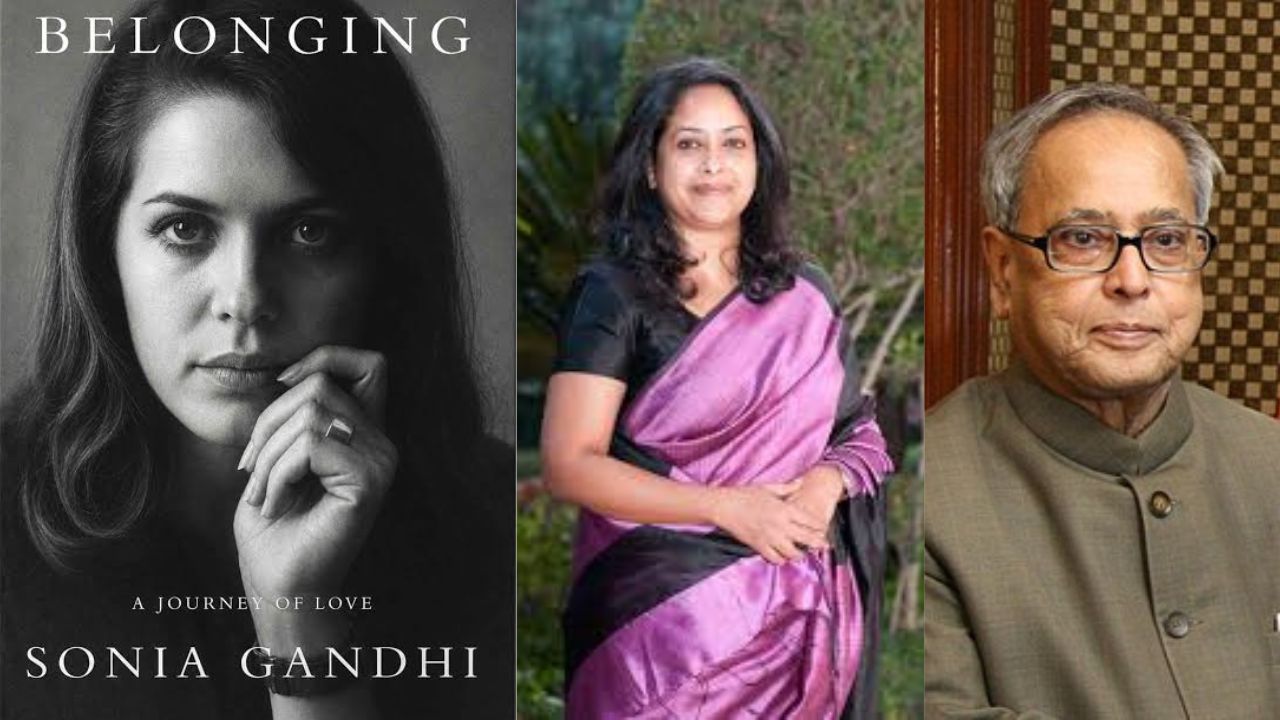
Sonia Gandhi's memoir revelation about Pranab Mukherjee's Prime Ministerial ambitions sparks a political debate, prompting a strong response from his daughter Sharmistha. (Img: X)
New Delhi: A fresh political debate has emerged around the Congress leadership's internal dynamics after former Congress president Sonia Gandhi's memoir revisited an intriguing episode involving veteran politician Pranab Mukherjee and his reported ambition to become Prime Minister.
Mukherjee's daughter, Sharmistha Mukherjee, has strongly defended her late father's political aspirations, questioning why Sonia Gandhi was surprised by the possibility that one of the Congress's most experienced leaders could harbour ambitions for the country's highest executive office.
The controversy has gained attention following the worldwide release of Sonia Gandhi's memoir, Belonging: A Journey of Love, on Tuesday, November 10. In the book, she recounts a conversation with Pranab Mukherjee in 2010, during which he allegedly suggested that it might be time for a change at the top. Sonia interpreted the remark as an indication of his long-standing desire to become Prime Minister.
Responding to the revelation, Sharmistha questioned whether political ambition should be viewed as unusual, particularly when it comes from a leader with decades of experience in governance, administration and public life.
Reacting to Sonia Gandhi's account in a social media post, Sharmistha Mukherjee challenged the suggestion that her father's Prime Ministerial aspirations were a matter of surprise. She argued that Pranab Mukherjee's ambition was backed by an extensive political career, administrative experience, intellectual ability and years of hard work.
Recalling a personal conversation with her father, Sharmistha said she had once asked him whether he wanted to become Prime Minister. According to her, he candidly responded that any politician worth his salt naturally aspired to occupy the country's highest political office. She further emphasised that her father had risen from a humble background and built his political stature through merit, perseverance and professional competence rather than inherited political privilege.
Sharmistha also questioned whether Sonia Gandhi's surprise stemmed from the possibility that someone outside the Gandhi-Nehru family could aspire to become Prime Minister and express that ambition directly.
In her memoir, Sonia Gandhi revisits an interaction with Pranab Mukherjee in 2010, when the Congress-led United Progressive Alliance (UPA) was in its second term in office and Manmohan Singh was serving as Prime Minister.
According to her account, Mukherjee had developed serious differences with then Finance Minister P Chidambaram. During one conversation, after expressing his frustration, he suggested that perhaps the time had come for a change at the top. Sonia interpreted the suggestion as an indirect expression of Mukherjee's long-held aspiration to become Prime Minister.
She recalled being taken aback by the suggestion and said she gently shifted the conversation to another subject. However, she also indicated that Mukherjee never made her feel that he resented her response or held the interaction against her. The episode has now attracted renewed attention because it offers a glimpse into the political relationships, leadership calculations and internal conversations that shaped the Congress during the UPA years.
Pranab Mukherjee was among the Congress's most influential and experienced political figures, having held several important constitutional and ministerial responsibilities during his career. He served as Finance Minister, Defence Minister and External Affairs Minister before being elected the 13th President of India in 2012. His decades-long association with the Congress leadership made him a central figure in the party's organisational and governmental decision-making.
His aspiration to become Prime Minister had also found mention in his own writings. In his book The Coalition Years, Mukherjee recalled that he had hoped to become Prime Minister in 2004 after Sonia Gandhi declined the opportunity to assume the office following the UPA's electoral victory. However, Manmohan Singh was ultimately selected to lead the government.
The decision marked a defining moment in the Congress's post-election leadership arrangement, with Sonia Gandhi retaining a central position in the party while Manmohan Singh headed the government.
An important aspect of Sharmistha's response concerned the personal relationship between her father and Sonia Gandhi. While questioning the former Congress president's reaction to Mukherjee's Prime Ministerial aspirations, Sharmistha also clarified that her father had not harboured resentment towards her over the 2010 conversation.
Referring to her father's diaries and her personal conversations with him, she described him as a pragmatic individual with a deep understanding of political realities and human behaviour. She maintained that Mukherjee understood Sonia Gandhi's reasons and recognised that political leaders, like other individuals, could have their own insecurities and apprehensions.
Her clarification adds another dimension to the controversy, distinguishing the political disagreement over ambition and leadership from any suggestion of a lasting personal confrontation between the two senior Congress figures.
The exchange has revived interest in the complex relationship between the Congress's organisational leadership and its senior political figures during the UPA era. Pranab Mukherjee represented a generation of Congress leaders whose political influence was built through decades of parliamentary experience, ministerial responsibilities and organisational work. His Prime Ministerial ambitions, therefore, touch upon larger questions concerning leadership selection, political merit and the distribution of power within the party.
Sonia Gandhi's account also offers an insight into the informal conversations and internal equations that influenced the UPA government's leadership structure. The reference to Manmohan Singh, P Chidambaram and Pranab Mukherjee brings renewed attention to the competing responsibilities and political relationships within the Congress during a crucial period of coalition governance. For Sharmistha, the central issue is the legitimacy of her father's ambition and the professional achievements that supported it.

