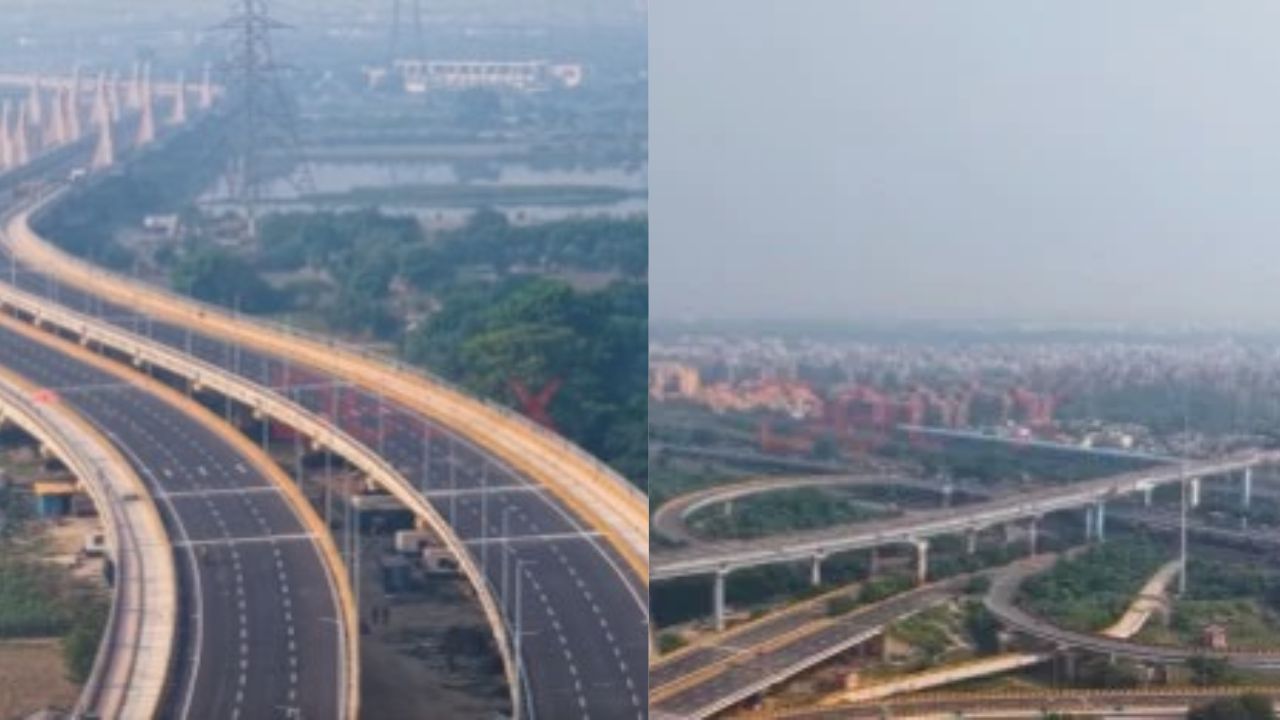
Delhi’s newly opened Barapullah Phase-III corridor faces congestion near the Sundial merger. (Img: X)
New Delhi: Delhi’s newly opened Barapullah Phase-III elevated corridor, conceived to provide a faster link between East and South Delhi, has run into an immediate traffic-management crisis, with officials identifying a sharp merger and an apparent mismatch between the corridor’s present-day traffic load and the road network for which it was originally planned.
The nearly 10.9-km elevated corridor connects Mayur Vihar Phase-I with the existing Barapullah corridor through Sarai Kale Khan towards South Delhi and the AIIMS area. The project was expected to reduce journey times between East and South Delhi by around 15 to 20 minutes. However, within days of opening, stretches around Sarai Kale Khan, Sundial and adjoining arterial roads witnessed substantial congestion.
A joint inspection by the Delhi Traffic Police and the Public Works Department (PWD), including an aerial drone survey, identified the merger near the Sundial as a critical bottleneck. According to officials, the geometry at the junction is relatively sharp and rectangular, forcing several streams of vehicles to merge abruptly into the existing Barapullah corridor.
The problem is compounded by a disparity in lane capacity. The newly opened corridor is drawing traffic that would otherwise travel through NH-24 and the DND Flyway, while the older Barapullah stretch has comparatively lower capacity. The result is a concentration of vehicles at the point where the two systems converge.
The episode has also raised questions about the relevance of the traffic assumptions underlying the project. The corridor was originally scheduled for completion in 2017 but encountered repeated delays before finally being opened in 2026. Reporting by the Hindustan Times, citing a PWD official, said planning studies for the project were more than two decades old, raising concerns about whether the traffic projections adequately reflected the Capital’s substantially changed mobility patterns.
The traffic problem became particularly visible during peak hours, with queues extending onto surrounding roads. Traffic authorities were compelled to temporarily regulate or close certain approaches and divert vehicles to prevent further accumulation. The congestion also spilled over into adjoining routes, affecting traffic movement beyond the immediate flyover.
Officials are now examining remedial measures rather than treating the congestion merely as a temporary consequence of the corridor’s opening. Among the proposals is a redesign of the merger near Sundial, with a smoother curvature intended to allow vehicles to join the existing corridor more gradually. Traffic-control measures and signals at suitable points are also being considered to regulate the inflow of vehicles.
Authorities are additionally considering changes to navigation information so that digital mapping platforms can provide commuters with more accurate traffic guidance. Regulation or diversion of traffic towards NH-24 may also be explored where feasible, with the objective of reducing pressure on the existing Barapullah stretch.
The difficulties encountered by the corridor underline a broader challenge in urban infrastructure: a road designed around one set of traffic projections may face very different demands by the time it becomes operational. In the case of Barapullah Phase-III, the prolonged construction period, changing traffic volumes and the abrupt transition between different road capacities have combined to expose a critical weakness at the point where the new and old corridors meet.

