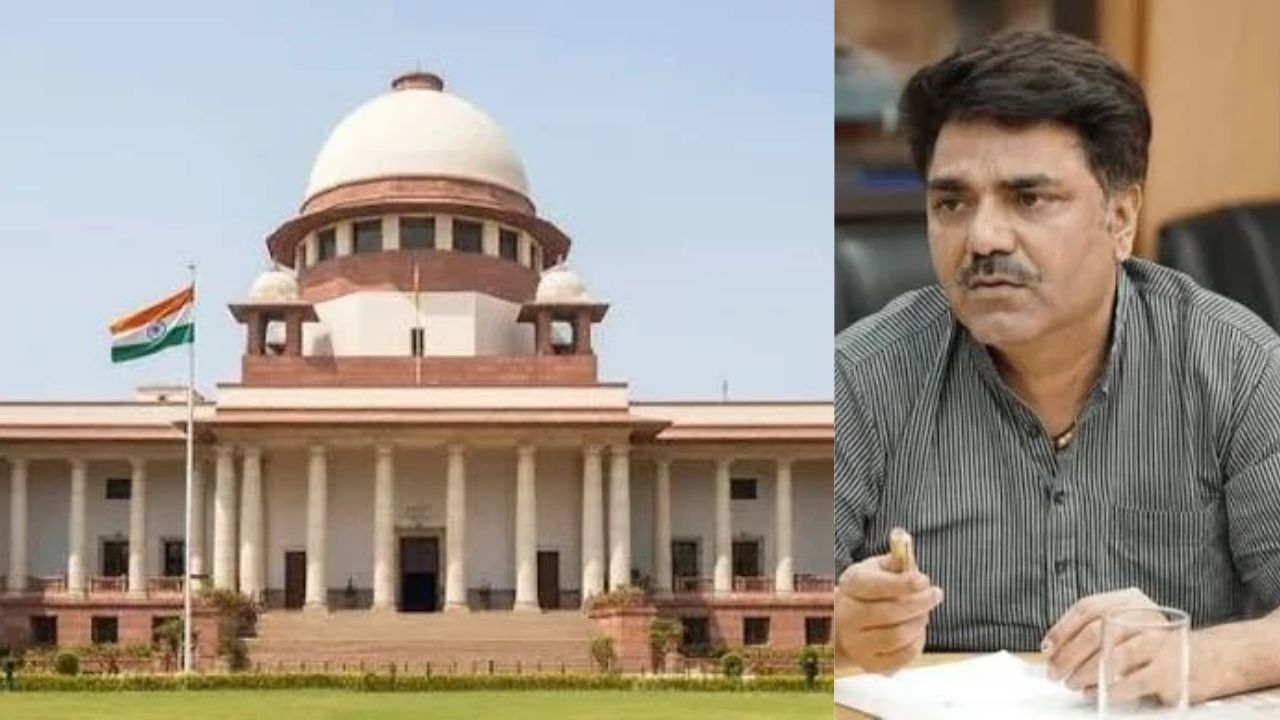
Supreme Court grants bail to former AAP MLA Naresh Balyan in the MCOCA case involving alleged links to gangster Kapil Sangwan. (Img: X)
New Delhi: The Supreme Court on Friday granted bail to former Aam Aadmi Party (AAP) MLA Naresh Balyan, arrested under the Maharashtra Control of Organised Crime Act (MCOCA), over his alleged links to an organised crime syndicate allegedly headed by absconding gangster Kapil Sangwan, also known as Nandu.
The Bench of Justice Vikram Nath and Justice Aparesh Singh granted relief to the former Uttam Nagar legislator after hearing submissions from both sides. The Apex Court, however, directed Balyan to cooperate fully with the ongoing trial and made it clear that any failure to comply with the conditions imposed by the court could result in the cancellation of his bail.
During the proceedings, the Supreme Court also questioned the Delhi Police's approach towards an elected public representative, raising concerns about the prosecution's decision to pursue the case against Balyan.
The bail hearing witnessed pointed judicial scrutiny of the prosecution's case, particularly concerning the allegations against Balyan and the evidence relied upon by the investigating agency.
Senior Advocate Vikas Singh, representing the AAP leader, argued that two crucial witnesses had subsequently retracted their earlier statements, raising questions about the evidentiary foundation of the prosecution's allegations.
The defence further submitted that Balyan had himself approached the authorities with a complaint against gangster Kapil Sangwan and had previously been provided police protection following threats allegedly emanating from the same individual.
Singh also contended that Balyan was not initially named as an accused in the case and questioned the admissibility and reliability of the material subsequently relied upon by the prosecution to establish his alleged connection with the organised crime syndicate.
During the hearing, Justice Vikram Nath questioned the prosecution over the decision to pursue an elected representative, bringing the issue of the investigation's basis and the allegations against Balyan into focus.
Appearing for the Delhi Police and the State, Additional Solicitor General Raja Thakare opposed the defence submissions and maintained that the matter involved serious organised criminal activities, including extortion, intimidation and unlawful property acquisition.
The State argued that MCOCA does not require multiple criminal cases to be registered against every individual accused. Instead, the statutory framework focuses on the activities of the organised crime syndicate and its continuing unlawful operations. The prosecution referred to 19 cases allegedly associated with the syndicate to substantiate its claim of organised criminal activity.
The case stems from an FIR registered by the Delhi Police Crime Branch on August 28, 2024, under Sections 3 and 4 of the Maharashtra Control of Organised Crime Act. Balyan was arrested on December 4, 2024, in connection with the investigation into the alleged criminal network operated by Kapil Sangwan.
According to the prosecution, the former AAP legislator allegedly functioned as a facilitator for the syndicate, which was purportedly involved in extortion, criminal intimidation, threats, shootings and the illegal acquisition of properties.
Investigators have alleged that members of the network targeted businessmen, property dealers and other individuals, using threats and coercion to extract money. The syndicate was also allegedly involved in forcing property owners to sell land and other assets at substantially undervalued prices.
The prosecution has relied on multiple FIRs and other investigative material to establish the alleged existence of a continuing organised criminal enterprise and Balyan's purported association with it. However, Balyan has consistently denied the allegations and challenged the legal basis for invoking MCOCA against him.
Before approaching the Supreme Court, Balyan had challenged the denial of bail before the Delhi High Court, which dismissed his plea on August 3, 2026. The High Court had observed that the available material at the bail stage prima facie indicated a connection between Balyan and the organised crime syndicate allegedly headed by Sangwan.
The prosecution had referred to approximately 17 FIRs registered in connection with the syndicate's alleged activities. The Supreme Court hearing, meanwhile, saw the State refer to 19 cases associated with the network.
In its assessment, the High Court held that the statutory requirements under MCOCA concerning continuing unlawful activity and the existence of an organised crime syndicate did not necessarily have to be established through multiple qualifying cases against each accused individually.
Balyan had argued that the invocation of MCOCA was legally unsustainable because the investigating agency had failed to identify any fresh continuing unlawful activity attributable to him. His defence also questioned the reliance on previous FIRs and chargesheets without establishing a fresh offence or producing sufficient material demonstrating his membership of the alleged criminal syndicate.
The High Court rejected these arguments, holding that the relevant statutory requirement was syndicate-centric rather than dependent exclusively on the individual criminal antecedents of every accused.
It also rejected the contention that registering a separate FIR under MCOCA amounted to double jeopardy, observing that the investigating agency could either incorporate the relevant provisions into an existing FIR or register a separate case after obtaining the necessary statutory approval.
The MCOCA proceedings against Balyan must also be distinguished from a separate extortion case involving allegations of links with Kapil Sangwan. On December 4, 2024, the same day Balyan was arrested in the MCOCA investigation, a trial court had granted him bail in the separate extortion matter. Subsequently, the trial court discharged him in that case after finding that the prosecution had failed to establish the foundational material required to frame charges.
Additional Chief Judicial Magistrate Paras Dalal observed that the prosecution had not produced sufficient prima facie evidence to establish an alleged prior meeting of minds between Balyan and Sangwan. The discharge in the separate extortion case was a distinct judicial development and did not automatically terminate the MCOCA proceedings, which continued independently.
Balyan subsequently challenged the denial of bail in the MCOCA matter, maintaining that the allegations were unsupported by credible evidence and that the proceedings were politically motivated. The Delhi Police opposed his release, arguing that the investigation remained at a crucial stage and that his release could potentially affect the probe.

