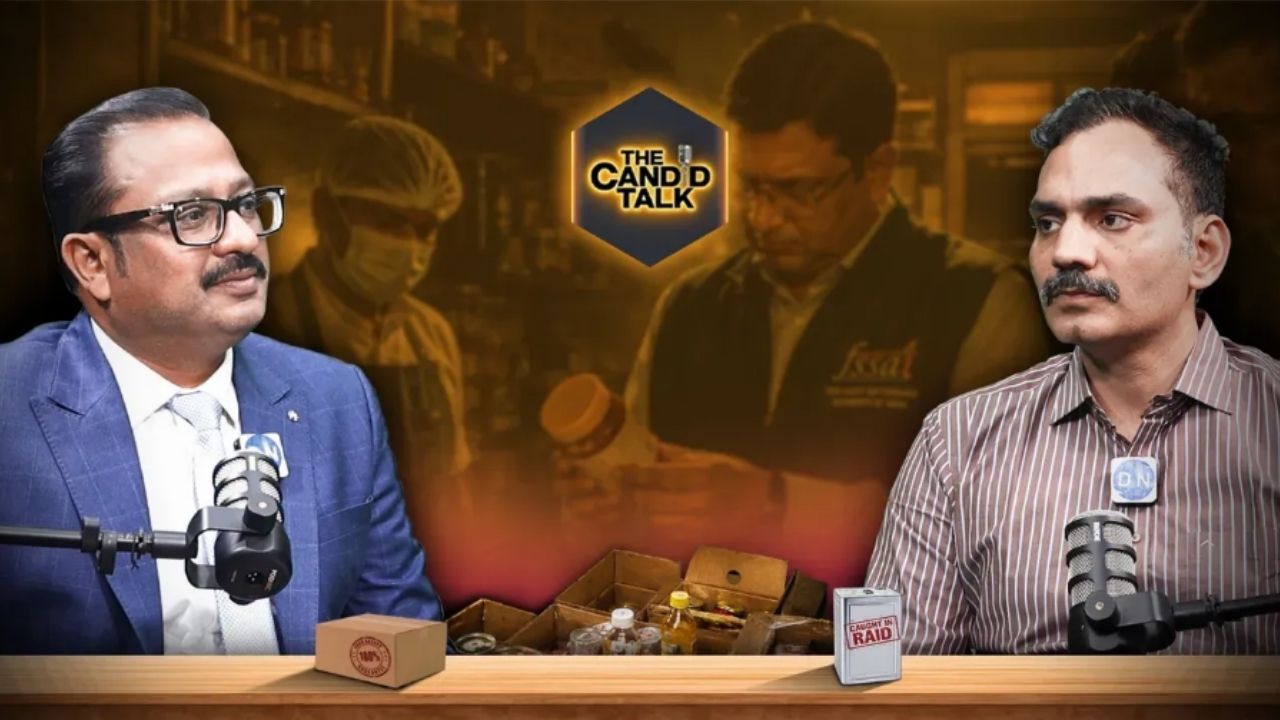
AGMUT Cadre IPS Officer Devesh Kumar Mahla
New Delhi: In this episode of 'The Candid Talk', Dynamite News Editor-in-Chief Manoj Tibrewal Aakash held an exclusive conversation with IPS officer Devesh Kumar Mahla, a 2012-batch officer from the AGMUT cadre. During the discussion, Devesh Kumar Mahla provided direct and forthright answers to probing questions about the realities of policing, security challenges, cybercrime, and administrative pressure in the national capital.
The Real Story Of The System, Stress, and Security
In this special episode of The Candid Talk, the conversation at the Dynamite News studio moved far beyond routine formalities. It raised several questions that typically remain behind the scenes. During the discussion, Devesh Kumar Mahla openly shared his views on the genuine challenges of policing, the pressures associated with VIP security, the changing landscape of cybercrime, and the weight of administrative responsibilities. He remarked that working in a city like Delhi is not merely about policing; it is "a test every single moment"—a place where even a minor lapse can instantly become a national headline.
Message For UPSC Aspirants
Responding to questions about the civil services aspirants, the IPS officer stated clearly that while the UPSC examination is certainly not easy, it is by no means impossible. He emphasized that there are no shortcuts to success. He advised young aspirants: "Whenever you study, do so with your whole heart and mind, so that when you finally sit for the examination, nothing feels unfamiliar or new to you." Regarding the interview stage, he offered a crucial piece of advice: "Speak with confidence about what you know, and honestly admit what you do not know."
Pressure Outweighs Power
Sharing his experiences from his tenure as the DCP of the New Delhi district, Devesh Kumar remarked that the environment there is characterized more by "expectations and pressure" than by power. He explained that Lutyens' Delhi is home to the country's top leaders, embassies, and high-profile institutions; consequently, even a minor incident can quickly escalate into major news. Therefore, every step taken in the realm of policing in this area must be executed with the utmost deliberation.

Cybercrime: A Borderless Threat
Speaking on the subject of cybercrime in the current era, he described it as a "borderless crime." He noted that criminals are now orchestrating offenses from beyond national borders. He stated that crimes such as intimidation, fraud, extortion, and banking scams have become entirely digital, thereby posing a new challenge for the police force. However, identifying AI as a powerful tool, he remarked that if utilized correctly, it could significantly streamline the investigative process.
Protests and Crowd Control
Devesh Kumar Mahla observed that spontaneous, small-scale protests have emerged as a major challenge for the police in recent times. Without any prior notice, groups of 10 to 15 individuals may gather at any location to stage a protest, disrupting traffic, security, and public order. He noted that in such situations, making immediate decisions and controlling the crowd constitutes the most arduous task.
26 January: The Ultimate Responsibility
The most significant discussion during the podcast revolved around the January 26th Parade. He revealed that in 2024, he had assumed his new responsibilities just 10 days prior to the event; consequently, his initial and greatest challenge lay in familiarizing himself with the area and mapping out the routes.
He stated, "Understanding which roads the public uses for access, where security checks are conducted, and how the movement flows—grasping all of this was absolutely essential." He leveraged the lessons learned from the 2024 experience to prepare for the 2025 event, implementing improvements at the ground level to ensure an even more successful and well-executed occasion.
He recounted that the event was executed so flawlessly that it was hailed as the "best-ever" arrangement for a January 26th Parade. In recognition of this achievement, the Defense Secretary issued a special gazette notification to award a commendation disc and a letter of appreciation to both him and his entire team.
Two aspects stood out as particularly critical in this endeavor: firstly—and undoubtedly—VIP security and the screening of the general public; and secondly—a key observation he had made in 2024—the systematic channeling of movement for the massive crowds, vehicular traffic, and other vehicles. If you provide it with proper direction and facilitate a smooth flow, 80% of your problems are resolved.
Is Delhi more unsafe compared to other cities?
Responding to this question, the IPS officer stated that if you wish to assess the safety and law-and-order situation of any location, you should observe the disparity in land prices between that specific place and its neighboring areas. If you examine the difference in land prices between Delhi and its adjacent regions, you will realize just how safe and secure Delhi truly is.
Secondly, if you call 112 in Delhi, the police will undoubtedly arrive and take appropriate action based on the merits of the case. It is rare to find this level of responsiveness anywhere other than Delhi: if your child—specifically a minor—has not returned home after an hour or two, and you approach the police, they will immediately register an FIR.
They do not delay or dismiss the matter with the assumption that you should simply "wait until evening" because your child will eventually return. This level of promptness is maintained through a centrally controlled fleet of over 600 police vehicles that are on patrol at all times.
Mahla further explained that crimes in Delhi tend to be highly publicized. As the national capital, the city attracts a significant amount of media attention. Due to this intense focus, any crime that occurs here gets highlighted, which, in turn, shapes public perception.
Approximately 40%—or even more—of the police personnel in Delhi suffer from ailments such as high blood pressure, diabetes, or hypertension. The sole reason for this is that their duty hours are so excessively long that they are unable to go home or consume proper home-cooked meals. Instead, they are forced to rely on street food or canteen meals, and they are unable to get adequate sleep.
Primary Function Of Policing
The primary function of policing involves maintaining law and order, managing crime, building rapport with the public, and engaging in community interactions. In the current scenario, the Delhi Police devotes 60% of its time exclusively to maintaining law and order and managing crime.
Furthermore, a significant portion of the remaining time—the additional 40%—is consumed by duties that fall outside the scope of traditional policing. Delhi is a place where situations frequently demand rapid, immediate action to achieve a resolution.
Consider the present reality: if an accident occurs in Delhi—whether it is a fatal crash or an incident resulting in injury—and a distress call is received, the officer assigned to that call cannot return home until the entire matter has been fully resolved. Now, completing this task might take 24 hours—or perhaps even 48 hours.
However, the officer coming on duty subsequently must proceed with the understanding that the officer to whom the call was originally assigned will see it through to the very end—completing the task before going home to eat, perhaps resting briefly, and then returning to duty, as they have another shift scheduled. If they fail to report back for that subsequent shift, their attendance will not be recorded.
Drug Addiction Among Youth
Habits of substance abuse typically take root while a child is still in school or college; subsequently—once they have left the educational institution—they may struggle to find the right direction in life. If the immense energy inherent in a young person is not channeled in the proper direction, they will inevitably drift toward activities and environments that are detrimental to their well-being. They require proper guidance and direction to effectively channelize their energy. In this regard, society, parents, schools—indeed, everyone—undoubtedly plays a crucial role.
Remarks On The Nirbhaya Case
Speaking on the Nirbhaya case, IPS officer Devesh Kumar Mahla stated: "I was undergoing training at the time; however, I subsequently read extensively about the incident and the police personnel involved.
Such events offer a unique perspective on society—revealing what issues trigger public outrage and how society subsequently responds and moves forward. Following the incident, the government enacted significantly stricter laws. Furthermore, the 'Nirbhaya Fund' was established; under this initiative, if an individual falls victim to such a crime, they are provided with financial compensation."

