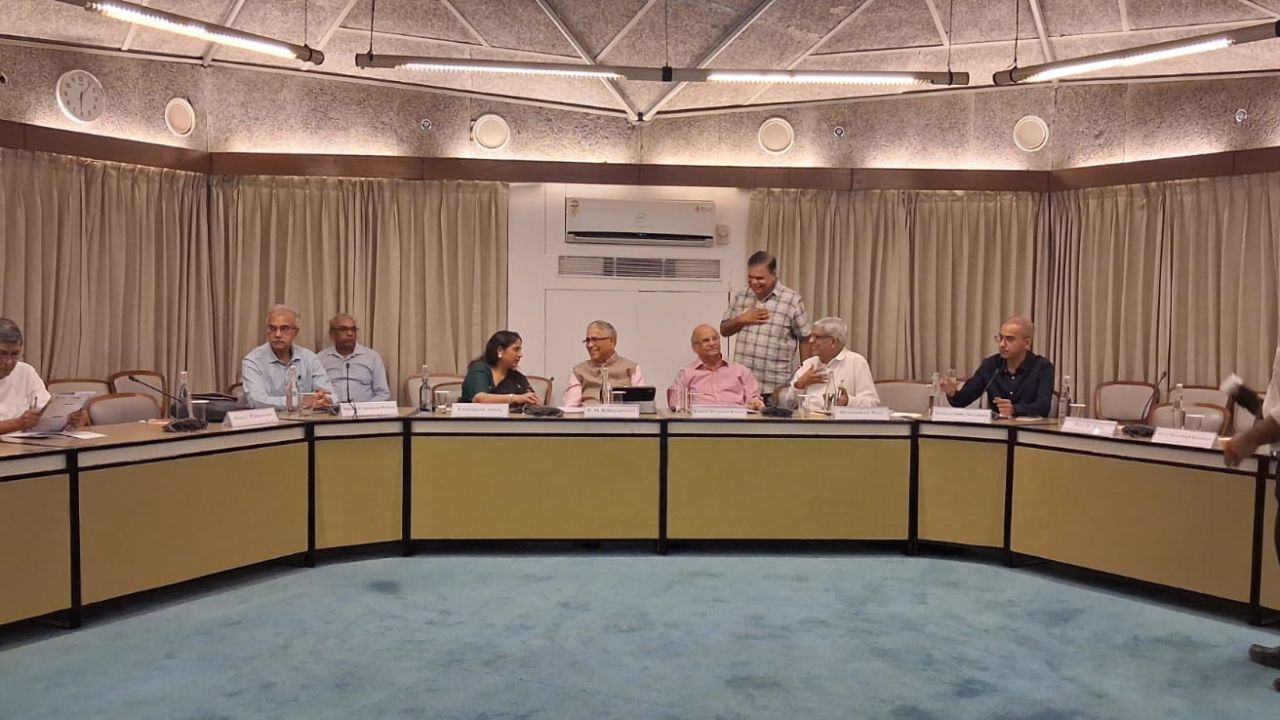
The event brought together researchers, academicians and students. (Photo: Dynamite News)
New Delhi: Scientists and science educators gathered at the India International Centre (IIC) in New Delhi on Tuesday to celebrate UNESCO's International Day of Light (IDL) 2026, where experts explained the science behind everyday natural phenomena, from blue skies and rainbows to sunlight and photonics.
The workshop, titled "Fascinating Light and Colour Phenomena in Nature," was organised by the Zaheer Science Foundation in collaboration with the India International Centre, with support from Shanti Foundation and vsworld.com.
Dr. M.D. Rais, former Chief Scientist of CSIR-NIScPR and Organising Secretary of UNESCO International Day of Light (IDOL) 2026 Workshop, delivered the opening remarks, providing an overview and background of the workshop. He warmly welcomed K. N. Shrivastava, Director of India International Centre (IIC), and also introduced the newly appointed Chairperson of Zaheer Science Foundation (ZSF), Hasan Jawaid Khan, along with Dr. Nakul Parashar, CEO of Shanti Foundation International.
Dr. Rais also extended his heartfelt appreciation and vote of thanks to all the team members of ZSF, Shanti Foundation International, IIC and the technical session experts for their valuable contributions and support in making the workshop a success. He specially expressed gratitude to Prof. John M. Dudley for delivering the keynote address and sharing his valuable insights during the session.
The event brought together researchers, academicians and students to promote scientific curiosity and highlight the importance of light in nature, research and modern technology.
Delivering the keynote address through a recorded video message, internationally acclaimed photonics expert Prof. John M. Dudley, Professor at Université Marie et Louis Pasteur, France, and Chair of the International Day of Light 2026 Steering Committee, stressed the transformative role of light in both nature and technological innovation.
"Light is central to both life and society," Dudley said, explaining that sunlight makes life on Earth possible through photosynthesis while photonics has become the backbone of several modern technologies.
New Delhi: Zaheer Science Foundation organised a workshop titled "Fascinating Light and Colour Phenomena in Nature" at the India International Centre as part of the UNESCO International Day of Light 2026 celebrations. The workshop was addressed by Dr. Tabassum Jamal, Chair of… pic.twitter.com/UDblwwl2HG
— Dynamite News (@DynamiteNews_) August 4, 2026
He noted that fibre-optic communication, medical imaging, lasers and advanced manufacturing all rely on photonics, making it one of the most significant enabling technologies driving scientific research and industrial innovation worldwide.
Speaking during the technical session, Prof. Zahid Husain Khan, National Node for IDL 2026 in India, described the Sun as Earth's primary source of light and energy.
He explained that sunlight regulates Earth's climate, drives photosynthesis and supports every form of life on the planet.
"The Sun, our nearest star, is the primary source of light on Earth. Its energy is produced through nuclear fusion, making it the driving force behind life and natural processes on our planet," he said.
Prof. Khan added that many of nature's spectacular visual displays originate from the interaction of sunlight with Earth's atmosphere and natural elements.
Breaking down familiar natural phenomena, Prof. Khan explained that sunlight appears white but actually contains all the colours of the visible spectrum.
"When white light passes through a prism, each colour bends differently because of its wavelength, producing the familiar rainbow. This process, known as dispersion, helps explain many fascinating light and colour phenomena in nature," he said.
He also discussed the "Mystery of the Three Blues," illustrating how different physical processes create varying shades of blue observed in nature.
New Delhi: Zaheer Science Foundation is organising a workshop titled “Fascinating Light and Colour Phenomena in Nature” at the India International Centre, New Delhi, as part of the UNESCO International Day of Light 2026 celebrations.#ZaheerScienceFoundation #Unesco… pic.twitter.com/3AS1ZGW8kK
— Dynamite News (@DynamiteNews_) August 4, 2026
Dr. Nakul Parashar of Shanti Foundation International spoke on the relationship between light and Earth's atmosphere, explaining how the colours of the sky, the Sun and celestial bodies are produced.
He said that blue skies, red sunsets and rainbows occur because sunlight interacts with particles and molecules in the atmosphere.
According to Dr. Parashar, these optical phenomena are governed by the fundamental principles of physics and provide valuable insights into atmospheric science as well as astronomy.
The programme began with an inaugural session addressed by Dr. Tabassum Jamal, Chair of the IDL Workshop, K.N. Shrivastava, Director of the India International Centre, and Prof. Zahid Husain Khan.
Other speakers included Prof. N. Raghuram of Guru Gobind Singh Indraprastha University, who discussed the role of light and colours in plants and marine life, and Dr. Nita Dilawar Sharma from the National Physical Laboratory, who explained several optical phenomena observed in everyday life.
The workshop concluded with discussions on photonics, atmospheric optics and biological colours, reinforcing UNESCO's objective of promoting scientific awareness and encouraging greater public engagement with the science of light.

