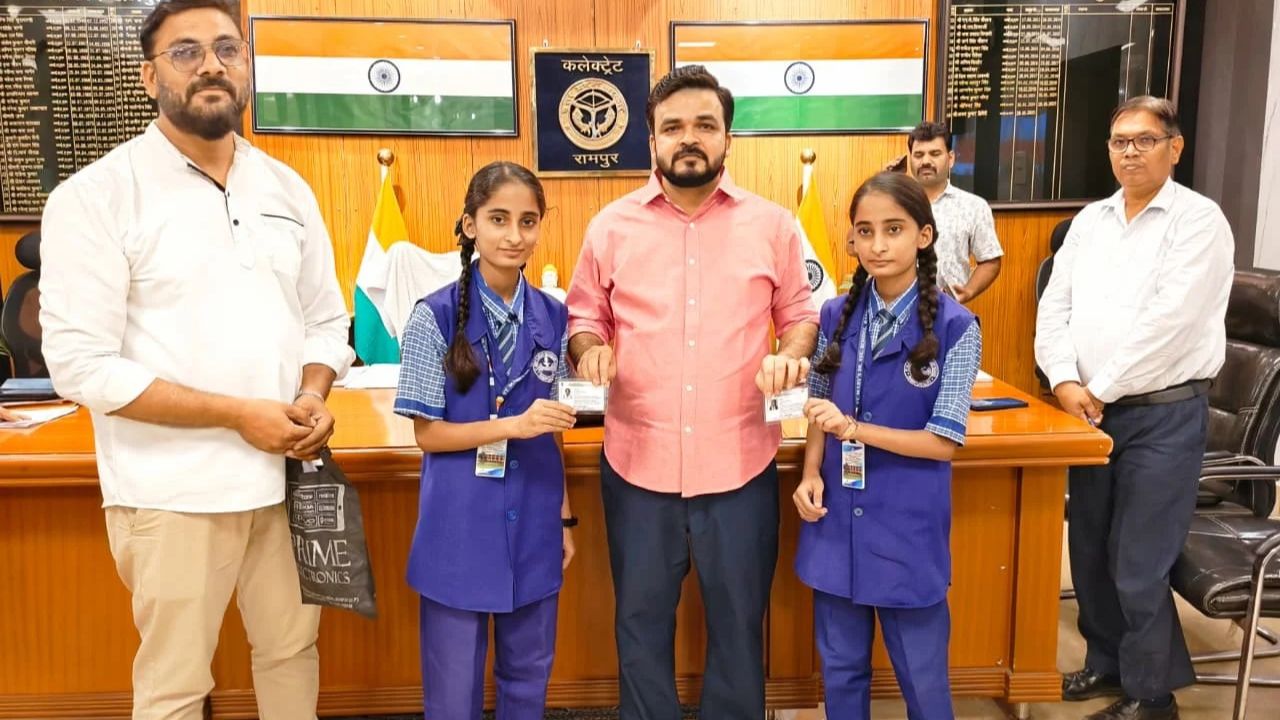
Twin sisters Tuba and Khizra finally receive separate Aadhaar identities after years of struggle. (Img: X)
Lucknow: A rare identity crisis that kept a family worried for years has finally come to an end in Uttar Pradesh’s Rampur, where twin sisters with identical biometric patterns have received separate Aadhaar identities after a special administrative intervention.
The sisters, Tuba Zubair and Khizra Zubair, faced an unusual technical hurdle during Aadhaar registration as their fingerprints and iris patterns showed extreme biometric similarity. After one sister’s Aadhaar was generated, the second sister’s registration repeatedly failed, with the system flagging her details as a possible duplicate.
The unusual case highlighted the challenges faced by citizens when advanced biometric identification systems encounter exceptional situations. For the family, the issue was not just a technical error but a question of securing basic identity documents needed for education, government services and future opportunities.
The family of Zubair Ilyas, a resident of Khari Kuan locality in Rampur, had been struggling for years to get a separate Aadhaar card for their second daughter.
Despite repeated attempts, the biometric authentication process could not differentiate between the twin sisters due to their matching fingerprints and iris scans. As Aadhaar has become a key document for school admissions, welfare schemes, banking services and various government facilities, the absence of an identity document created uncertainty for the child’s future.
Seeking a solution, Zubair Ilyas approached the Rampur district administration during the public grievance hearing, known as Janata Darshan.
After hearing the family’s concern, Rampur District Magistrate Ajay Kumar Dwivedi took immediate cognisance of the matter and initiated efforts to find a technical solution.
The district administration contacted the Unique Identification Authority of India (UIDAI) headquarters in New Delhi and explained the unusual biometric similarity issue. After discussions and technical examination, UIDAI processed the case under special provisions.
Following nearly three months of coordination and follow-up, both sisters were issued separate Aadhaar cards, ending the family’s prolonged struggle for recognition.
The case became significant because it involved a rare situation where the very technology designed to establish individual identity faced difficulty distinguishing two individuals.
While biometric authentication systems generally help prevent duplication and identity fraud, exceptional cases like identical twins can create unique challenges. The Rampur case showed how administrative intervention and technical review can help ensure that genuine citizens are not deprived of essential documents.
For the family, receiving the Aadhaar cards brought relief and removed concerns about future access to education, government schemes and other citizen services.
After the successful resolution of the issue, Zubair Ilyas visited the District Magistrate’s office along with his daughters and expressed gratitude to the administration.
The district authorities said that resolving public grievances and ensuring eligible citizens receive access to government services remains a priority. The case has also drawn attention to the importance of responsive governance when technology-related challenges affect ordinary citizens. The resolution of the twin sisters’ Aadhaar issue may serve as an example for handling similar biometric exceptions in the future.
As digital identity systems continue expanding across India, cases involving unique biometric patterns may require specialised solutions to maintain both security and accessibility. The Rampur incident has once again brought focus on the balance between advanced technology, human sensitivity and citizen-centric administration.

