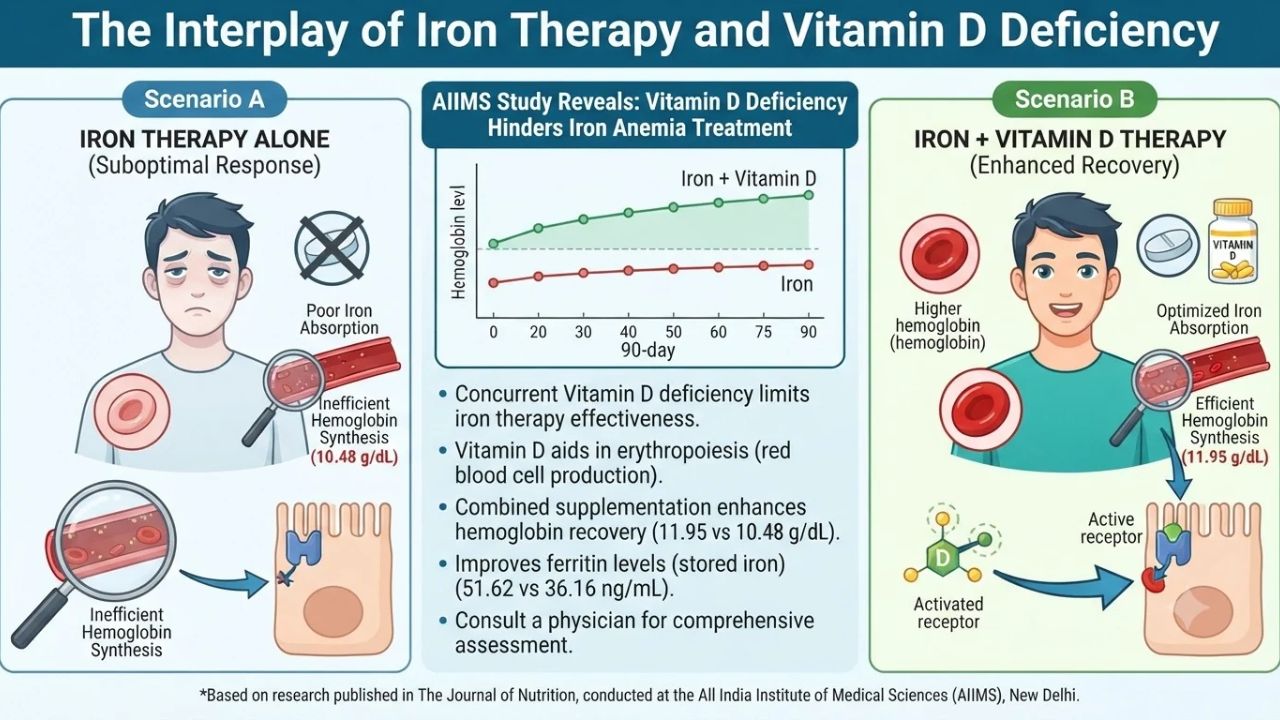
AIIMS research highlights how vitamin D supplementation could improve the response to iron therapy among patients with iron-deficiency anaemia. (Img: AI-Generated)
New Delhi: Iron supplements have long remained the cornerstone of treatment for iron-deficiency anaemia. However, new research from the All India Institute of Medical Sciences (AIIMS), New Delhi, has highlighted an important nutritional factor that could influence treatment outcomes: vitamin D status.
A study published in The Journal of Nutrition has found that supplementing vitamin D alongside conventional iron therapy may significantly enhance haemoglobin recovery and improve the body's iron reserves among adults suffering from iron-deficiency anaemia (IDA) and concurrent vitamin D deficiency.
The findings could have important implications for anaemia management in India, where nutritional deficiencies remain a major public health concern. The research indicates that inadequate vitamin D levels may be one of the contributing factors behind a suboptimal haematological response in certain patients receiving conventional anaemia treatment.
The research involved 400 adults diagnosed with iron-deficiency anaemia. Of these, 385 participants completed the 90-day assessment, providing researchers with an opportunity to evaluate changes in haemoglobin concentration and iron-storage parameters following treatment.
All participants received standard nutritional supplementation comprising iron, folic acid and vitamin B12. However, vitamin D supplementation was additionally introduced for one group of patients identified as vitamin D deficient.
This group received 60,000 international units (IU) of vitamin D weekly for six weeks, alongside conventional anaemia treatment. The results demonstrated that participants receiving the additional vitamin D supplementation experienced the most substantial improvement in haematological indicators.
After 90 days, the adjusted average haemoglobin concentration in the group receiving iron and vitamin D reached 11.95 grams per decilitre (g/dL). In comparison, vitamin D-deficient participants who received iron without additional vitamin D supplementation recorded an adjusted average haemoglobin level of 10.48 g/dL. The difference highlights the potential contribution of vitamin D status to haemoglobin restoration during iron-deficiency anaemia treatment.
Beyond haemoglobin recovery, the researchers also observed improvements in ferritin concentrations among patients receiving combined supplementation. Ferritin is an important biomarker used to assess the body's stored iron reserves. Unlike haemoglobin, which reflects the oxygen-carrying capacity of blood, serum ferritin provides an indication of the amount of iron stored in the body.
Participants receiving vitamin D alongside iron recorded an adjusted average ferritin concentration of 51.62 nanograms per millilitre (ng/mL). The corresponding figure among vitamin D-deficient patients treated with iron without additional vitamin D was 36.16 ng/mL.
These findings suggest that correcting vitamin D deficiency may potentially support not only haemoglobin synthesis but also the replenishment of iron reserves. The improvement in both haemoglobin and ferritin is particularly relevant because successful treatment of iron-deficiency anaemia involves restoring circulating haemoglobin as well as rebuilding depleted iron stores.
Vitamin D is traditionally associated with calcium absorption, bone mineralisation and skeletal health. However, emerging scientific research has increasingly examined its wider physiological functions, including its possible involvement in erythropoiesis, the biological process responsible for producing red blood cells.
Red blood cell production takes place primarily in the bone marrow and depends on several nutritional and hormonal factors. Iron is indispensable for haemoglobin synthesis, while folate and vitamin B12 support normal cell division and maturation.
Vitamin D may also influence pathways associated with red blood cell production and iron metabolism. Researchers have explored its potential relationship with hepcidin, a hormone that regulates iron absorption, storage and distribution within the body.
Hepcidin plays a central role in controlling the availability of iron for haemoglobin synthesis. Changes in iron regulation can affect how efficiently the body utilises available iron, potentially influencing the response to supplementation.
Vitamin D also has recognised immunomodulatory and anti-inflammatory properties. Since chronic inflammation can interfere with iron metabolism and contribute to functional iron deficiency, researchers have been investigating whether vitamin D status could influence these processes.
Although these biological mechanisms provide a possible explanation for the study findings, further investigation is required to establish precisely how vitamin D supplementation improves the response to iron therapy.
What AIIMS Researchers Recommend
The research team, which included investigators from the departments of Pharmacology, Medicine, Clinical Haematology and Nephrology at AIIMS, highlighted the importance of considering vitamin D deficiency when evaluating patients who do not respond adequately to conventional iron treatment.
The findings suggest that assessing vitamin D status could be particularly relevant in individuals with persistent or inadequately corrected iron-deficiency anaemia despite receiving appropriate supplementation.
Patients with a suboptimal rise in haemoglobin may require a more comprehensive clinical evaluation to identify other underlying factors, including inadequate treatment adherence, poor iron absorption, ongoing blood loss, inflammation and additional nutritional deficiencies. Vitamin D deficiency could represent another potentially modifiable factor in this clinical assessment.
The researchers have emphasised that the findings should not be interpreted as a recommendation for universal vitamin D supplementation among all anaemia patients. The potential treatment advantage identified in the research was particularly relevant to individuals who had both iron-deficiency anaemia and low vitamin D levels.
The study also does not establish that vitamin D can independently treat anaemia or replace established iron supplementation protocols. Vitamin D supplementation should therefore be guided by an individual's clinical condition, laboratory findings and medical assessment.
The 60,000 IU weekly regimen used in the study was a specific research intervention and should not be adopted as a self-medication schedule. Larger clinical trials and additional investigations will be necessary to establish the reproducibility of the findings, identify the patients most likely to benefit and determine the optimal supplementation strategy.

