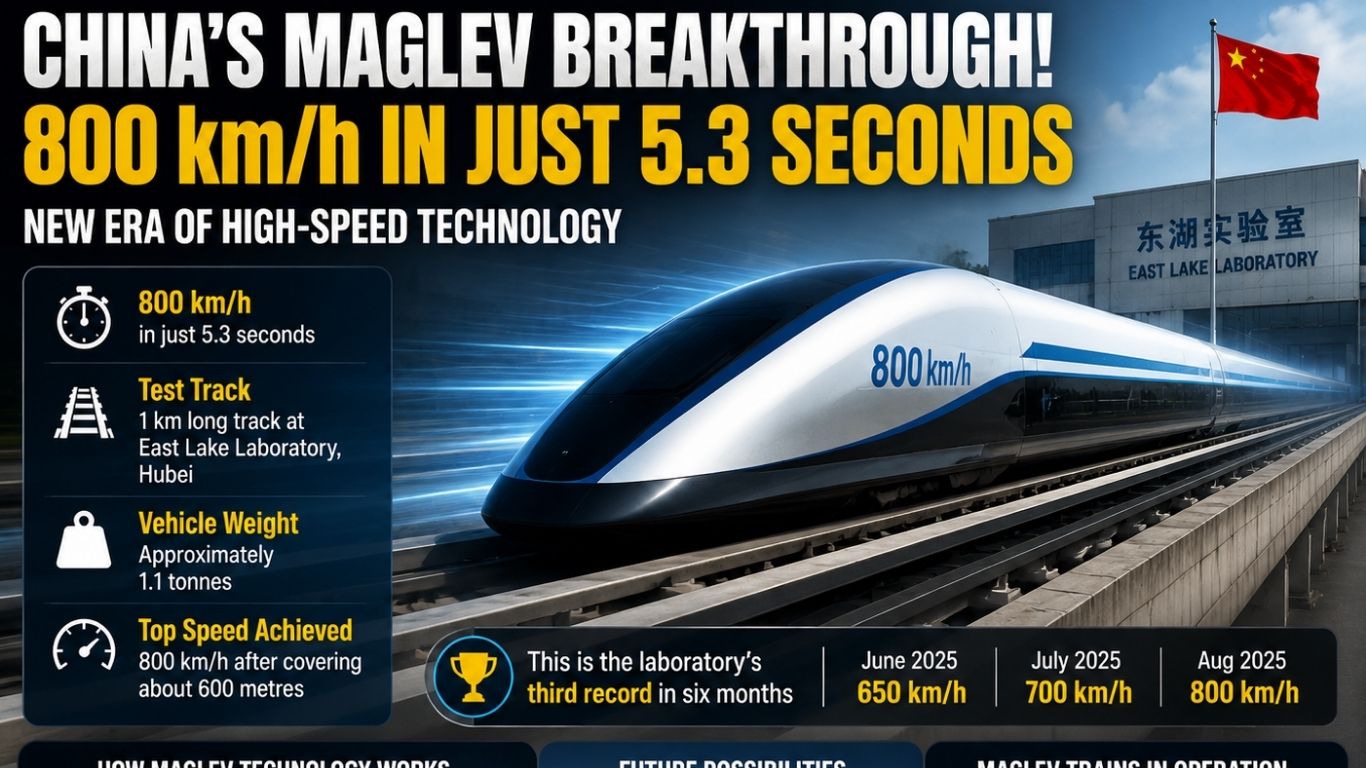
China maglev train speed (Img AI Generated)
New Delhi: China has achieved a major breakthrough in magnetic levitation (maglev) technology after an experimental vehicle reached a speed of 800 km/h in just 5.3 seconds during a high-speed test.
The lightweight experimental vehicle, weighing around 1.1 tonnes, achieved the milestone on a one-kilometre-long test track at the East Lake Laboratory in Hubei province.
According to China’s state news agency Xinhua, the vehicle reached a maximum speed of 800 km/h after covering nearly 600 metres. After the test run, which lasted around eight seconds, the vehicle was brought to a controlled stop safely.
This marks the laboratory’s third major speed record in six months. Earlier tests saw the vehicle reach around 650 km/h in June 2025 and nearly 700 km/h in July 2025.
However, experts clarified that the achievement was made on an experimental test track and does not represent the operating speed of a passenger maglev train.
Although the speed appears suitable for futuristic high-speed transportation, China’s current research is primarily focused on understanding the potential of electromagnetic propulsion and levitation systems.
Researchers believe the technology could have applications beyond transportation, including aerospace electromagnetic launching, drone technology, and the emerging low-altitude economy.
Achieving such extreme speeds comes with significant technical challenges. At 800 km/h, even a small track irregularity can affect stability and safety.
The experiment tested several advanced systems, including high-power energy supply, wireless communication, precision linear motor control, and high-speed stability mechanisms.
Experts say it would be too early to introduce such speeds into passenger services because maglev infrastructure requires highly precise, straight, and level tracks that cannot easily integrate with conventional railway networks.
One of the most promising future applications of this technology could be in the aerospace sector.
A powerful electromagnetic launch system could potentially accelerate spacecraft or rockets during the initial launch phase, reducing the burden on rocket engines and lowering fuel requirements.
Maglev trains use powerful magnetic forces to lift vehicles above the track and move them forward using electromagnetic propulsion. Since there is no physical contact between wheels and rails, friction is significantly reduced, allowing much higher speeds compared to traditional rail systems.

