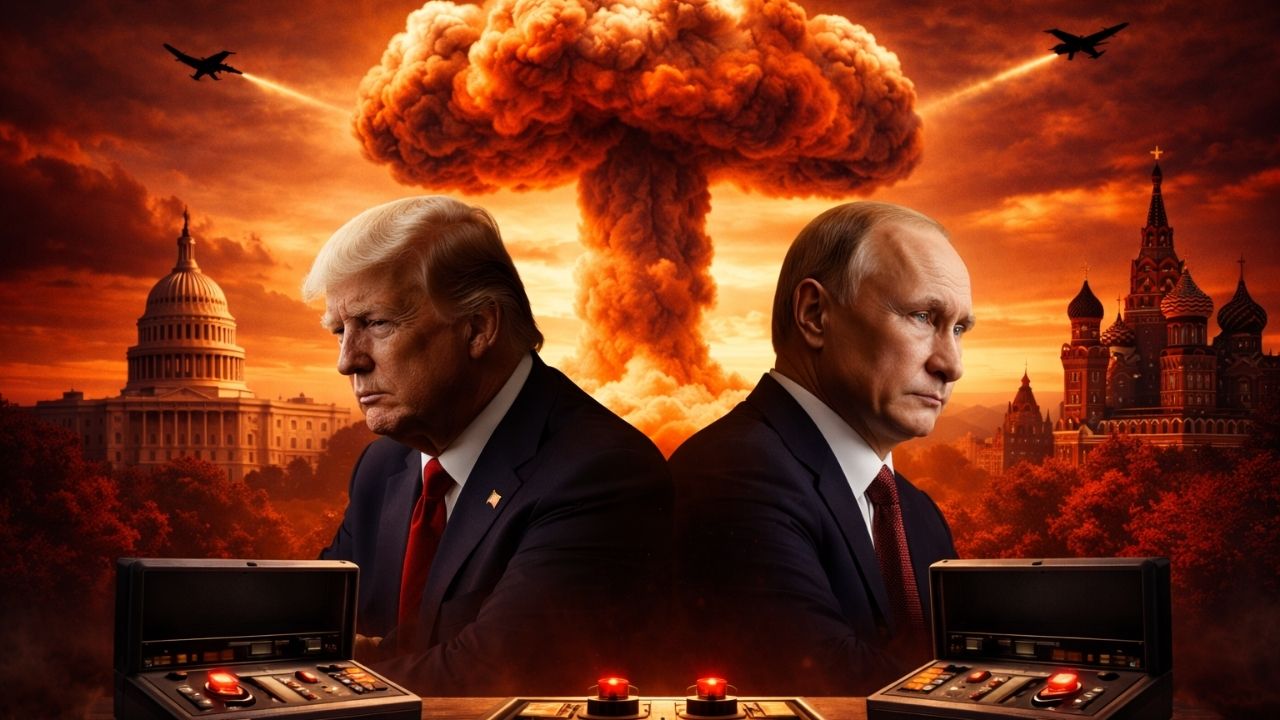
Tense standoff in a nuclear world (Image source: AI)
New Delhi: On February 5, 2026, the world entered a new and potentially dangerous era in nuclear arms control. The New START Treaty, originally signed in 2011 between the United States and Russia under President Barack Obama, officially expired.
This treaty had set strict limits on the number of deployed strategic nuclear warheads and launchers for both countries, establishing a framework for inspections, data exchanges, and transparency to reduce the risk of misunderstandings or accidental escalation.
With its expiration, there are now no legal restraints on the number of nuclear weapons Russia or the U.S. can deploy. This has raised global concerns, with former Russian President Dmitry Medvedev tweeting that the world has entered a period where no treaty exists to limit nuclear arsenals, marking a first since 1972.
Media outlets worldwide are highlighting the increased risk, warning that mistrust between these nuclear powers could push the world closer to potential conflict.
International reactions reflect widespread apprehension. In Japan, survivors and relatives of victims of the Hiroshima and Nagasaki atomic bombings have staged protests, emphasizing the urgency of nuclear disarmament. Experts warn that with the treaty gone, misunderstandings or miscalculations between nuclear powers could escalate quickly, making the world less safe.
The treaty had allowed on-site inspections, bi-annual data sharing, and limits on missile deployment. Its expiration removes these safeguards, leaving nations with minimal visibility into each other’s nuclear activities. This significantly increases the potential for mistrust, which historically correlates with heightened nuclear risk.
While the U.S. has indicated that renewing the treaty without including China would be ineffective, adding China—or any other nuclear-armed country—presents diplomatic challenges.
Experts argue that any new arms control agreement must be multilateral, involving countries like China, India, and Pakistan, to ensure accountability and prevent unilateral escalation. However, achieving such global cooperation remains complex, and until then, the world operates in a more dangerous nuclear environment.
While much of India focuses on trade negotiations, agriculture deals, and economic policy, global peace and nuclear security arguably carry greater stakes.
The expiration of the New START Treaty reminds us that geopolitical stability depends on proactive measures, transparency, and trust. The international community now faces the task of exploring new frameworks that involve multiple countries to prevent future nuclear escalation.

