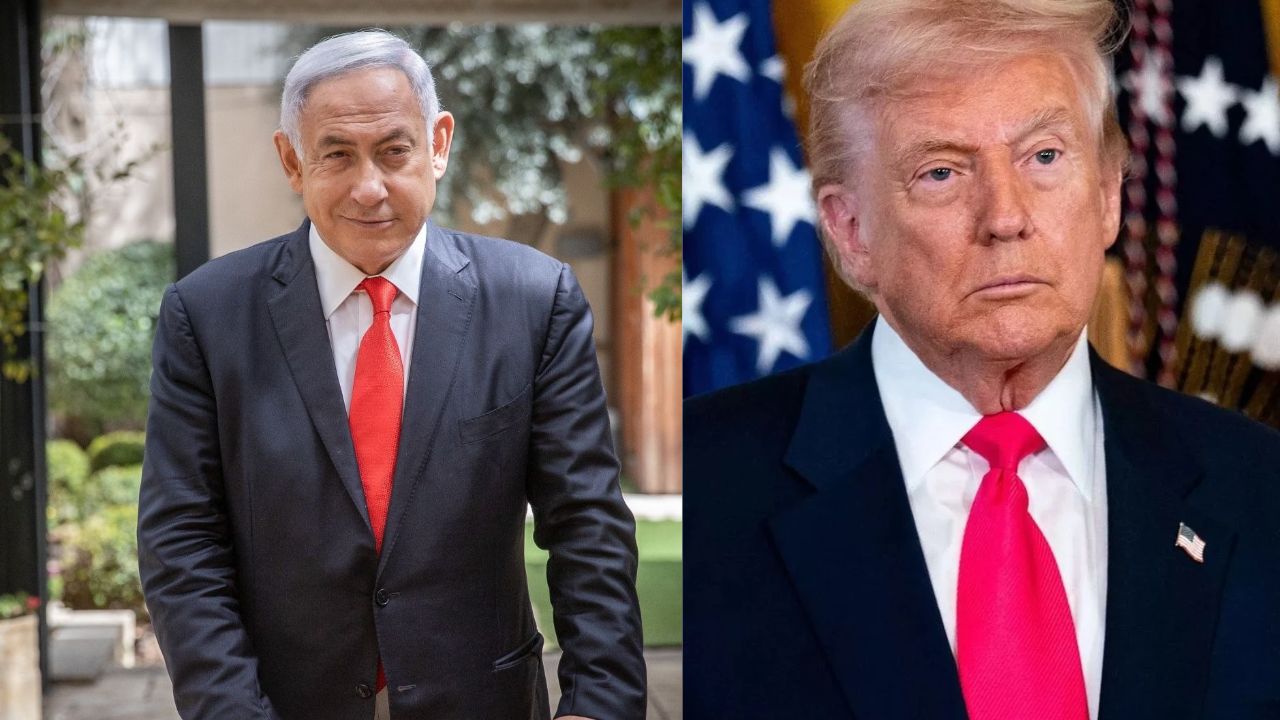
Benjamin Netanyahu has made Donald Trump’s endorsement a major theme of his campaign ahead of Israel’s national election. (Img: X)
Jerusalem: Israeli Prime Minister Benjamin Netanyahu has put his close relationship with US President Donald Trump at the centre of his election campaign, suggesting that renewed military action against Iran could remain an option if he secures another term. Trump has publicly urged Israeli voters to back Netanyahu, framing the unfinished conflict with Tehran as a key security priority.
The high-stakes election, scheduled for October 27, comes amid persistent regional tensions, domestic divisions over national security and questions about Netanyahu’s political future. With his Likud Party facing the possibility of losing seats, the prime minister is presenting his alliance with Washington as a strategic advantage, while his leading rival, Gadi Eisenkot, has accused him of using fear and threatening imagery to influence voters.
Trump renewed his endorsement of Netanyahu on Sunday, October 25, calling on Israeli voters to return the incumbent prime minister to office and arguing that the military campaign against Iran needed to be completed. The US president had first publicly endorsed Netanyahu on October 18, making his support a prominent feature of the final phase of the Israeli election campaign.
Netanyahu used a televised appearance later on Sunday to highlight what he described as an exceptionally close relationship with Trump. He pointed to the US president’s public appeal to Israeli voters as evidence of the strength of their partnership and suggested that such close alignment between the leadership in Washington and Jerusalem might not be guaranteed under a future US administration.
The Israeli prime minister also indicated that Trump was prepared to take further steps against what he characterised as the Iranian threat. Netanyahu linked the prospect of continued action to his own political leadership, presenting his return to office as an important factor in Israel’s ability to confront Tehran.
Trump, responding to reporters on Monday, said he had issued both endorsements independently and maintained that Netanyahu had performed well as prime minister under difficult circumstances.
The endorsement carries implications beyond Israeli domestic politics. Trump’s Republican Party is preparing for the November 3 US midterm elections, with the Iran conflict emerging as a politically sensitive issue amid rising fuel prices and public dissatisfaction over the economic consequences of the war.
Netanyahu has also escalated his rhetoric on Iran’s leadership, saying he had instructed Israel’s intelligence agency, Mossad, and the Israel Defense Forces to pursue efforts aimed at bringing down the Iranian regime. He argued that removing the current leadership in Tehran was necessary to eliminate the threat Israel believes it faces.
The remarks have renewed speculation about whether the prolonged suspension of major fighting could give way to another phase of military confrontation. The conflict was launched jointly by the United States and Israel in February, according to the reports, but major combat operations have remained suspended for months following ceasefire negotiations conducted without Israeli participation.
The White House, meanwhile, has indicated that Washington does not intend to launch another attack on Iran before the US midterm elections. Deputy Press Secretary Anna Kelly described Iran as being in a severely weakened economic and military position and said the US blockade would remain in force.
Her comments suggest that, despite Netanyahu’s statements, Washington’s immediate military calculations may not align with expectations of an imminent escalation. The distinction is significant as Israeli voters assess the government’s security record and the potential consequences of another confrontation with Iran.
The situation also places renewed attention on the Strait of Hormuz, a strategically critical maritime corridor for global energy supplies. Any further military escalation involving Iran could have implications for oil shipments, regional security and international energy markets, although the scale of any potential impact would depend on developments on the ground.
Netanyahu’s principal challenger, centrist politician and former military chief Gadi Eisenkot, has criticised the prime minister’s campaign strategy, accusing him of using fear, misleading claims and threatening imagery to influence voters.
Eisenkot has acknowledged Trump’s importance as a partner in Israel’s security relationship but said the US president would be expected to work with whichever leader Israeli voters chose. His position seeks to distinguish the strategic relationship between the two countries from Trump’s explicit electoral support for Netanyahu.
The dispute intensified after Netanyahu shared computer-generated campaign material depicting the threat of a nuclear explosion over Tel Aviv. The imagery presented Iran as an existential danger to Israel and reinforced the prime minister’s central campaign argument that the country requires a leader capable of confronting its adversaries.
Netanyahu also shared an AI-generated video depicting Iran’s Supreme Leader Ayatollah Mojtaba Khamenei lying in a hospital bed and suggesting that another Netanyahu term could bring him closer to his deceased father, Ali Khamenei. Ali Khamenei was killed on the first night of the US-Israeli strikes against Iran in February, according to the supplied reports.
Eisenkot argued that the use of such imagery reflected a campaign built around fear and threats rather than a substantive assessment of the country’s challenges. The exchange highlights the growing role of AI-generated visuals and digital campaigning in high-stakes elections, where dramatic imagery can shape public debate but also raise concerns about context, accuracy and political messaging.
Tuesday’s election is Israel’s first national vote since the Hamas-led attacks of October 7, 2023, which exposed serious security failures and triggered wars across multiple fronts. The election is therefore expected to serve as a political verdict on the government’s handling of national security, the subsequent military campaigns and the wider direction of the country.
Netanyahu, 77, is seeking another term as Israel’s longest-serving prime minister. His Likud Party is projected by opinion polls cited in the reports to lose seats, potentially depriving his coalition of right-wing, far-right and ultra-Orthodox parties of its narrow parliamentary majority.
However, the opposition also faces significant challenges. Eisenkot and other opposition groups have yet to establish a clear path towards assembling a coalition capable of replacing Netanyahu. Israel’s fragmented parliamentary system means that the final outcome will depend not only on individual party performances but also on coalition negotiations and the distribution of seats in the Knesset.
Netanyahu has previously demonstrated considerable political resilience. Since 2009, his opponents have managed to remove him from office only briefly, following four inconclusive elections over a two-year period. He returned to power around 18 months later, underlining the difficulty of building a stable alternative government.
Israeli political discourse has also moved further to the right. Nearly all major Jewish-led parties, including Eisenkot’s, oppose the two-state solution that has underpinned decades of international efforts to resolve the Israeli-Palestinian conflict. This shift could further complicate prospects for renewed peace negotiations.
The election thus presents voters with competing arguments over leadership, security and political stability. Netanyahu is portraying himself as the leader best equipped to confront Iran and other perceived threats, while his opponents contend that his polarising approach has weakened national unity.
Trump’s intervention has given the Israeli election an added international dimension, linking Netanyahu’s political prospects to Washington’s broader Middle East strategy. While the US president’s endorsement could strengthen Netanyahu’s campaign among voters who prioritise the security partnership, the unpopularity of the Iran war in the United States introduces a potential political liability for Trump himself.
Rising fuel prices and concerns over the economic impact of the conflict have made the war a difficult issue for the Republican Party ahead of the November 3 midterms. The White House’s statement that the United States will not attack Iran before that vote also signals an effort to distinguish its immediate military posture from the prospect of future action.
For Israel, the immediate question is whether Netanyahu can retain enough parliamentary support to continue governing. For the wider region, the election may influence the direction of Israeli policy towards Iran, the prospects for renewed hostilities and the future of diplomatic efforts to contain the conflict.
With voters preparing to cast their ballots, Netanyahu’s alliance with Trump has emerged as one of the campaign’s defining themes. Whether that partnership translates into an electoral advantage, and whether the next government pursues further confrontation with Tehran will depend on the election result and the strategic decisions that follow.

