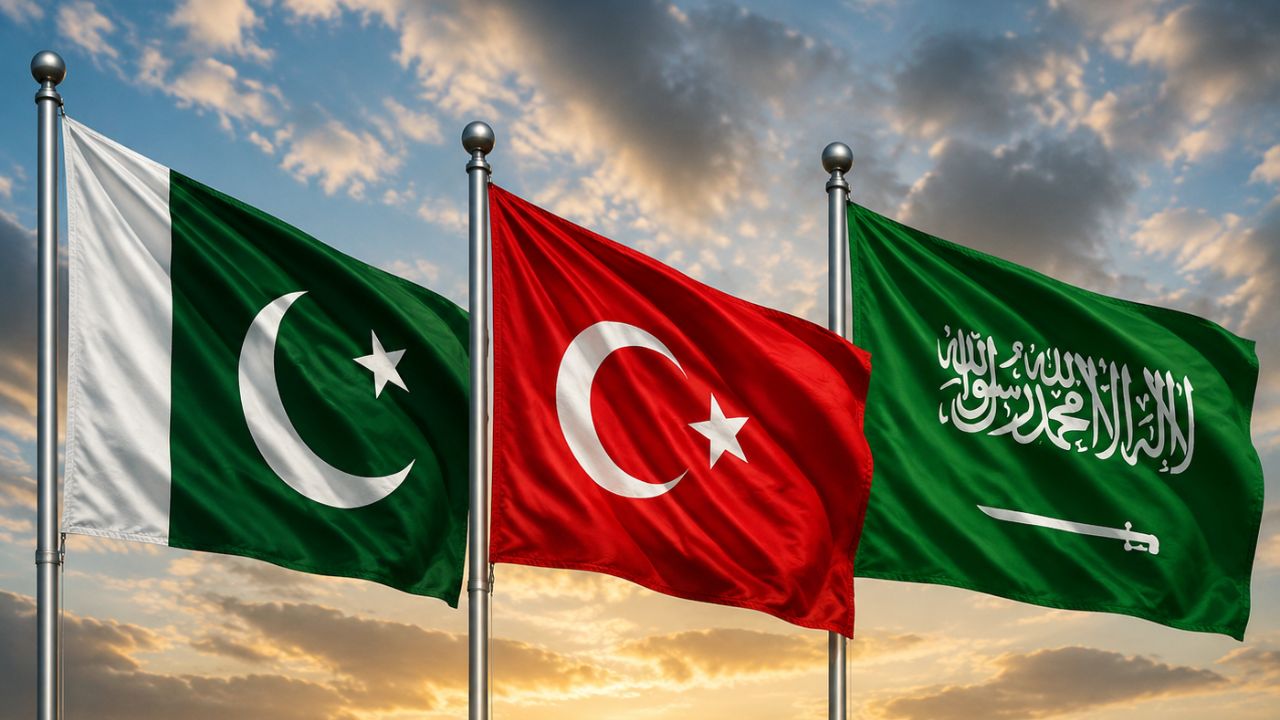
Mecca: Pakistan, Saudi Arabia and Turkey have signed a landmark trilateral defence pact in Mecca, creating a new security framework in West Asia where an armed attack on one member would be treated as an attack on all three nations. The historic defence arrangement aims to strengthen military cooperation, strategic coordination and collective security at a time when the Middle East is witnessing growing geopolitical rivalries, missile threats, drone warfare and instability around key energy routes.
The pact, known as the Mecca Joint Defence Agreement, marks a major shift in regional security calculations as countries across West Asia reassess their defence partnerships amid rising tensions involving Iran, Israel and other regional actors. The agreement was signed during a high-level meeting attended by Saudi Crown Prince Mohammed bin Salman, Turkish President Recep Tayyip Erdogan and Pakistan Prime Minister Shehbaz Sharif. Pakistan’s military leadership, including Chief of Army Staff Field Marshal Asim Munir, was also present during the discussions.
According to Pakistan’s Foreign Ministry, the defence pact is aimed at expanding cooperation in defence planning, military coordination, intelligence sharing, counterterrorism efforts and strengthening collective capabilities against external threats. However, the three countries have not disclosed detailed operational aspects of the arrangement, including the exact military response mechanism, level of troop deployment, intelligence-sharing structure or possibility of joint military operations.
The pact comes at a time when the Middle East is facing one of its most challenging security environments in decades. Growing tensions between Iran, Israel and their allied groups have increased concerns over missile attacks, drone strikes, maritime security threats and protection of critical infrastructure. The security situation around strategic waterways, particularly the Strait of Hormuz, has become a global concern. The route plays a crucial role in international energy trade, and any disruption could impact oil markets, shipping networks and global economic stability.
Saudi Arabia, one of the world’s leading oil producers and a key Gulf power, has been strengthening its defence capabilities while protecting its economic transformation programme under Vision 2030. The kingdom has previously faced security threats targeting energy facilities, increasing its focus on advanced air defence systems and strategic partnerships. Turkey, a NATO member with one of the largest military forces in the alliance, has expanded its regional diplomatic and defence influence in recent years. Pakistan brings extensive military experience and remains the only nuclear-armed Muslim-majority country, giving it strategic importance in regional security discussions.
The defence pact brings together three strategically important nations with different strengths. Saudi Arabia contributes its economic influence, financial capabilities and position as a major Gulf power. Turkey provides advanced defence technology, military expertise and NATO experience. Pakistan contributes decades of military training capability, strategic depth and defence cooperation experience.
The three countries have maintained defence ties for several years, but the latest pact upgrades their cooperation into a formal trilateral security framework. Pakistan and Saudi Arabia have historically maintained close military relations, with Islamabad providing training and defence support to Saudi forces. Pakistan has also deployed military personnel and defence assets to Saudi Arabia under previous security arrangements.
Meanwhile, defence cooperation between Turkey and Pakistan has expanded significantly through naval exchanges, military exercises, defence production partnerships and technology collaboration. Saudi Arabia has also increased defence engagement with Turkey, including cooperation in areas such as unmanned aerial vehicles and advanced military systems.
The new security framework could increase coordination between the three countries in areas such as military exercises, intelligence cooperation, counterterrorism operations and defence technology development. Experts believe the pact could eventually develop into a wider regional security mechanism if the countries establish permanent coordination structures and regular joint activities.
The agreement also reflects a broader trend where regional powers are attempting to create independent security arrangements instead of relying entirely on traditional global alliances. Major powers including the United States, China, Russia and India are expected to closely monitor the development because of its possible impact on energy security, military partnerships and geopolitical influence in West Asia.
Despite Pakistan’s nuclear capability, the defence framework does not indicate any nuclear cooperation or collective nuclear deterrence arrangement. Analysts believe the focus is likely to remain on conventional military cooperation, intelligence exchange, defence technology, counterterrorism operations and coordinated security planning. Pakistan’s nuclear strategy continues to remain focused on its own regional security concerns, particularly in South Asia.
The pact has attracted global attention as it brings together three influential Muslim-majority nations with significant military and economic capabilities. Saudi Arabia’s financial strength, Turkey’s defence capabilities and Pakistan’s military experience together create a new strategic combination that could increase their collective diplomatic influence. If implemented through regular military exercises, institutional coordination and deeper defence cooperation, the arrangement could contribute to a more regionally driven security architecture.
The new defence partnership is likely to be closely observed in India because of Pakistan and Turkey’s expanding military relationship and Saudi Arabia’s growing role in regional security affairs. India maintains strong economic and strategic ties with Saudi Arabia, particularly in energy cooperation, investments and trade partnerships.
At the same time, New Delhi has closely followed increasing defence collaboration between Pakistan and Turkey, especially in areas related to military technology and strategic cooperation. However, the three countries have maintained that the pact is defensive in nature and is not aimed against any specific nation. Turkish officials have indicated that the framework could remain open to broader regional cooperation and would function alongside existing bilateral and international security arrangements.
The trilateral defence pact follows months of discussions aimed at building a stronger strategic partnership between Islamabad, Riyadh and Ankara. Turkey has repeatedly supported greater regional cooperation to address emerging security challenges, while Saudi Arabia and Pakistan have continued expanding their decades-old defence relationship.
The Mecca defence pact represents a significant development in regional security diplomacy and highlights growing efforts by West Asian and neighbouring powers to establish new defence frameworks amid shifting global alliances. As conflicts, energy security concerns and geopolitical competition continue to reshape the Middle East, the Pakistan-Saudi Arabia-Turkey defence pact could become an important factor in determining the future balance of power in West Asia.

