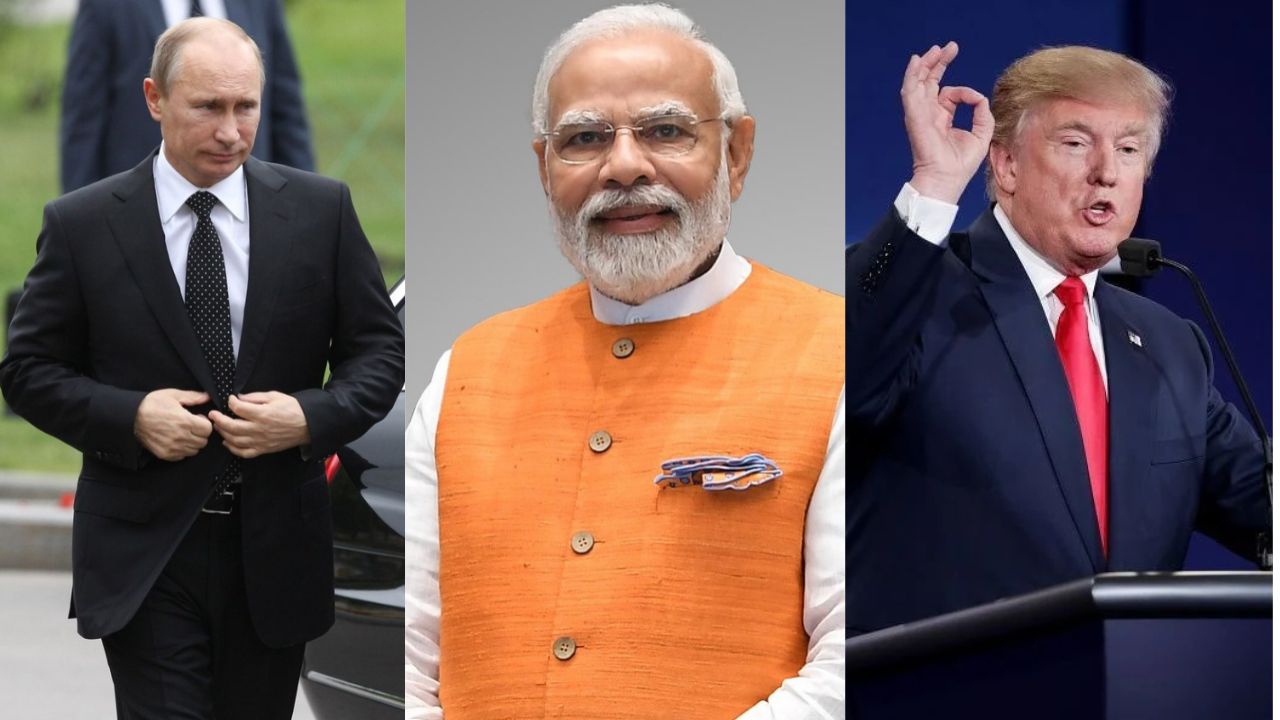
India gets temporary relief from the threat of US tariffs of up to 100% over Russian oil purchases. (Img: Pinterest)
Washington DC: US President Donald Trump has temporarily waived the application of sanctions, restrictions and tariffs under the Lindsey O. Graham Sanctioning Russia and Iran Act of 2026, offering significant relief to India and China just days before the most consequential provisions were due to take effect.
The executive order, issued on Friday, invokes US national interests as the justification for suspending the measures, which could have exposed Indian exports to tariffs of up to 100% over the country's purchases of Russian oil and gas.
The decision eases an immediate source of uncertainty for Indian exporters, oil refiners and policymakers navigating the complex intersection of energy security, international sanctions and bilateral trade negotiations. However, the reprieve is not necessarily permanent. The administration has retained the option to revisit the measures, leaving businesses with continued uncertainty over the future direction of US trade policy towards countries buying Russian energy.
The legislation, signed by Trump in September 2026, established a framework for imposing sweeping economic penalties on Russia and countries purchasing its energy exports. Named after the late US Senator Lindsey O. Graham, a prominent supporter of Ukraine in Washington, the measure was designed to restrict Moscow's revenue streams and increase economic pressure over the war in Ukraine.
Under the legislation, the administration was authorised to impose tariffs of up to 100% on goods imported from the five largest buyers of Russian crude oil or gas, including India, China, Slovakia, Hungary and Azerbaijan. It also provided for potential penalties against countries helping Russia circumvent sanctions, alongside measures targeting Russian officials, banks, energy interests and defence-linked entities.
The legislation envisaged tariffs of up to 500% on US imports of Russian energy products. Its provisions also covered Russian President Vladimir Putin and senior members of the Russian government. The deadline for implementing key measures was approaching on October 18, making Trump's executive order a significant last-minute intervention.
By invoking the national-interest provision, Trump has deferred the application of the relevant sanctions, restrictions and duties. The move does not amount to a permanent repeal of the legislation or an unconditional guarantee that India will remain exempt from future penalties.
India is among the world's largest crude oil importers and has relied heavily on Russian supplies since Western sanctions following Moscow's invasion of Ukraine reshaped global energy trade. Discounted Russian crude became an important component of India's procurement strategy, helping refiners balance costs, availability and domestic fuel requirements.
Had Washington imposed an additional 100% tariff on Indian goods under the legislation, exporters could have faced a substantial competitive disadvantage in the American market. The US is one of India's most important trading partners, and a sharp increase in import duties could have affected pricing, order flows, supply-chain decisions and the commercial viability of shipments across multiple sectors.
The proposed penalties would also have complicated India's energy procurement decisions. Restrictions affecting Russian crude could have forced Indian refiners to seek alternative suppliers, potentially increasing acquisition costs at a time when geopolitical tensions in the Middle East were already disrupting energy markets and creating uncertainty around shipments through the Strait of Hormuz.
India had consistently maintained that its energy policy is guided by the need to ensure reliable and affordable supplies for its population of approximately 1.4 billion people. The Ministry of External Affairs had also indicated that New Delhi was in communication with US officials about the implications of India's Russian oil purchases for bilateral relations and international energy markets.
The waiver provides immediate breathing room for policymakers and businesses. However, the precise commercial impact will depend on future US tariff decisions, the evolution of Russian crude availability and the terms governing India's trade with Washington.
The latest development follows a turbulent period in India-US trade relations. In 2025, the Trump administration imposed an additional 25% penalty on Indian imports linked to New Delhi's purchases of Russian crude, alongside a 25% reciprocal tariff. The combined tariff burden was reported at 50%.
In February 2026, Washington removed the additional 25% penalty and reduced the reciprocal tariff to 18% under a broader India-US trade framework. Trump subsequently suggested that India would stop purchasing Russian oil, although New Delhi did not publicly make an equivalent commitment in the material cited in the reports.
The Graham Act subsequently revived concerns that Indian exporters could face another round of steep trade penalties. Its implementation was also seen as a potential complication for negotiations on a wider bilateral trade agreement.
With the latest waiver, the immediate threat of tariffs of up to 100% under the legislation has receded. The decision could create a more favourable environment for negotiations, although it does not settle the broader questions surrounding market access, tariff predictability and India's energy relationship with Russia.
For Indian businesses, the distinction between a temporary waiver and a durable trade arrangement remains important. Exporters require clarity on applicable duties and the possibility of future policy changes before making long-term pricing, investment and supply-chain commitments.
The executive order comes amid a notable shift in Trump's public engagement with Moscow. The US President has been critical of Ukrainian President Volodymyr Zelensky and has suggested that Ukraine needs new leadership capable of reaching an agreement to end the war.
Trump has also announced an arrangement with Russian President Vladimir Putin under which Russia would supply more than 300,000 tonnes of diesel to the United States initially, with further shipments expected in subsequent months, according to the reports provided.
Zelensky criticised the arrangement, arguing that energy purchases risk undermining the pressure being placed on Moscow over the war. He also alleged that Russia continued attacking Ukraine despite the agreement.
The juxtaposition of proposed economic penalties against countries purchasing Russian energy and a US arrangement to obtain Russian diesel has drawn attention to the competing priorities shaping Washington's policy. Energy affordability, domestic fuel prices, diplomatic negotiations and pressure on Russia are all part of a complicated strategic calculation.
For India, the latest waiver reinforces the importance of assessing US policy through both its economic and geopolitical dimensions. The decision reduces immediate tariff exposure but does not eliminate the possibility that energy purchases could become a point of contention again.
The waiver comes at a time when India is balancing Russian crude purchases against uncertainty in the Middle East. Disruptions to regional energy flows and shipping routes have increased the importance of diversifying supply sources, while Russian oil has continued to play a major role in India's import mix.
However, the absence of an immediate tariff threat does not guarantee unlimited availability of Russian crude at favourable prices. Reports cited in the supplied material indicate that Indian refiners could face tighter Russian oil supplies in October and November as exports decline and competition from China intensifies.
China, the world's largest crude oil importer, has reportedly increased purchases amid disruption to Middle Eastern supplies. Strong demand and advance bookings could allow Chinese buyers to secure cargoes more aggressively, potentially leaving Indian refiners competing for a smaller pool of available shipments.
If Russian supplies become more expensive or less accessible, India may have to increase procurement from alternative markets. Such a shift could raise input costs for refiners and expose the domestic economy to greater sensitivity to international crude prices.
The US waiver therefore addresses one part of India's energy challenge: the risk of additional trade penalties imposed by Washington. It does not remove supply-side pressures, geopolitical uncertainty or competition for cargoes.
The decision has been viewed as a positive development for India's trade and energy security outlook. Manoj Mishra, Partner and Tax Controversy Management Leader at Grant Thornton Bharat, described the waiver of the proposed 100% tariffs as significant relief, highlighting its potential to reduce disruption to energy sourcing and shield Indian exporters from adverse consequences in the US market.
He also pointed to the importance of greater tariff clarity and predictability for long-term export planning and supply-chain decisions. Although the waiver could ease a source of uncertainty in India-US trade negotiations, businesses will continue to monitor the administration's next steps.
The central question is whether the pause develops into a more stable policy position or remains a temporary measure that can be reversed as diplomatic and commercial priorities change.
India has gained relief from the immediate prospect of tariffs of up to 100% under the Graham Act. Indian exporters can avoid an additional layer of uncertainty, while oil refiners retain greater flexibility in managing procurement decisions involving Russian crude.
Yet the waiver should not be interpreted as the final resolution of the India-US trade dispute or as a permanent exemption from all Russia-related penalties. The legislation remains relevant, and the administration could reconsider its position if circumstances change.
The next phase will depend on Washington's approach to sanctions enforcement, the progress of India-US trade negotiations, the availability and pricing of Russian crude, and the wider geopolitical situation affecting global energy supplies.
For New Delhi, the immediate priority remains balancing affordable energy, diversified sourcing and export competitiveness while protecting its economic interests. Trump's decision has reduced the near-term pressure, but the durability of that relief will depend on what Washington does next.

