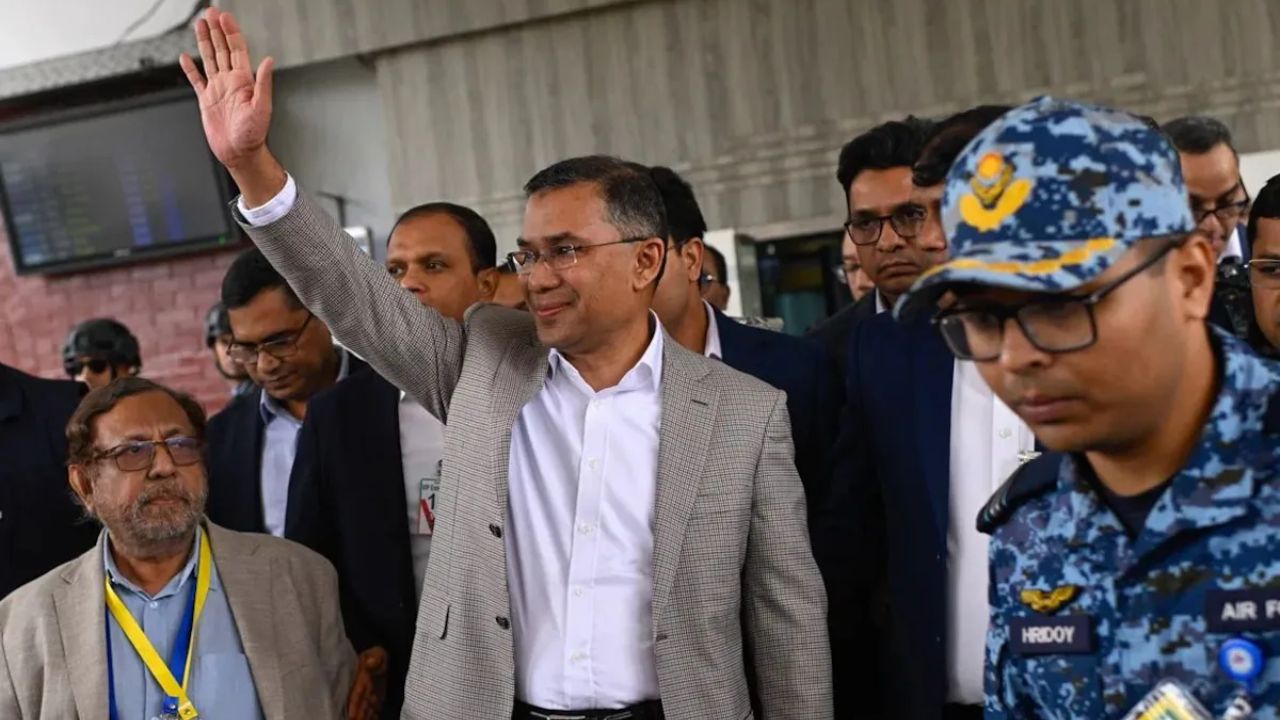
Tariq Rahman set to lead Bangladesh as PM
New Delhi: The emergence of the Bangladesh Nationalist Party (BNP) as the largest party in Bangladesh’s general election marks a turning point in Dhaka’s political landscape.
With Tarique Rahman set to assume office and the Jamaat-e-Islami falling short of a majority, New Delhi is closely assessing what the transition means for bilateral ties.
While the absence of the Awami League signals a shift from the political order India has worked with for over a decade, the outcome is not necessarily adverse for New Delhi. In fact, it presents a calibrated opportunity.
Prime Minister Narendra Modi was quick to congratulate Rahman, reiterating India’s commitment to a democratic and progressive Bangladesh and expressing hope for strengthening the multifaceted partnership.
Here are five reasons why the new political scenario in Dhaka may not be bad news for India:
1. Jamaat Kept from Majority: A Strategic Comfort
For India, the fact that Jamaat-e-Islami has not secured a majority is significant. Historically viewed in New Delhi as ideologically closer to Pakistan and hardline currents, a dominant Jamaat presence could have raised concerns about border security, radical networks and instability along India’s northeastern frontier.
Though Jamaat moderated its tone during the campaign, its past rhetoric often included anti-India mobilization. Its inability to dominate the political space reduces the likelihood of immediate ideological polarization in Dhaka.
2. Economic Pressures Encourage Pragmatism
Bangladesh faces economic headwinds, including pressure on foreign exchange reserves, export challenges and inflation. Any incoming government will need stability and external cooperation to restore growth.
India is among Bangladesh’s largest trade partners, with expanding cooperation in power supply, petroleum pipelines, rail and road connectivity, and port access. Indian investments in Bangladesh run into billions of dollars.
For a BNP-led administration, maintaining economic continuity with India will be a practical necessity rather than a political choice. Economic realities may naturally push Dhaka toward constructive engagement.
3. Diplomatic Channels Already in Place
India has, in recent months, maintained open lines of communication across Bangladesh’s political spectrum. Diplomatic outreach ensured that ties would not abruptly deteriorate in the event of regime change.
By engaging beyond party lines, New Delhi has laid the groundwork for continuity. This preparation makes it harder for any new government to adopt an overtly confrontational posture toward India without diplomatic costs.
4. Deep Structural Interdependence
India-Bangladesh relations extend beyond political leadership. Connectivity projects linking Bangladesh with India’s Northeast - including rail corridors, inland waterways and border trade points - create mutual economic stakes.
For Dhaka, halting these initiatives would undermine development goals. Advancing them, on the other hand, would reinforce a growth-oriented image domestically. This structural interdependence encourages stability regardless of which party is in power.
5. Strategic Balance in a Changing Region
The Indo-Pacific is witnessing heightened geopolitical competition, particularly with China’s growing regional footprint and its close ties with Pakistan. In such an environment, Bangladesh is unlikely to lean entirely toward any single power bloc.
India remains a key regional actor in energy security, maritime cooperation and disaster management. Strategic diversification - rather than alignment against India - is likely to guide Dhaka’s foreign policy under a pragmatic leadership.

