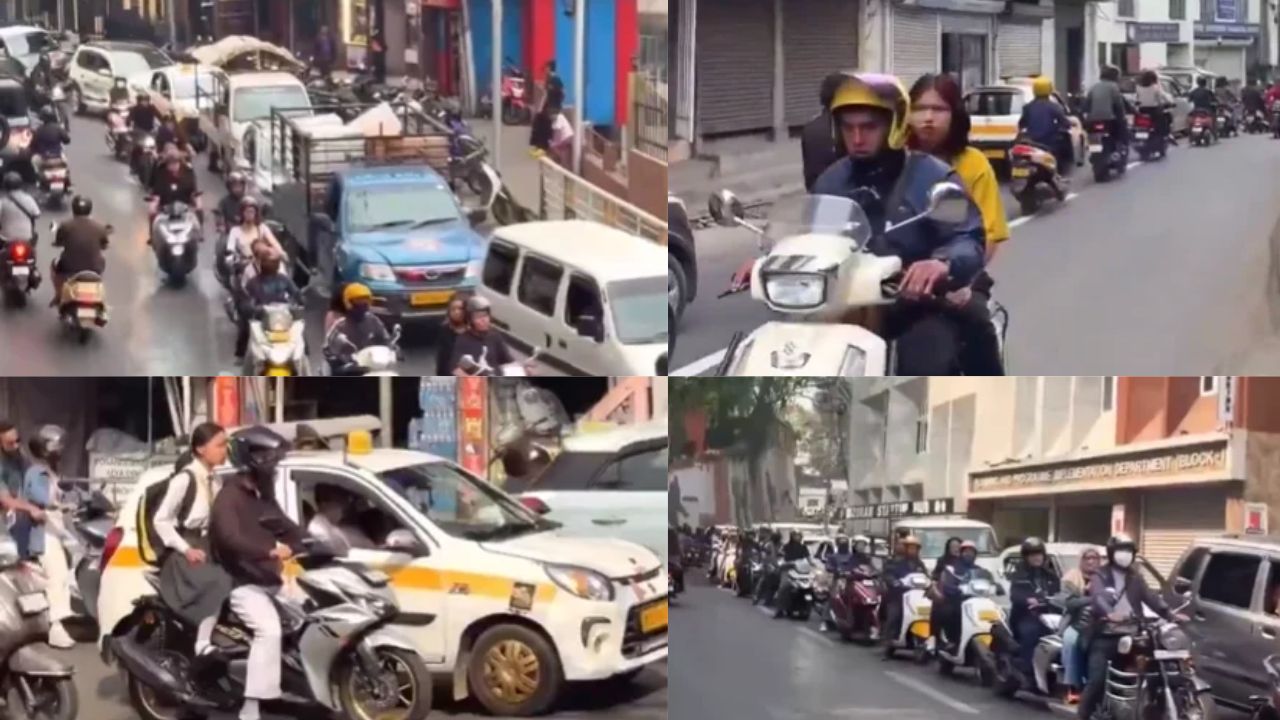
Aizawl's remarkably disciplined traffic and no-honking culture have caught the attention of industrialist Anand Mahindra. (Img: X)
New Delhi: Industrialist Anand Mahindra has drawn attention to the remarkable traffic discipline in Mizoram’s capital, Aizawl, praising its motorists for adhering to road rules and maintaining a no-honking culture even during busy traffic hours.
In a post on X on Sunday, Mahindra shared a video showcasing the city’s orderly traffic movement, observing that the absence of constant honking and unnecessary noise was something increasingly difficult to find in India's major urban centres.
Recalling his earlier remarks about Aizawl’s driving etiquette, Mahindra said the city demonstrated how collective civic responsibility could transform everyday public spaces. He noted that while people generally travel to destinations for their scenic beauty, architectural heritage and historical attractions, the pursuit of tranquillity could emerge as an equally meaningful reason to explore a place.
"In our bustling metropolises, quietness has become a rare luxury," Mahindra remarked, suggesting that Aizawl's peaceful atmosphere itself could make it an attractive destination for travellers.
The video shared by Mahindra features a woman recording traffic conditions on Aizawl's roads. Despite a considerable number of vehicles waiting on the streets, the scene is strikingly devoid of the familiar cacophony of horns.
The woman points out that motorists patiently wait for their turn instead of resorting to incessant honking. She also draws attention to the manner in which drivers respect designated stop lines and refrain from crossing them, even when traffic begins to accumulate.
She attributes the orderly movement to people's patience and willingness to follow traffic regulations, contrasting the experience with the noise pollution commonly witnessed in several Indian cities. The video has once again brought the northeastern city's road culture into focus, with its emphasis on restraint, mutual consideration and respect for traffic rules.
Mahindra's observations prompted considerable appreciation on social media, with users describing Aizawl's traffic management as an example other urban centres could emulate. Several users pointed out that disciplined driving was not necessarily dependent on sophisticated infrastructure but on citizens respecting basic road regulations.
Some also shared similar experiences from other parts of the Northeast, highlighting how adherence to lane discipline and traffic rules could help prevent congestion and improve road safety.
The discussion also brought attention to the broader consequences of irresponsible driving, including unnecessary noise pollution, traffic bottlenecks and road accidents. Aizawl's example, therefore, has sparked a wider conversation about the role of individual responsibility in making Indian cities quieter, safer and more orderly.
I’ve posted before about the remarkable traffic discipline of the people of Aizawl, their respect for lane etiquette and the city’s no-honking policy introduced in 2017.
Today, I find myself reflecting on the outcome of that collective discipline, which this lady speaks of with such pride: the quietness of her city.
In our bustling metropolises, quietness has become a rare luxury.
As travellers, we have traditionally looked for breathtaking landscapes and magnificent monuments.
But for the #SundayWanderer in me, & I bet for many others, the ‘quest for quiet’ may well become the most compelling reason to travel.
(Video courtesy @RajeshwariRW)
— anand mahindra (@anandmahindra) November 22, 2026

