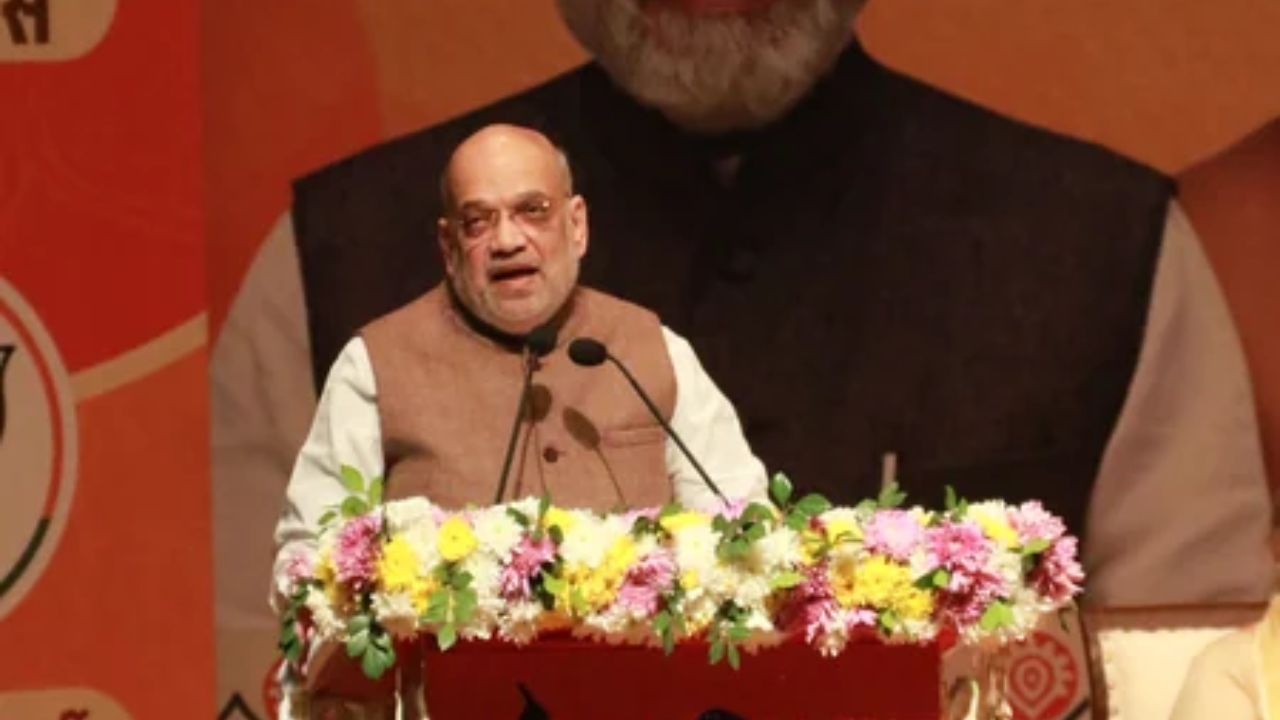
Amit Shah's big Constitution Day announcement puts Uniform Civil Code back in the national spotlight. (Img: X)
New Delhi: Union Home Minister Amit Shah on Thursday announced that every state governed by the Bharatiya Janata Party (BJP) will move towards implementing the Uniform Civil Code (UCC), placing the proposed common civil law framework firmly back at the centre of India's constitutional and political discourse on Constitution Day.
Declaring that laws governing citizens should not be determined by religious identity, Shah reiterated the government's commitment to a uniform legal framework irrespective of faith, while invoking the constitutional vision of the country's founding leaders.
The announcement marks a significant political signal on one of the BJP's longstanding ideological and governance priorities. It also sets the stage for renewed discussions on personal laws, constitutional equality, religious freedom and the relationship between individual rights and uniform legal provisions.
Addressing a gathering in New Delhi on November 26, Shah said the framers of the Indian Constitution had incorporated the idea of a Uniform Civil Code under the Directive Principles of State Policy.
He argued that the constitutional vision envisaged a common framework under which citizens belonging to different religious communities would be governed by uniform civil laws.
The Home Minister maintained that legislation should not be formulated differently on the basis of religious identity. He also directly criticised the Congress leadership for opposing the BJP's position on the issue.
Shah declared that BJP-governed states would implement the Uniform Civil Code in the coming period, indicating that the party intends to expand the initiative across states under its political administration.
The UCC debate has gained momentum following developments in several states. Goa has historically followed a common civil-law framework, while Uttarakhand has introduced its own Uniform Civil Code framework. Gujarat, Assam and Madhya Pradesh have also figured prominently in the BJP's wider UCC implementation agenda.
The expansion of the framework across BJP-governed states could become a major legislative and administrative undertaking, involving consultations, legal scrutiny and the harmonisation of different personal-law provisions. The precise scope and implementation timelines will depend on the respective state governments and their legislative processes.
The Uniform Civil Code refers to a proposed common set of civil laws governing matters such as marriage, divorce, inheritance, succession and adoption, irrespective of an individual's religious affiliation. At present, different religious communities in India are governed by different personal-law frameworks in several areas of family and civil matters.
Article 44 of the Constitution, which forms part of the Directive Principles of State Policy, calls upon the State to endeavour to secure a Uniform Civil Code for citizens throughout the territory of India. However, the Directive Principles are not directly enforceable by courts. Their objective is to guide governments in framing legislation and public policy.
The proposed UCC has remained a subject of extensive constitutional debate, with supporters emphasising gender justice, equality before the law and legal uniformity, while critics have raised concerns about religious freedom, cultural diversity and the protection of minority rights.
Beyond the UCC announcement, Shah used Constitution Day to underline the importance of understanding the Constitution in its entirety rather than treating it merely as a political document. He highlighted the constitutional framework governing the transfer and exercise of political power, emphasising that citizens possess the authority to elect their representatives while governments are obligated to function within constitutional boundaries.
He also stressed the significance of the Preamble, describing its principles as foundational to India's national aspirations and democratic governance. The Home Minister referred to India's history of peaceful transfers of political power, arguing that constitutional procedures have enabled successive governments to assume office without violence.
Shah also recalled the contributions of prominent personalities associated with the framing and presentation of the Indian Constitution. He referred to the work of Sardar Vallabhbhai Patel in matters concerning fundamental rights, minority welfare and tribal communities, alongside the contribution of Dr BR Ambedkar, who chaired the Drafting Committee.
He highlighted Durgabai Deshmukh's role in deliberations concerning equality, social justice and women's welfare, while acknowledging Prem Behari Narain Raizada's contribution to the handwritten Constitution. Shah also recognised the artistic contribution of Acharya Nandalal Bose, whose illustrations gave the original copies of the Constitution their distinctive visual identity.
The Home Minister encouraged political leaders and citizens to examine the original Constitution, particularly its illustrations, to gain a deeper understanding of India's cultural and civilisational heritage. He pointed to depictions of Lord Ram, Lord Buddha, Lord Mahavira, Guru Gobind Singh, Rani Lakshmibai, the Dandi March and Netaji Subhas Chandra Bose in the original document.
Shah also spoke about India's historical and cultural identity, arguing that centuries of civilisational achievements had been undermined by prolonged colonial subjugation.
He maintained that India had once been recognised internationally as a centre of knowledge, prosperity and cultural excellence, but the psychological consequences of colonial rule had weakened the country's collective self-confidence.
Invoking references to India's traditional knowledge systems and cultural heritage, he called for a renewed appreciation of the country's historical contributions.
Amit Shah Credits Modi Government With Tackling Naxalism
The Home Minister also highlighted the impact of Left-Wing Extremism, particularly in the Bastar region, describing decades of insurgency as a major obstacle to development and the delivery of constitutional rights.
Recounting an experience from his visit to Bastar, Shah referred to an elderly resident who lacked a ration card, was missing from the electoral rolls and had no access to electricity or drinking water.
He argued that such deprivation demonstrated how Naxalism had prevented vulnerable communities from accessing basic public services and exercising their constitutional entitlements.
Shah credited the Narendra Modi government with accelerating efforts to eliminate Naxalism and extending governance and welfare benefits to previously affected populations.
He maintained that restoring democratic participation, access to public services and basic infrastructure was essential to ensuring that residents of conflict-affected regions could exercise their rights fully.
Shah also highlighted the transformation of welfare delivery through digital infrastructure, financial inclusion and Direct Benefit Transfer (DBT) mechanisms. He contrasted the earlier challenges associated with the delivery of government assistance with the present system, under which benefits are transferred directly into beneficiaries' bank accounts.
Referring to a former Prime Minister's observation that only a fraction of government funds reached intended beneficiaries, Shah argued that digital governance under Prime Minister Narendra Modi had significantly improved financial transparency and reduced intermediary intervention.
He distinguished the concept of reach from conventional physical connectivity, explaining that roads, airports and metro networks represented infrastructure, while digital financial systems enabled disadvantaged citizens to access welfare entitlements directly. According to Shah, the government's emphasis on digital empowerment had strengthened financial inclusion and improved the delivery of benefits to economically weaker sections.

