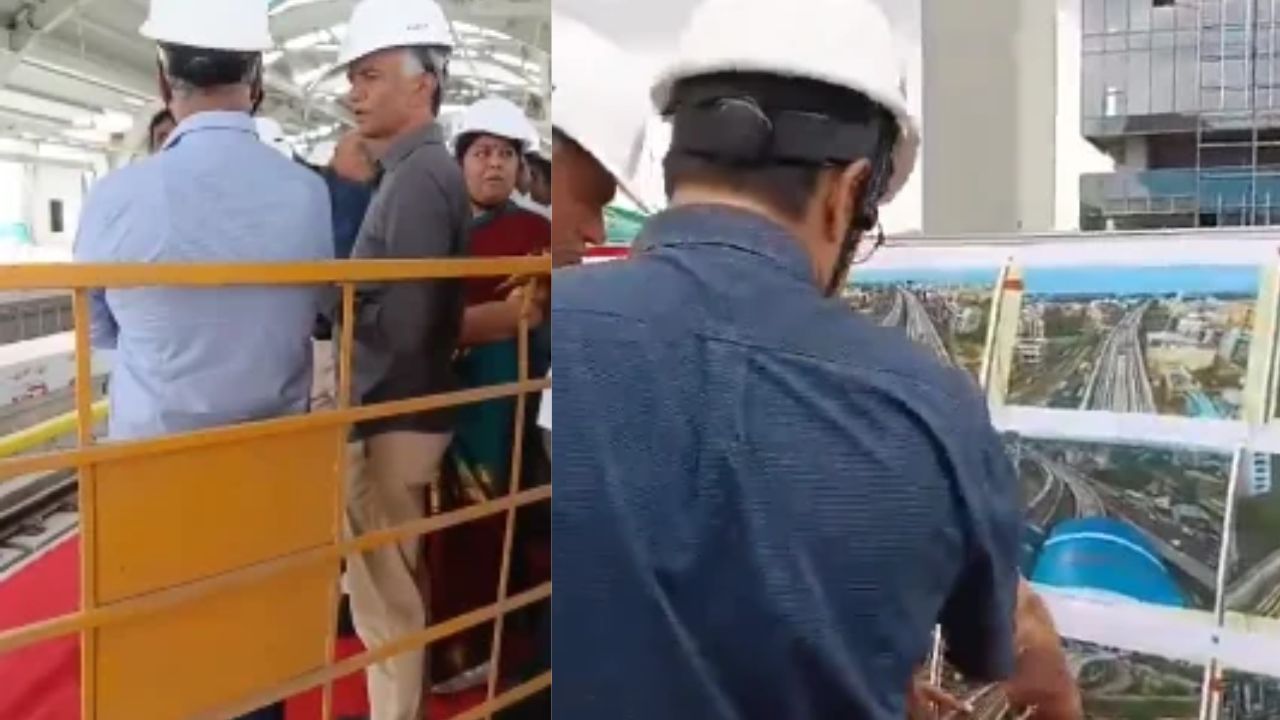
Bengaluru's Metro expansion gathers momentum as trial runs begin on the KR Puram–Central Silk Board Blue Line corridor ahead of its targeted mid-2027 launch. (Img: X)
Bengaluru: Bengaluru's ambitious Metro expansion programme has reached a significant milestone, with trial runs commencing on the much-awaited Blue Line corridor connecting KR Puram and Central Silk Board. The 19-km Phase 2A stretch, featuring 13 stations along the city's heavily congested Outer Ring Road (ORR), is targeted to become operational by mid-2027, potentially transforming daily commuting for lakhs of residents and technology professionals.
The development marks an important step towards addressing Bengaluru's persistent traffic congestion, particularly along its prominent IT and commercial corridor, which accommodates several multinational corporations, technology parks and business establishments employing approximately 12 lakh people.
Greater Bengaluru Development Minister Krishna Byre Gowda inspected the ongoing Namma Metro trial operations on Tuesday, accompanied by officials of Bangalore Metro Rail Corporation Limited (BMRCL). The initial testing exercise has commenced from KR Puram towards Mahadevapura, covering the first four stations. Trial operations are expected to expand progressively to additional stations over the coming weeks as the project advances towards operational readiness.
The proposed Metro corridor is expected to provide a high-capacity public transportation alternative along the ORR, which has witnessed sustained growth in commercial activity, employment generation and commuter movement over the past decade.
Also Read: Jensen Huang Reveals Daily Therapy, Defends Return as Nvidia CEO
The commencement of trial operations represents a crucial transition from civil construction and infrastructure installation to systems integration, operational testing and safety validation. The initial trial programme covers the stretch from KR Puram towards Mahadevapura, with testing expected to continue across the first four stations during November.
Another four stations are scheduled to be incorporated into the testing programme in December. The phased approach will allow engineering teams to assess train movement, track infrastructure, electrical systems, operational interfaces and other essential components before progressively extending trial operations across the entire corridor.
Automatic signalling installation remains one of the key pending milestones. The state government is targeting completion of this work by January 2027, following which the mandatory statutory safety inspection and certification process is expected to begin after February.
The overall testing and certification exercise is estimated to require approximately seven to eight months. The process will involve comprehensive assessment of signalling systems, train control mechanisms, operational safety, emergency response arrangements and infrastructure reliability.
The mid-2027 commissioning target will depend on the timely completion of these activities and the necessary statutory clearances. According to project officials, approximately 37.1 km of tracks have been laid out of the total 39.2 km planned for the Phase 2A section, indicating substantial progress in track infrastructure development.
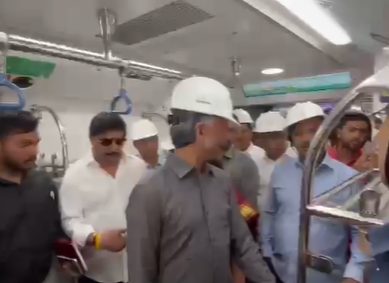
A potential game-changer for nearly 12 lakh employees working along the ORR, the Blue Line promises a high-capacity alternative to road-based commuting. (Img: X)
The KR Puram–Central Silk Board stretch is among the most strategically important components of Bengaluru's Metro expansion because of its alignment with the Outer Ring Road.
The ORR has developed into a major technology and employment hub, accommodating leading IT companies, multinational corporations, business parks, corporate offices and commercial establishments. Its concentration of employment has generated enormous daily commuter movement, particularly during morning and evening peak hours.
With approximately 11–12 lakh people employed along this corridor, the absence of adequate high-capacity public transportation has contributed to persistent traffic bottlenecks and longer commuting times.
The upcoming Blue Line is expected to strengthen connectivity between important commercial destinations and residential neighbourhoods while providing an alternative to private vehicles and road-based transportation.
Commuters travelling through KR Puram, Mahadevapura, Marathahalli, Bellandur and the Central Silk Board junction are expected to benefit from improved access to the Metro network. The corridor could also encourage greater adoption of public transportation among technology professionals, office employees and other daily commuters, potentially easing pressure on major road intersections. Improved Metro accessibility is expected to support better last-mile connectivity, more predictable journey times and greater integration between different modes of urban transportation.
The 19-km Phase 2A corridor forms part of the larger 58.2-km Blue Line project, which is being developed to establish an important rapid transit connection between Central Silk Board and Kempegowda International Airport.
The complete alignment will pass through major locations, including KR Puram and Hebbal, creating a strategic transportation link between southern, eastern and northern Bengaluru.
The entire project is being implemented at an estimated cost of Rs 20,000 crore, making it one of the city's major investments in urban mobility infrastructure.
The government aims to complete the full Blue Line within the next 18 months, although individual sections will become operational in phases depending on construction progress, systems integration and regulatory approvals.
Once completed, the corridor is expected to improve connectivity between Bengaluru's technology clusters, commercial districts, residential areas, railway connections and airport infrastructure.
The airport connection is particularly significant for business travellers, airport employees and passengers who currently depend heavily on road-based transportation to reach Kempegowda International Airport.
The expanded Metro network is expected to offer a more integrated public transport alternative while reducing dependence on private vehicles and taxis for airport journeys.
While Phase 2A has entered the trial operations stage, the Karnataka government is also prioritising the acceleration of construction under Phase 2B.
Particular attention is being directed towards the KR Puram–Hebbal stretch, where construction progress needs to improve through closer coordination between contractors, engineering teams and project implementation agencies.
Officials have been instructed to expedite work and address execution-related bottlenecks that could affect the larger Blue Line completion schedule. The KR Puram–Hebbal section is critical to establishing northward Metro connectivity and integrating the corridor with the airport-bound alignment.
The government has reiterated that financial constraints should not disrupt ongoing Metro infrastructure projects and that the necessary funds will be released according to project requirements. The completion of both Phase 2A and Phase 2B will be essential to delivering the full 58.2-km Blue Line network.
The financial requirements associated with Bengaluru's Metro expansion have emerged as a major consideration amid foreign exchange fluctuations, rising construction costs and increasing debt-servicing obligations. The Karnataka government bears the burden of loan repayments and provides financial assistance to BMRCL to manage its operational losses.
Currency depreciation has increased the repayment liability associated with foreign borrowing. The US dollar, which was valued at approximately Rs 70–80 when certain loans were originally secured, has subsequently moved towards Rs 100.
The movement in exchange rates has increased the effective repayment burden by nearly 30 per cent, adding financial pressure to infrastructure projects involving substantial overseas borrowing. The government is making budgetary provisions and releasing funds as required to ensure that Metro construction activities do not face delays because of funding shortages.
Such financial commitments are particularly important for large-scale urban infrastructure projects involving substantial capital expenditure, long repayment periods, imported equipment and complex construction requirements.
Alongside the Blue Line expansion, the Karnataka government is pursuing additional Metro infrastructure proposals to strengthen Bengaluru's public transportation network. The proposed Red Line Metro project is yet to receive final approval from the Union government. The state has held discussions with central officials regarding the proposal, with recent deliberations described as constructive, although a formal clearance remains pending.
The proposal is part of the state's broader strategy to expand mass rapid transit infrastructure in response to Bengaluru's growing population, urbanisation and increasing commuter demand. The state government has also submitted a proposal for a double-decker transportation corridor connecting Sarjapur with St John's Hospital through Iblur Junction.
The proposed infrastructure would integrate road and Metro transportation within an elevated corridor, potentially improving traffic management along one of Bengaluru's rapidly developing stretches. Sarjapur Road has experienced considerable residential and commercial development, with apartment complexes, technology offices and business establishments generating increasing traffic volumes.
The proposed double-decker arrangement is intended to accommodate future transportation requirements while making more efficient use of limited urban road space. If implemented, the integrated infrastructure model could provide additional road capacity alongside dedicated Metro connectivity, addressing the growing transportation requirements of the Sarjapur–Iblur region.
The financial sustainability of Bengaluru's Metro operations is another important consideration as the network continues to expand. BMRCL's ticket revenue is currently insufficient to cover its entire operating expenditure, creating a continuing requirement for financial assistance from the state government.
Including depreciation, the corporation records an estimated annual loss of approximately Rs 700 crore. However, when depreciation is excluded, its operating position is estimated to reflect a surplus of around Rs 60 crore.
Depreciation represents the accounting reduction in the value of infrastructure, rolling stock, signalling equipment and other capital assets over their useful life. Its inclusion significantly influences the reported financial performance of capital-intensive transportation organisations.
The commencement of Blue Line services is expected to increase operational expenditure, particularly in areas such as electricity consumption, train maintenance, station management, security, personnel deployment and signalling operations.
The state government is examining ways to improve BMRCL's revenue generation and strengthen its financial self-sufficiency so that the corporation can gradually meet its routine operational requirements without depending entirely on government grants. However, despite the financial pressures associated with Metro expansion and operations, no decision has been taken to increase passenger fares.
The government has also indicated that comparisons between Bengaluru Metro and Delhi Metro should account for differences in network length, passenger volumes, operational structures and the extent of financial assistance provided by the Union government.
The Blue Line represents more than another addition to Bengaluru's expanding Metro network. It is a strategic infrastructure intervention aimed at addressing the growing mismatch between employment concentration, urban expansion and available transportation capacity.
The Outer Ring Road has become a critical economic artery supporting Bengaluru's technology industry and corporate ecosystem. However, the concentration of employment along the corridor has also intensified peak-hour congestion and placed considerable pressure on existing road infrastructure.
The introduction of high-capacity Metro services is expected to improve public transport accessibility, provide more predictable commuting options and support the city's long-term economic growth.
For thousands of technology professionals, office employees and residents travelling daily across eastern and southeastern Bengaluru, the corridor could represent a substantial improvement in public transportation access.
With trial operations underway, automatic signalling installation targeted for January 2027 and statutory safety certification expected thereafter, the coming months will be critical for the project's commissioning schedule.
If the proposed timeline is maintained, Bengaluru's much-awaited Blue Line could begin carrying passengers by mid-2027, potentially bringing significant relief to lakhs of commuters travelling along one of India's busiest technology corridors.


