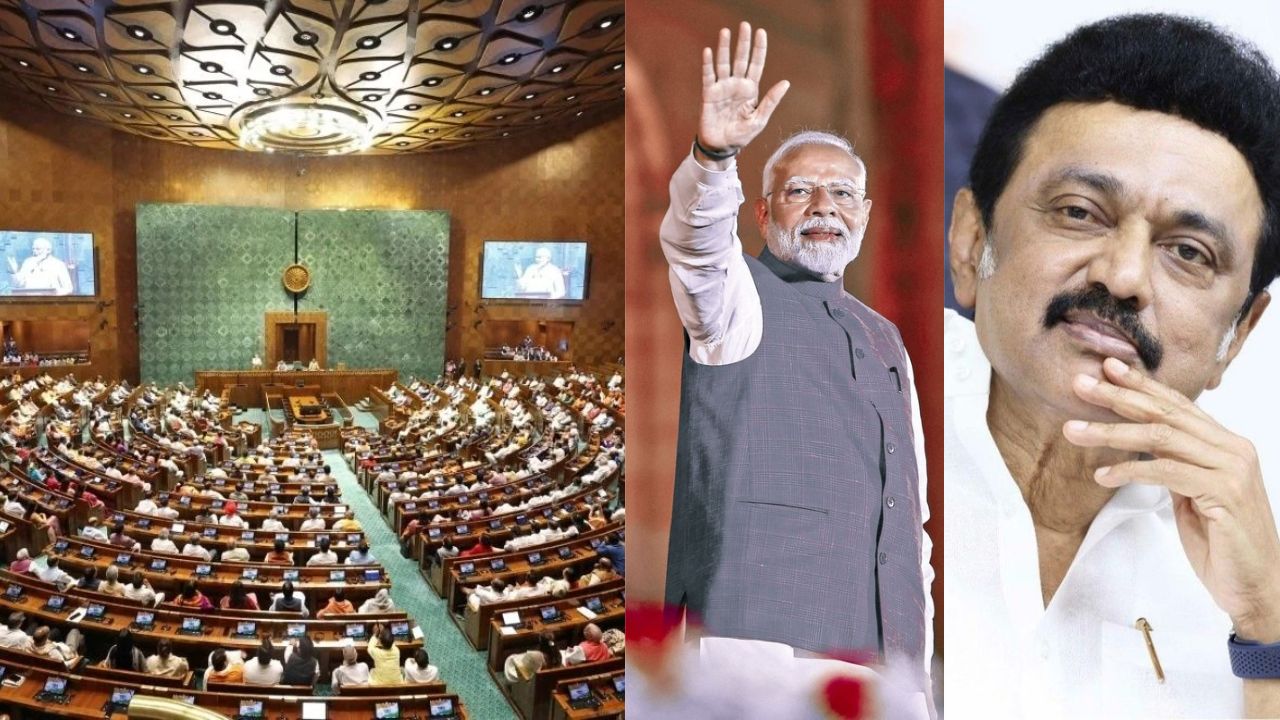
BJP's delimitation numbers game: The Centre looks beyond its NDA allies as the DMK signals conditional support for the proposed legislation. (Img: X)
New Delhi: With a crucial constitutional amendment on delimitation approaching Parliament, the BJP-led National Democratic Alliance (NDA) government is intensifying its efforts to assemble the numbers required to push through a major restructuring of India’s parliamentary representation. The political arithmetic has become particularly significant, with the government reportedly exploring support beyond its traditional allies, including the Dravida Munnetra Kazhagam (DMK), the Nationalist Congress Party (Sharadchandra Pawar) and sections of the Trinamool Congress (TMC) and Eknath Shinde-led Shiv Sena.
The emerging political equation could prove decisive as Parliament prepares for a special sitting beginning November 30, with the proposed legislative package linking delimitation to the implementation of 33 per cent reservation for women in legislative bodies ahead of the 2029 Lok Sabha elections.
At the heart of the government's challenge is the constitutional requirement of a two-thirds majority in both Houses of Parliament for the passage of a Constitution Amendment Bill. In the Lok Sabha, where three seats are currently vacant, the effective strength stands at 540. The government would therefore need the support of at least 360 MPs if the threshold is calculated on the basis of the full effective membership.
The BJP's confidence reportedly stems from indications that several regional parties could consider supporting the legislation on the basis of their respective political and federal interests, even if they remain opposed to the ruling party on other issues.
One of the most significant developments is the DMK's emerging willingness to consider supporting the proposed delimitation exercise, provided Tamil Nadu's existing proportion of representation in the Lok Sabha is constitutionally protected.
Two senior DMK leaders have indicated that the party does not necessarily have to oppose every legislative initiative brought forward by the BJP-led government. The party's position, according to political sources, is increasingly centred on safeguarding Tamil Nadu's parliamentary representation rather than rejecting an expansion of the Lok Sabha outright.
Tamil Nadu currently has 39 elected representatives in the 543-member Lok Sabha, accounting for approximately 7.18 per cent of the House. The DMK wants this proportional share, broadly equivalent to 7.2 per cent, to remain protected even if the total number of parliamentary constituencies increases substantially.
The party has consistently argued that southern states should not face a reduction in their relative political influence because of successful population-control measures. Its concern is that a delimitation exercise based predominantly on population growth could disproportionately increase the parliamentary weight of states with higher population growth rates, potentially weakening the representation of southern states.
The DMK is not opposed to an increase in the overall number of Lok Sabha seats. However, it wants a legally binding safeguard ensuring that Tamil Nadu does not lose its existing share of parliamentary representation.
Party sources have indicated that the leadership is awaiting the draft legislation before taking a definitive decision. The DMK is also seeking written assurances rather than relying exclusively on statements made by Union government representatives or assurances delivered during parliamentary debates.
The dispute over delimitation is rooted in the longstanding constitutional and political debate surrounding the distribution of parliamentary representation among India's states. The existing allocation of Lok Sabha seats has been shaped by the freeze on population-based readjustment introduced through constitutional amendments, with the current framework linked to the 1971 Census for determining the inter-state allocation of seats.
The DMK argues that states which implemented family-planning programmes and successfully stabilised population growth should not be politically disadvantaged compared with states that experienced faster demographic expansion.
Tamil Nadu's 39 Lok Sabha seats represent approximately 7.18 per cent of the elected strength of the House. Any substantial alteration to this proportion could have long-term implications for the state's political influence in national policymaking, legislative negotiations and the distribution of parliamentary representation.
The party has therefore demanded an extension of the existing freeze on delimitation based on the 1971 Census by another 25 years through a constitutional amendment. The demand also reflects concerns over the powers and eventual recommendations of the Delimitation Commission. During an earlier parliamentary debate in April, DMK MP Kanimozhi Karunanidhi questioned whether assurances provided by the Union government would be sufficient if the Commission ultimately adopted a different approach.
Her intervention highlighted the distinction between a political assurance and a statutory guarantee. The DMK wants the protection of southern states' representation incorporated directly into the legislative framework, leaving little room for ambiguity during implementation.
The Union government has reportedly communicated to the DMK that its proposed framework envisages a uniform 50 per cent increase in Lok Sabha seats across all states, without reducing their relative share of parliamentary representation.
Under the formula outlined by Union Home Minister Amit Shah during the earlier parliamentary debate, the strength of the Lok Sabha could rise from 543 to 816 seats. Tamil Nadu's existing 39 seats would consequently increase to approximately 59. However, the DMK remains cautious about relying on this proposal without examining the actual provisions of the legislation.
The party's concern is that an assurance made by the political executive may not necessarily bind the Delimitation Commission unless the relevant safeguards are incorporated into the constitutional and statutory framework.
The DMK has also maintained that even retaining the existing 1971 Census-based arrangement would require appropriate constitutional intervention. Otherwise, the provisions governing population-based delimitation could become applicable after the relevant constitutional freeze expires.
The party's leadership is expected to examine the draft Bill and consult senior functionaries before announcing its final position.
Apart from the DMK, the BJP-led government is reportedly looking towards the NCP (Sharadchandra Pawar), which has eight MPs in the Lok Sabha, as another potential source of support. The DMK's 22 MPs and the NCP (SP)'s eight MPs could collectively provide 30 additional votes if both parties eventually support the legislation.
Political sources have also indicated that sections of the TMC and the Eknath Shinde-led Shiv Sena could feature in the government's broader parliamentary outreach strategy. However, these potential support calculations should not be interpreted as confirmed commitments. The final position of each party will depend on the provisions of the proposed legislation, negotiations with the Centre and the political consequences of supporting the constitutional amendment.
The BJP's challenge is therefore not merely to secure the backing of its established allies but also to persuade regional parties that the proposed delimitation framework will protect their respective political interests.
The government has sought to reconvene Parliament for a special sitting to advance the constitutional amendment Bills associated with delimitation and women's reservation. According to Union Parliamentary Affairs Minister Kiren Rijiju, the Lok Sabha is scheduled to reconvene on November 30, while the Rajya Sabha is scheduled to meet on December 2 to transact essential government business.
The legislative package is expected to address the expansion of the Lok Sabha, the delimitation process and the proposed implementation of 33 per cent women's reservation before the 2029 general elections.
The proposed expansion could take the Lok Sabha's strength to as many as 850 members, according to the broader legislative framework being discussed. The government is seeking to advance women's reservation by linking its implementation to the proposed delimitation exercise. The constitutional and legislative arrangements surrounding this linkage are expected to be central to the parliamentary proceedings.
The political stakes are particularly high because an earlier attempt to secure passage of a Constitution Amendment Bill linking women's reservation with delimitation failed to obtain the necessary support in the Lok Sabha during a special sitting in April 2026. That setback has made cross-party negotiations and regional political calculations especially important for the government.
The DMK's emerging position has also generated discussion about its broader political strategy and relationship with the Congress. Senior party leaders have reportedly described an approach of maintaining political distance from both the BJP and the Congress, with decisions increasingly guided by Tamil Nadu's interests and the party's regional political priorities.
The party's position reflects a distinction between ideological opposition and issue-based legislative cooperation. While the DMK remains opposed to several aspects of the BJP's political and governance agenda, its leadership appears willing to evaluate individual legislative proposals on their merits.
The changing political equation also comes against the backdrop of reported dissatisfaction within the DMK over developments involving its former INDIA bloc partners following the Tamil Nadu Assembly election.
According to accounts attributed to party leaders, the DMK was unhappy with the manner in which certain allies, including the Viduthalai Chiruthaigal Katchi (VCK), the Indian Union Muslim League (IUML) and Left parties, moved away from the DMK-led alliance to support the Tamilaga Vettri Kazhagam (TVK).
A senior DMK leader also reportedly expressed disappointment over the Congress leadership's handling of the political developments, particularly the absence of prior communication from Rahul Gandhi.
The same account suggested that the DMK leadership continued to hold considerable regard for Sonia Gandhi, while relations with Rahul Gandhi had become strained. These reported grievances could influence the party's approach to future opposition coordination, although they do not establish any decision to enter into an alliance with the BJP.
The coming parliamentary session could become a defining moment in the debate over India's federal structure, demographic representation and the future composition of the Lok Sabha. For BJP, the immediate challenge is to demonstrate that it can secure the constitutionally mandated two-thirds majority despite the failure of its earlier legislative attempt.
For DMK and other regional parties, the central issue is whether the proposed delimitation framework will protect the political weight of states that have successfully controlled population growth.
The outcome could have far-reaching consequences for the balance of power between northern and southern India, the federal distribution of parliamentary seats and the representation of women in elected legislatures. Ultimately, the DMK's decision may hinge on one critical question: will the Centre translate its assurances into enforceable constitutional safeguards?
With the special parliamentary sitting approaching, the BJP's ability to assemble the required numbers will depend not only on coalition arithmetic but also on its willingness to accommodate the demands of influential regional parties. The proposed delimitation legislation could therefore become a major test of political negotiation, constitutional consensus and cooperative federalism in India.

