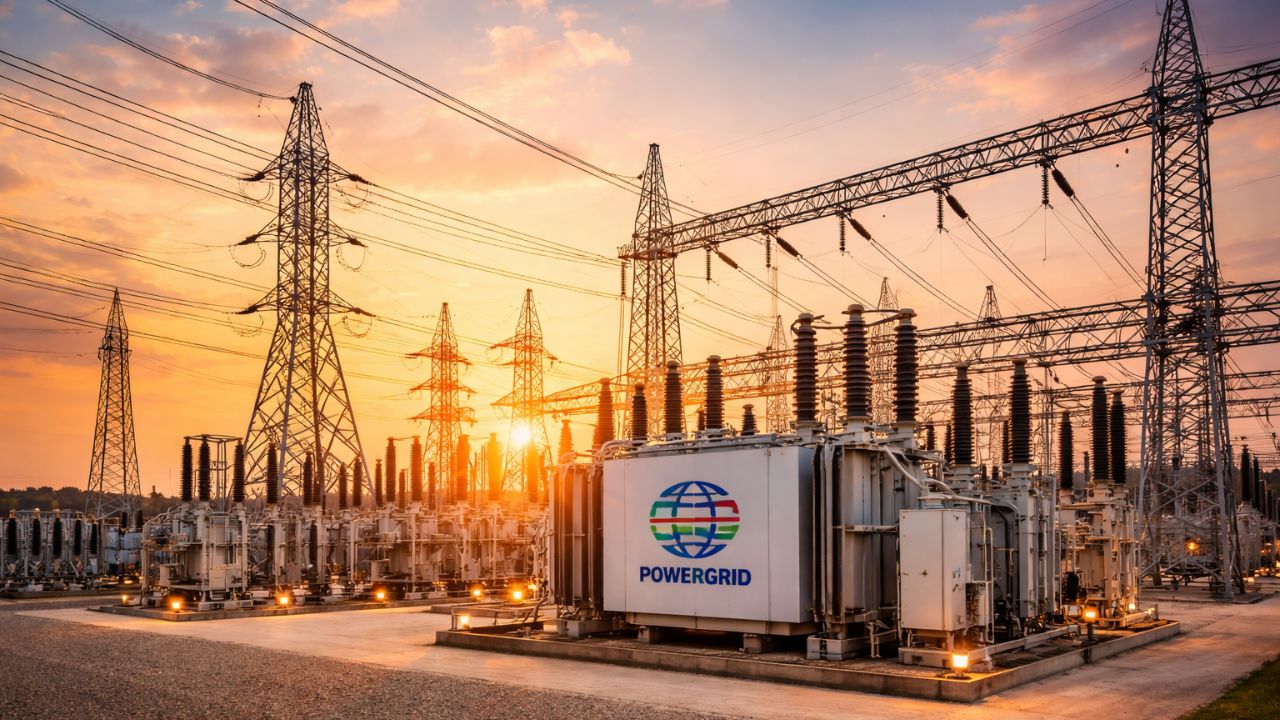
Cabinet Boosts POWERGRID Investment Limit
New Delhi: In a significant move aimed at strengthening India’s power transmission network, the Cabinet Committee on Economic Affairs (CCEA) has approved enhanced financial delegation for POWERGRID under existing guidelines applicable to Maharatna Central Public Sector Enterprises (CPSEs). The decision increases the company’s permissible equity investment limit in each subsidiary from ₹5,000 crore to ₹7,500 crore, while retaining the overall cap of 15% of the company’s net worth.
This policy shift is expected to accelerate investments in large-scale transmission projects and reinforce India’s push toward clean energy expansion.
POWERGRID, the country’s largest and most experienced power transmission service provider, will now have greater flexibility to invest in its subsidiaries. By raising the per-subsidiary investment ceiling, the government has effectively empowered the company to undertake more capital-intensive projects without procedural delays.
Importantly, the overall investment cap of 15% of net worth remains unchanged, ensuring financial prudence while enabling operational expansion.
The enhanced delegation comes at a crucial time, as India aims to achieve 500 GW of installed capacity from non-fossil fuel sources. A robust transmission network is essential for evacuating renewable energy generated from solar, wind, and other clean sources, often located far from consumption centers.
With increased investment capacity, POWERGRID will be better positioned to develop the transmission corridors required to integrate renewable energy into the national grid efficiently.
The approval also allows POWERGRID to compete for and execute technologically advanced and capital-heavy projects, including Ultra High Voltage Alternating Current (UHVAC) and High Voltage Direct Current (HVDC) transmission systems. These high-capacity networks are vital for long-distance power transfer with minimal losses.
Additionally, the move is expected to enhance competition in Tariff-Based Competitive Bidding (TBCB) processes for major transmission projects. Broader participation typically improves price discovery, leading to more cost-effective infrastructure development.
By strengthening competition and enabling larger investments, the government aims to ensure reliable, affordable, and clean energy access for consumers. Efficient transmission infrastructure not only supports renewable integration but also stabilizes the grid and reduces overall system costs.
This decision reflects the government’s commitment to accelerating energy transition while maintaining financial discipline within public sector enterprises.

