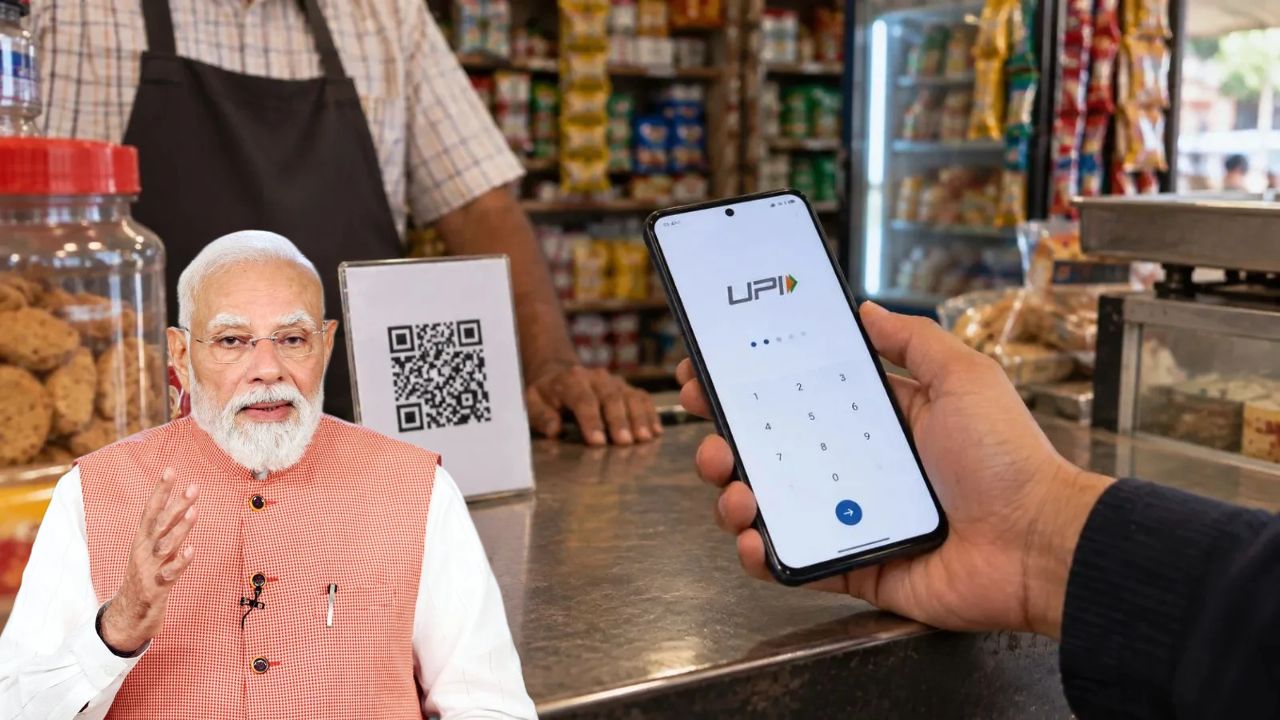
The Centre has clarified its position on the new UPI charges amid allegations of foreign pressure (Img: Dynamite)
New Delhi: The Centre has pushed back against allegations that the decision to introduce charges on certain high-value UPI payments was influenced by the United States, as the new Merchant Discount Rate (MDR) regime triggers a political debate.
The issue came into focus after the Congress alleged that the government had introduced the new UPI charges under pressure from Washington. The government has rejected the claim and maintained that the revised framework is aimed at supporting the long-term sustainability of the digital payments ecosystem.
Under the new framework announced by the National Payments Corporation of India (NPCI), a 0.4% MDR will apply from October 15 to specified person-to-merchant UPI transactions above Rs 2,000.
The charge is levied on the merchant side rather than directly on the customer. For transactions of Rs 75,000 or more, the MDR will be capped at Rs 300 per transaction.
The new system does not mean that users will suddenly have to pay a fee every time they transfer money through UPI.
Person-to-person transactions, such as sending money to family members or friends, will remain outside the new MDR framework. Merchant payments up to Rs 2,000 will also remain free under the announced structure.
The controversy follows earlier concerns raised by the United States over India's digital payment policies.
Opposition leaders have linked the new MDR structure to those broader trade-related concerns and alleged that the government changed its approach because of pressure from the US.
The government, however, has not accepted that interpretation. Its position is that the new framework is an Indian policy decision intended to provide a sustainable financial model for UPI while continuing to protect users from direct transaction charges.
MDR stands for Merchant Discount Rate. It is a fee within the payment ecosystem and is not the same as a tax charged directly to a UPI user.
Under the new arrangement, eligible merchants will bear the MDR on qualifying transactions. The government has also directed banks and payment system participants to ensure that the cost is not passed on to customers as a separate UPI charge.
This distinction is important because a customer paying Rs 5,000 to a merchant through UPI should not automatically expect an additional 0.4% amount to be deducted from their account simply because the payment crosses the Rs 2,000 threshold.
The framework also provides relief for smaller merchants.
Merchants receiving up to Rs 1 lakh per month through UPI QR transactions are exempt from the MDR under the specified category. The structure is therefore aimed primarily at qualifying larger-value merchant transactions rather than every UPI payment made in the country.
Certain sectors will follow separate MDR arrangements.
Payments involving services such as railways, fuel, telecom and insurance can attract a flat Rs 5 MDR in the specified categories. Capital-market related transactions have also been assigned a separate rate structure.
The new structure comes after years in which UPI payments operated without a conventional MDR model for users and merchants.
The government and NPCI have argued that the revised arrangement can help support the infrastructure behind UPI, including payment processing, security and other services required to handle the country's rapidly expanding digital transaction volumes.
UPI processed about 24 billion transactions worth nearly $311 billion in August 2026, according to Reuters, underlining the enormous scale of the payment network.
The announcement has opened a wider political argument over the future of India's digital payment system.
The Congress and other opposition voices have questioned the timing of the decision and alleged a connection with US trade concerns. The government has rejected the foreign-pressure allegation and framed the MDR as an internal measure for maintaining the financial and operational sustainability of UPI.
For ordinary users, the immediate takeaway is that UPI itself is not becoming a paid service. The new MDR primarily concerns specified merchant transactions above Rs 2,000, while person-to-person transfers remain free under the announced rules.

