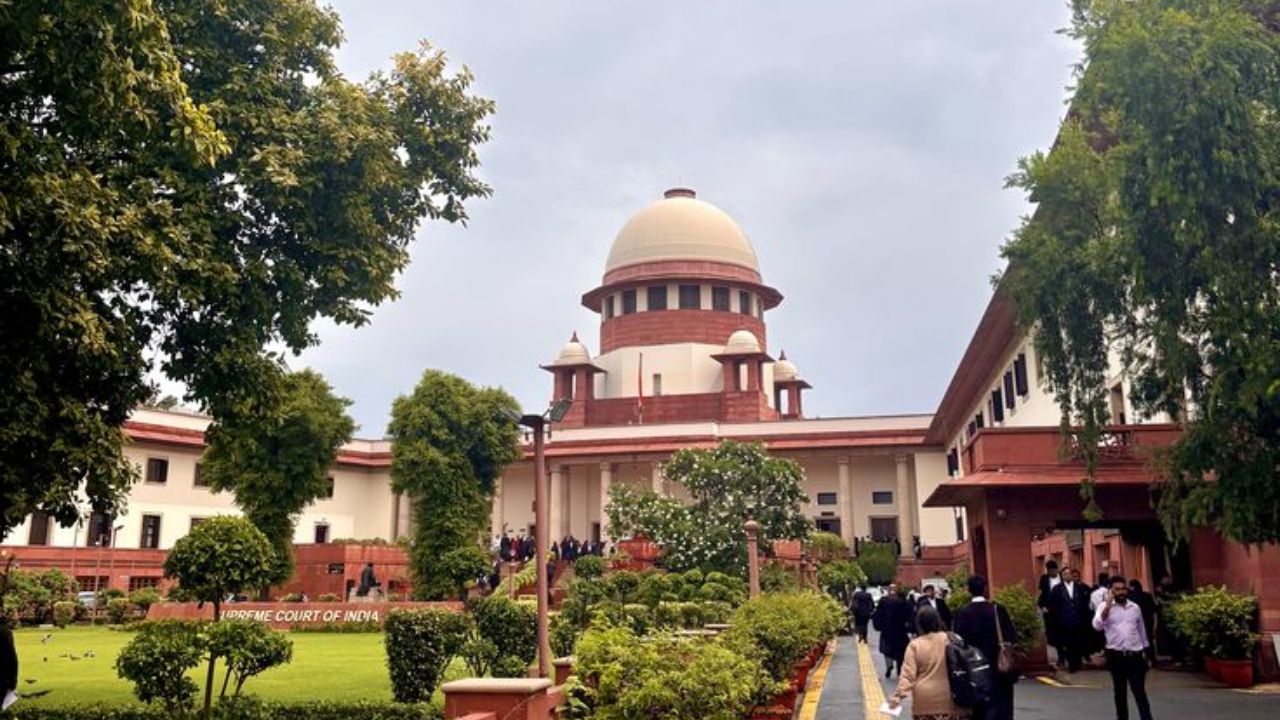
Supreme Court (Img-Pinterast)
New Delhi: The debate over India’s reservation policy has intensified after the Central government opposed the introduction of the creamy layer principle in Scheduled Caste (SC) and Scheduled Tribe (ST) quotas, telling the Supreme Court that any major change in the existing framework must be decided by Parliament through a proper legislative process. The Union Ministry of Social Justice and Empowerment, in an affidavit submitted before the Supreme Court, argued that SC/ST reservations are not based only on economic conditions but are linked to historical injustice, social discrimination, caste-based exclusion, tribal identity and inadequate representation in government services and educational institutions.
The government maintained that the creamy layer concept, which excludes relatively advanced sections from reservation benefits, cannot be automatically extended to SC and ST communities because their constitutional status and historical circumstances are different from those of other backward classes. The Centre’s response has once again brought the decades-old debate over reservation benefits, equality and social justice into focus. The issue raises a crucial question: should economic status determine access to reservation benefits, or should reservation continue to focus primarily on historical and social disadvantage?
The creamy layer principle refers to the exclusion of socially and economically advanced sections within a backward community from reservation benefits. The idea behind this concept is to ensure that affirmative action reaches those sections that continue to face disadvantage instead of being repeatedly accessed by relatively privileged groups within the same category.
At present, the creamy layer principle is mainly applied to Other Backward Classes (OBC) reservations. It was introduced to prevent the concentration of quota benefits among economically and socially advanced sections of backward communities. However, the Union of India has argued that this principle cannot be directly applied to SC and ST reservations because these categories were created to address centuries of social discrimination, exclusion and lack of representation rather than only economic backwardness.
The debate gained momentum after a petition before the Supreme Court sought directions for introducing income-based preferences and internal classification within reserved categories, including SC, ST, OBC and Socially and Educationally Backward Classes (SEBC). The petition argued that a more targeted approach could ensure that economically weaker individuals within reserved communities receive greater access to government jobs and educational opportunities.
The petitioners referred to previous Supreme Court observations on sub-classification within reserved categories and argued that reservation benefits should reach the most disadvantaged sections. However, the Centre opposed this argument, stating that reservation is not merely a poverty alleviation measure. According to the government, reservation is a constitutional mechanism designed to correct historical discrimination, social exclusion and inadequate representation.
The Centre told the Supreme Court that SC, ST and OBC categories have different constitutional foundations and social realities. According to the Centre, Scheduled Castes have historically faced caste-based discrimination, untouchability and social exclusion, while Scheduled Tribes have faced challenges related to geographical isolation, cultural differences, limited access to education and economic development.
These factors make SC/ST reservations fundamentally different from OBC reservations, where the creamy layer principle evolved through judicial interpretation, noted the affidavit, highlighting that reservation policies were introduced to ensure equal representation and opportunities for communities that have faced long-term structural disadvantages.
The government referred to important Apex Court judgments while defending its position on the creamy layer debate. It cited the 2008 Constitution Bench judgment in Ashoka Kumar Thakur versus Union of India, arguing that the creamy layer principle has primarily been recognised in relation to OBC reservations.
It also referred to the 2005 judgment in E.V. Chinnaiah versus State of Andhra Pradesh, stating that any decision regarding exclusion criteria within SC communities involves constitutional issues that require consideration through the legislative process. The government maintained that courts should not introduce major changes in reservation policy without extensive empirical research, socio-economic data analysis and legislative discussion.
The Centre argued that reservation policy involves complex constitutional, social and administrative considerations that cannot be decided only through judicial intervention. Any modification in SC/ST reservation rules requires detailed assessment of social conditions, representation levels in government employment and education, and the impact of such changes on beneficiary communities, it noted.
According to the affidavit, reservation policies were part of India’s broader social justice framework and required democratic debate and parliamentary consideration before any major reform. The Centre also highlighted the importance of maintaining the separation of powers between the judiciary, executive and legislature.
The creamy layer principle originated from the landmark 1992 Supreme Court judgment in Indra Sawhney versus Union of India, commonly known as the Mandal Commission case. In this judgment, the Supreme Court upheld reservations for Other Backward Classes but ruled that the advanced sections among backward communities should be excluded from quota benefits.
The objective was to ensure that reservation reaches those who continue to face social and educational disadvantages. Over the years, the debate expanded to include questions about whether similar criteria should apply to SC and ST communities, leading to a wider discussion on equality, representation and social justice.
Supporters of applying the creamy layer principle to SC/ST reservations argue that it could ensure a more equitable distribution of benefits within reserved communities. They believe that economically stronger sections should make way for those who remain socially and financially disadvantaged. Those opposing the move argue that SC/ST communities continue to face caste-based discrimination and social barriers even when some individuals achieve economic progress. They maintain that reservation is aimed at addressing historical injustice and representation gaps rather than only financial inequality.
The Centre’s stand before the Supreme Court indicates that any major change in SC/ST reservation policy will require a broader legislative decision rather than only judicial directions. The Apex Court is currently examining several important issues related to reservation, including sub-classification within SC categories and the distribution of quota benefits among different sections.
The outcome of this debate could have far-reaching implications for India’s affirmative action system and the future structure of reservation policy. For now, the government’s position remains clear: extending the creamy layer formula to SC/ST reservations requires parliamentary consideration, constitutional analysis and a detailed assessment of social realities. The debate continues to remain one of India’s most significant discussions on equality, representation and social justice.

