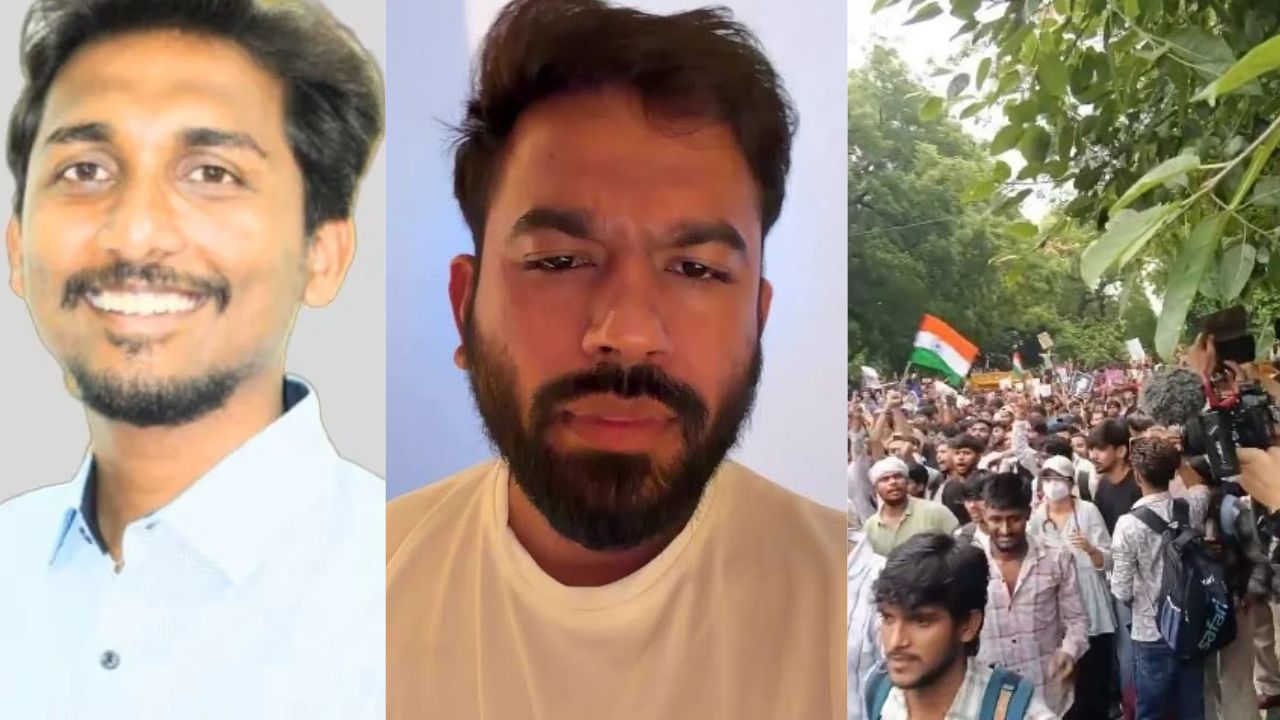
Ajinkya Shinde is set to lead the CJP demonstration while senior party leaders remain in detention. (Img: X)
New Delhi: CJP organisation in-charge Ajinkya Shinde is set to lead the protest against CEC Gyanesh Kumar at Jantar Mantar after CJP Founder Abhijit Dipke, along with party leaders Saurav Das and Ashutosh Ranka were arrested as soon as they landed in the national capital for the agitation.
In a pre-recorded video message, Dipke designated Shinde to lead the demonstration at Jantar Mantar for as long as he, Das and Ranka remained in detention. The party said Dipke had recorded the message on Friday night because he anticipated the possibility of being detained after reaching Delhi. The move appears intended to ensure that the planned demonstration continues despite the absence of the party’s senior leadership.
The announcement has given the protest a new focus, with attention shifting towards Shinde’s role and whether CJP supporters will be able to assemble despite restrictions imposed by the authorities.
NCP (Sharadchandra Pawar) spokesperson Anish Gawande, who was reportedly travelling on the same flight, also described the detention of the three leaders. He expressed concern about the manner in which police personnel entered the aircraft and said the leaders’ precise whereabouts were not immediately clear to him.
Gawande also appealed for restraint, urging the police to treat young protesters as citizens exercising their rights rather than as criminals.
The protest centres on allegations concerning the Special Intensive Revision of electoral rolls and the role of Chief Election Commissioner Gyanesh Kumar. The CJP has accused the electoral-roll revision process of causing large-scale voter deletions and has demanded Kumar’s resignation. Dipke has alleged that around 13 crore voters have been removed from electoral rolls since 2024, a claim that requires independent verification and should not be treated as an established figure.
The party has argued that changes to voter lists could have serious implications for electoral participation and the credibility of elections. It has also linked its concerns to the narrow vote-share difference between the National Democratic Alliance and the Opposition INDIA bloc in the 2024 Lok Sabha elections.
The Election Commission has rejected allegations of irregularities, maintaining that major decisions relating to the SIR exercise were taken unanimously by the full commission.
Separately, a report by The Indian Express said Election Commissioners Sukhbir Singh Sandhu and Vivek Joshi had raised objections on at least 14 occasions over 10 months concerning decisions and procedures linked to the SIR exercise.
The reported objections have added to the scrutiny surrounding the revision process, although they do not by themselves establish that voter deletions were unlawful. The controversy has therefore developed into a broader dispute over electoral transparency, institutional accountability and the protection of eligible voters’ rights.
The planned demonstration prompted extensive security measures across the national capital. Police barricades, checkpoints and road restrictions were introduced around central Delhi, while personnel from the Delhi Police and Central Armed Police Forces were deployed at key locations.
Officials cited concerns about crowd management and public order after permission for the demonstration was denied. Loudspeaker announcements warned against unauthorised gatherings, processions and road blockades in restricted areas under the applicable legal provisions.
Reports on the planned deployment cited thousands of Delhi Police personnel and a substantial presence of central forces. The scale of the security arrangements has also raised concerns about the impact on commuters, businesses and people travelling through central Delhi.
The Delhi Metro Rail Corporation initially announced restrictions affecting 57 stations before revising the list. Entry and exit gates at 45 stations were subsequently closed for the specified period, while interchange arrangements remained available at affected stations except where separately restricted.
The Railways also cancelled or rescheduled certain services because of anticipated congestion around New Delhi and Hazrat Nizamuddin railway stations. The measures were intended to manage the expected movement of people and traffic during the protest period.
Retail liquor outlets were ordered to remain closed on October 9 and 10, although licensed restaurants, bars and clubs were permitted to continue serving liquor under the applicable rules. The Sarai Kale Khan and New Ashok Nagar Namo Bharat stations were also scheduled to remain closed during the specified security window.
These restrictions have added a practical dimension to the controversy, affecting daily travel and access to key parts of the capital. Commuters have had to account for possible diversions, station closures and delays while navigating the affected areas.
The immediate questions concern the whereabouts and legal status of Dipke, Das and Ranka, the grounds for their detention and whether the CJP demonstration will proceed under Shinde’s leadership.
The incident has brought together several contentious issues: the right to peaceful assembly, police powers, electoral transparency and the treatment of political dissent. As the situation develops, official clarification about the detentions and the status of the planned protest will be crucial to establishing what happened and what comes next.

