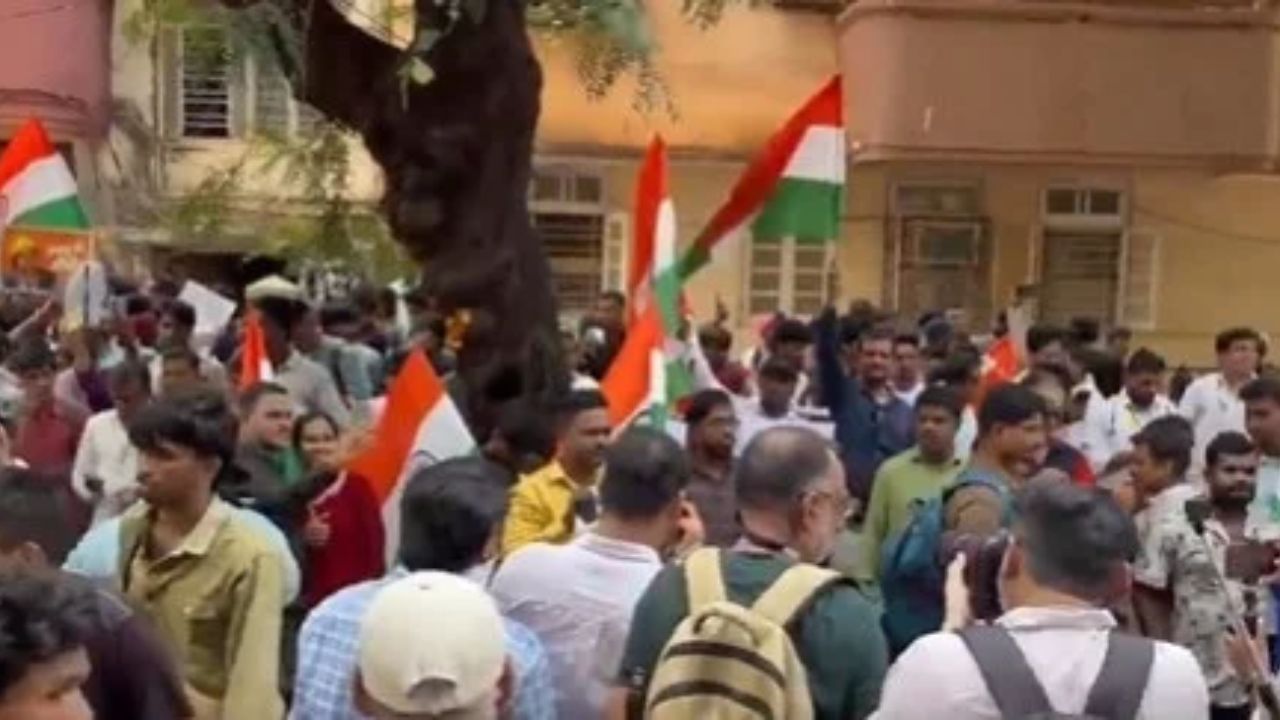
CJP founder Abhijeet Dipke leads a protest against Chief Election Commissioner Gyanesh Kumar at Mumbai’s Shivaji Park. (img: X)
Mumbai: This state capital witnessed a major CJP mobilisation on Gandhi Jayanti as founder Abhijeet Dipke led a protest demanding Chief Election Commissioner Gyanesh Kumar’s resignation. The demonstration has drawn attention amid the continuing controversy over the Special Intensive Revision (SIR) of electoral rolls, reported differences within the Election Commission and demands for greater transparency.
The Cockroach Janta Party (CJP) chose Mumbai’s Shivaji Park for its October 2 mobilisation as part of its campaign against CEC Gyanesh Kumar and the Election Commission’s handling of electoral-roll revision.
The organisation had announced a nationwide protest campaign beginning in Mumbai, with its demands centred on Kumar’s resignation, changes to the SIR process and greater transparency in the appointment of the Chief Election Commissioner.
The Mumbai choice has also acquired a political dimension because of Maharashtra’s contrasting results in the 2024 Lok Sabha and Assembly elections. CJP has sought to connect those contrasting electoral outcomes with its broader questions about voter-list management and electoral processes.
Those arguments remain political allegations and do not, by themselves, establish that either election was improperly conducted.
## The Maharashtra Election Angle
In the 2024 Lok Sabha election, the BJP won nine of the 28 seats it contested in Maharashtra. The Mahayuti alliance, comprising the BJP, Shiv Sena and NCP, won 17 of the state’s 48 Lok Sabha seats.
The Maha Vikas Aghadi, comprising Congress, Shiv Sena (UBT) and NCP (SP), won 30 seats, while one seat went to an independent candidate.
The picture changed sharply in the Maharashtra Assembly election held months later. The BJP won 132 seats, while Shiv Sena secured 57 and NCP 41. The Mahayuti alliance therefore won 230 of the 288 Assembly seats.
The MVA parties together won 46 seats.
The difference between the two election outcomes has since become part of a wider political debate over Maharashtra’s electoral landscape. CJP has used that contrast while questioning the administration of voter rolls and electoral procedures.
## Rahul Gandhi’s Maharashtra Connection
The Mumbai protest also comes against the backdrop of Rahul Gandhi’s earlier allegations concerning electoral processes in Maharashtra.
Following the Assembly election, the Congress leader raised allegations of vote manipulation and referred to constituencies in Vidarbha while questioning aspects of electoral-roll management.
Those allegations have since become part of the broader opposition campaign over SIR, voter deletions and the functioning of the Election Commission.
The Election Commission has rejected allegations of political manipulation and has maintained that voter-roll revision is intended to identify eligible voters while removing duplicate, ineligible or otherwise invalid entries.
## Why Gandhi Jayanti Matters
The October 2 date gives the CJP mobilisation an additional historical dimension.
Gandhi Jayanti marks the birth anniversary of Mahatma Gandhi and is closely associated with ideas of non-violence, civil resistance and mass political mobilisation.
Mumbai also has a major place in India’s freedom movement. The Quit India Movement was launched from Gowalia Tank Maidan in 1942, now known as August Kranti Maidan.
CJP has sought to use that historical association while presenting its protest as a campaign centred on electoral transparency and institutional accountability.
## Shivaji Park Under Heavy Security
The protest turned Shivaji Park and the surrounding Dadar area into a high-security zone.
Heavy police deployment, barricades and security arrangements were put in place around the protest site, with personnel also deployed near Dadar railway station. The measures were aimed at crowd control, traffic management and maintaining law and order as protesters gathered.
Mumbai Police had earlier denied permission for the planned demonstration. Despite that, CJP announced that it would proceed with its mobilisation and called it a Jail Bharo Andolan.
The protest also raised concerns among some local residents over traffic disruption and the impact of a large political gathering on movement around Shivaji Park.
## What Is CJP Demanding?
The central demand of the CJP campaign is the resignation of Chief Election Commissioner Gyanesh Kumar.
The organisation has also called for greater transparency in the process of appointing the CEC, changes to the SIR exercise and safeguards around electoral rolls.
Another major demand concerns preserving the 2025 voter list, with CJP arguing that further changes to electoral records should be subject to greater scrutiny.
The organisation has announced plans to expand the agitation beyond Mumbai, with protests planned in several other cities before a larger mobilisation in Delhi.
## Why Gyanesh Kumar And The Election Commission Are Under Scrutiny
The CJP protest comes amid heightened scrutiny of the Election Commission following reports of internal objections over aspects of electoral-roll management and SIR.
An investigation reported that Election Commissioners Sukhbir Singh Sandhu and Vivek Joshi had raised formal objections on multiple occasions over a 10-month period concerning decisions and orders linked to election administration.
The reports triggered questions about decision-making within the three-member constitutional body and whether all major decisions were being taken collectively.
The Election Commission has disputed interpretations suggesting a breakdown in its functioning and has maintained that decisions relating to SIR were taken unanimously.
The controversy has also reached the legal arena, with the Supreme Court agreeing to hear a plea raising questions about the manner in which decisions have been taken within the Election Commission under Gyanesh Kumar.
## A Wider National Protest
The Mumbai mobilisation is taking place alongside demonstrations and political activity in other parts of the country over the Election Commission and SIR.
Protests were also planned in Delhi on October 2, while student organisations, activists and political groups have separately raised concerns about electoral-roll revision and voter exclusions.
The simultaneous mobilisation has pushed electoral-roll management, voter verification and the institutional functioning of the Election Commission into the national spotlight.
For ordinary voters, the debate has a direct relevance. Electoral rolls determine who can participate in elections, making procedures for voter registration, deletion, verification and correction especially important.

