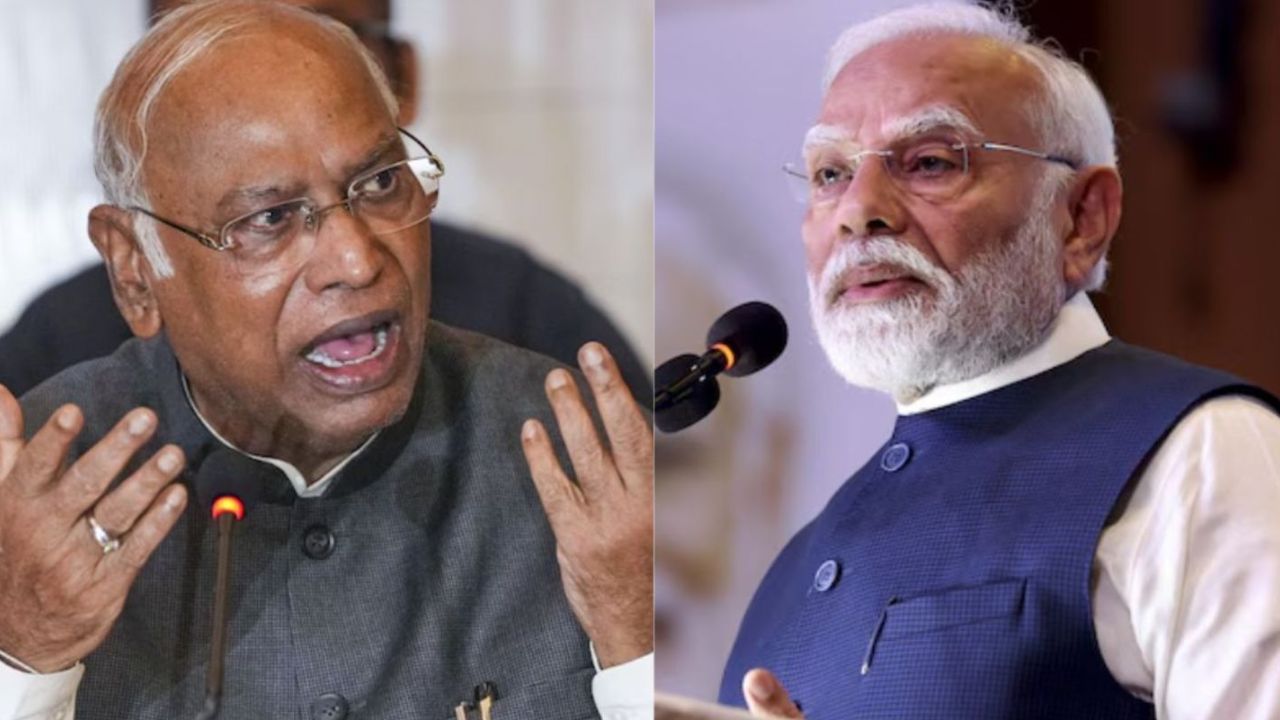
Mallikarjun Kharge seeks clarity from Prime Minister Narendra Modi after the ITBP chief confirms continuing face-offs along the Arunachal Pradesh border. (Img: X)
New Delhi: Congress president Mallikarjun Kharge has demanded answers from Prime Minister Narendra Modi after the Indo-Tibetan Border Police (ITBP) chief confirmed that face-offs between Indian and Chinese troops were continuing at multiple locations along the Arunachal Pradesh border. The remarks have reignited questions over border security, the effectiveness of diplomatic engagement with Beijing and the government’s handling of tensions along the Line of Actual Control (LAC).
Kharge has described the reported confrontations as a serious national security concern, asking whether India’s patrolling access has been affected and whether the outcomes of years of bilateral negotiations have translated into tangible progress on the ground. He has also linked the border issue to India’s growing trade deficit with China, questioning the consistency of the government’s security and economic policies.
The latest political confrontation follows remarks by ITBP Director General Shatrujeet Singh Kapur, who said that face-offs had taken place at several locations in Arunachal Pradesh and were continuing. He made the observations while addressing personnel at an event in Alwar, Rajasthan, ahead of the force’s 65th Raising Day.
The statement has drawn renewed attention to the eastern sector of the India-China frontier, particularly the Taksing area in Arunachal Pradesh’s Upper Subansiri district, where reports of confrontations had emerged earlier. The developments have raised questions about the operational situation along the LAC, patrol movements and the management of competing territorial claims.
The ITBP guards India’s 3,488-kilometre LAC with China. Its personnel operate in challenging mountainous terrain, where patrol encounters, infrastructure development and differing perceptions of the boundary can create friction between the two sides.
Kapur also highlighted the ITBP’s efforts to strengthen operational readiness, including the deployment of specialised Shaurya commando teams, drone capabilities and enhanced training designed to prepare personnel for high-altitude confrontations. These measures underline the importance of preparedness as India continues to manage a sensitive border with China.
Responding to the ITBP chief’s remarks, Kharge called on the Prime Minister to explain the situation along the Arunachal Pradesh frontier and clarify whether another serious confrontation was developing.
The Congress president referred to reports of Chinese incursions near Taksing that emerged in August and questioned why the public had not received a comprehensive explanation of the developments. He also pointed to the September 6 Corps Commander-level meeting at Wacha-Damai, arguing that continued face-offs raised questions about the effectiveness of military-level dialogue.
Kharge’s central concern is whether India’s diplomatic and military engagements with China have delivered measurable improvements in the border situation. He cited repeated interactions between Modi and Chinese President Xi Jinping, meetings involving National Security Adviser Ajit Doval and Chinese representatives, discussions under the Working Mechanism for Consultation and Coordination on India-China Border Affairs, and engagements at multilateral forums such as the Shanghai Cooperation Organisation and BRICS.
He questioned whether India’s patrolling rights as they existed before the May 2020 border crisis had been fully restored. That issue remains a central point in the wider debate over disengagement, border management and the long-term stability of India-China relations.
Kharge also urged the government to brief Parliament and the public on the developments rather than focus on political exchanges with the Opposition. His remarks have placed transparency and accountability alongside national security as key themes in the emerging political debate.
The latest controversy comes against the backdrop of previous military stand-offs between India and China, including the Doklam standoff in 2017 and the deadly Galwan Valley clash in June 2020, in which 20 Indian Army personnel lost their lives.
The Galwan confrontation significantly altered the trajectory of bilateral relations, prompting heightened military deployments, infrastructure development and sustained diplomatic negotiations. Although the two countries have continued engaging through military and diplomatic channels, differences over the boundary and the restoration of normal patrolling arrangements have remained sensitive issues.
The reports from Arunachal Pradesh have therefore attracted attention because they concern another strategically important sector of the frontier. However, the confirmation of continuing face-offs does not, by itself, establish that the situation has escalated to the scale of the Galwan clash or that a wider military confrontation is imminent.
The distinction matters as authorities assess developments along the LAC, where the immediate objective is to prevent localised encounters from escalating and maintain stability through established military and diplomatic mechanisms.
Beyond the border situation, Kharge questioned whether repeated high-level meetings and negotiations with Beijing had delivered sufficient results. He cited reported interactions between the two countries’ leaders, rounds of Special Representatives’ talks and meetings under the border consultation mechanism.
The Congress president’s criticism centres on the gap he perceives between diplomatic engagement and outcomes on the ground. He has asked whether India’s pre-May 2020 patrolling access has been fully restored and whether the government has adequately explained the current border situation.
Diplomatic engagement is one of the principal mechanisms used by both countries to manage tensions, negotiate disengagement arrangements and prevent incidents from escalating. The effectiveness of those efforts is assessed not only through the number of meetings held but also through their implementation, the situation on the ground and the ability of both sides to maintain peace along the frontier. The latest ITBP remarks have renewed scrutiny of these questions, although the precise status of individual patrol routes and border arrangements requires specific official clarification.
Kharge has also targeted the government over India’s economic dependence on China, arguing that rising imports and the widening trade deficit sit uneasily alongside the government’s emphasis on domestic manufacturing and self-reliance.
According to figures published by the Embassy of India in Beijing, India’s imports from China rose from USD 65.21 billion in the 2020-21 financial year to USD 131.63 billion in 2025-26. Over the same period, the bilateral trade deficit increased from USD 44.02 billion to USD 112.16 billion.
The figures indicate that India’s trade imbalance with China has expanded substantially, even as the two countries continue to navigate difficult security and diplomatic relations. The increase in imports reflects the scale of commercial ties and India’s reliance on Chinese supplies across a range of manufactured goods, machinery, electronics and industrial inputs.
Kharge has used the figures to question the effectiveness of the government’s Make in India and domestic manufacturing strategies. He has also raised concerns about reported proposals to ease certain restrictions on Chinese investment and consider Production Linked Incentive benefits for eligible China-linked ventures.
The wider policy challenge is to reduce vulnerabilities in strategic supply chains while sustaining industrial production, investment and access to essential components. Trade with China remains economically significant, but the scale of the deficit has intensified debate over import substitution, export competitiveness and the pace of domestic manufacturing expansion.
The official trade data provide context for the political dispute. India’s imports from China reached USD 131.63 billion in 2025-26, while exports to China stood at USD 19.47 billion, leaving a trade deficit of USD 112.16 billion.
The imbalance highlights the gap between the value of goods India purchases from China and the value of goods it sells to the neighbouring country. The figures do not, on their own, establish the causes of the deficit or demonstrate that any single policy decision is responsible for its growth.
Addressing the imbalance involves several interconnected issues, including domestic manufacturing capacity, access to Chinese markets, competitiveness of Indian exports, supply-chain diversification and the availability of critical components. These economic considerations have become increasingly relevant as border tensions continue to shape public and political debate over India’s relationship with Beijing.
The issue brings together two major concerns for India: maintaining stability along a disputed border and managing a deep economic relationship with a strategically significant neighbour.
For residents of border regions and security personnel deployed in difficult terrain, developments along the LAC have direct implications for safety, infrastructure and day-to-day border management. For businesses and consumers, India-China trade relations influence the availability and cost of a wide range of goods and industrial inputs.
For policymakers, the challenge is to protect national security interests while ensuring that diplomatic channels remain effective and economic vulnerabilities are addressed. The debate also highlights the importance of timely, precise communication when developments along a sensitive international boundary become the subject of public concern.
Kharge’s intervention has intensified political scrutiny of the government’s China policy, but his allegations and questions should be distinguished from independently established facts about the border situation.

