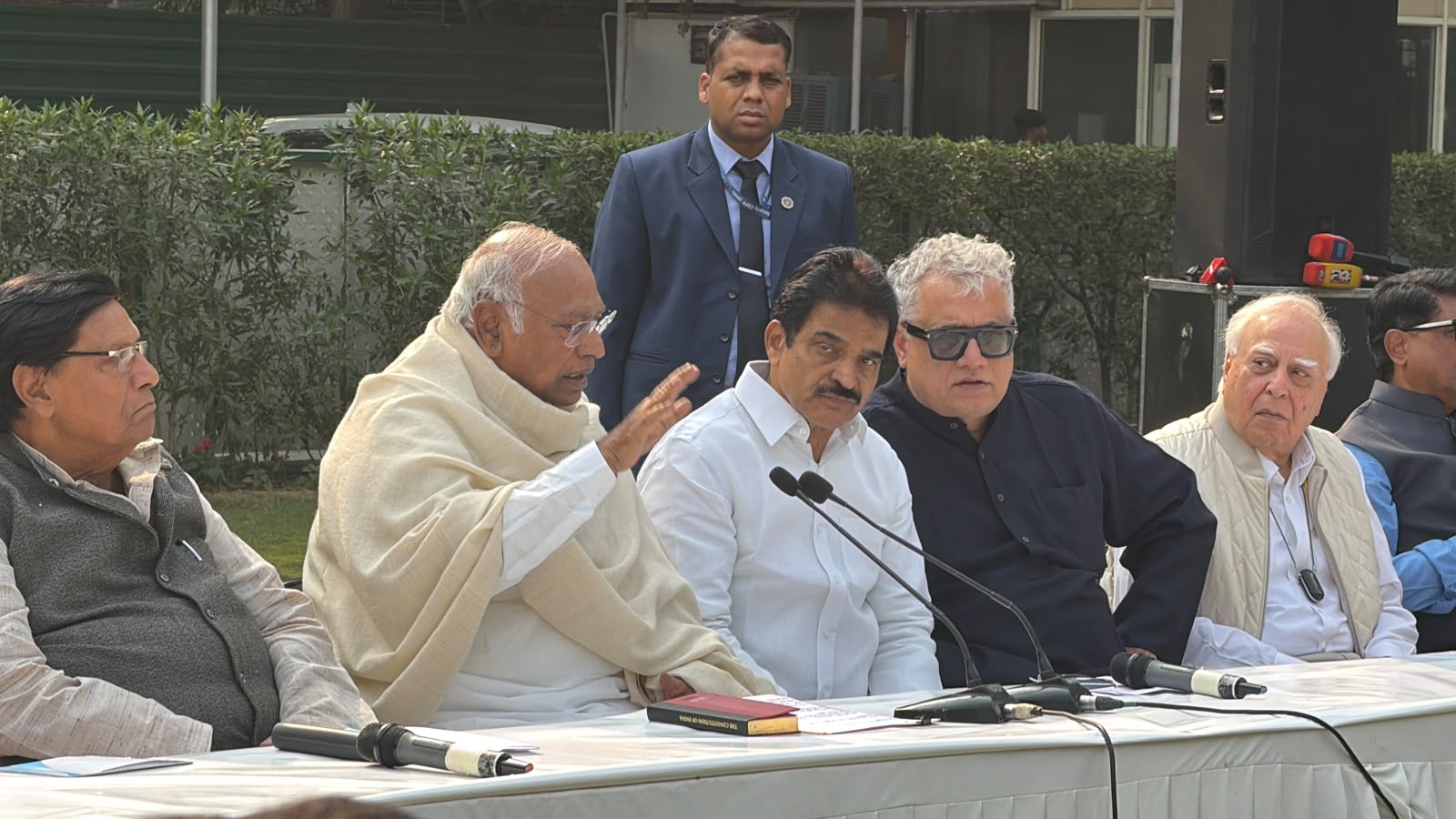
Congress president Mallikarjun Kharge has termed the proposed constitutional amendment a grave threat to democracy. (Img: Dynamite News)
New Delhi: A major political confrontation is unfolding over the Centre's proposed Delimitation Bill, with the INDIA bloc announcing a united opposition to the legislation even as the DMK and Sharad Pawar-led NCP (SP) have indicated support for the revised seat-expansion formula, subject to safeguards.
Congress president and Leader of Opposition in the Rajya Sabha Mallikarjun Kharge has termed the proposed constitutional amendment a grave threat to democracy, raising concerns over federal representation, electoral fairness, SC-ST reservation and the Election Commission's role.
The controversy has intensified ahead of Parliament's special session, with the proposed legislation potentially increasing the Lok Sabha's maximum strength to 850 members and State Assemblies' strength to 650.
Floor leaders of the INDIA bloc convened at Kharge's residence in New Delhi on November 28 to formulate a coordinated strategy against the Centre's proposed delimitation exercise.
The meeting was attended by Lok Sabha Leader of Opposition Rahul Gandhi, Congress leader Priyanka Gandhi Vadra, Trinamool Congress's Abhishek Banerjee, RJD's Manoj Jha and other opposition representatives.
After the deliberations, Kharge announced that the alliance would collectively oppose the proposed constitutional amendment, accusing the government of attempting to consolidate political power.
The opposition has outlined three principal demands: retaining the existing strength of the Lok Sabha, implementing the 33% women's reservation within the current number of parliamentary seats, and protecting the existing state-wise proportion of representation for another 25 years.
The bloc believes that increasing the strength of Parliament alongside delimitation could have far-reaching consequences for India's federal structure and the distribution of political influence.
Kharge's objections extend beyond the proposed expansion of parliamentary seats. He has argued that the proposed framework does not adequately address the interests of Scheduled Castes and Scheduled Tribes, particularly regarding the revision of reserved constituencies in accordance with demographic changes.
He has also questioned the Election Commission's proposed involvement in the delimitation process, referring to concerns over electoral roll revisions and previous constituency-reorganisation exercises in Assam and Jammu and Kashmir.
Congress leaders have similarly criticised the government's approach to women's reservation, arguing that the issue should not be used to justify a wider restructuring of parliamentary representation.
Congress MP Pramod Tiwari accused the BJP of undermining constitutional institutions and said the INDIA bloc meeting was intended to formulate a collective response.
Congress leader Pawan Khera said the party would communicate its detailed position following the deliberations.
Another Congress MP, Syed Nasir Hussain, alleged that opposition leaders were facing pressure to switch political sides through the threat of central investigative agencies, including the Enforcement Directorate and Central Bureau of Investigation. He described the alleged political strategy as 'Operation Lotus'.
These allegations reflect the broader political tensions surrounding the proposed constitutional amendment.
The Union Cabinet has approved a constitutional amendment proposing a proportional 50% increase in the number of Lok Sabha seats allocated to every state and Union Territory.
If enacted, the proposal could raise the maximum strength of the Lower House to 850 members. The corresponding expansion of State Legislative Assemblies could take their maximum strength to 650.
A key feature of the proposed framework is the continuation of the existing proportion of parliamentary representation among states for 25 years. The arrangement would remain in place until it is revised according to population figures from the Census conducted after 2051.
The government is seeking to combine an expansion of legislative capacity with safeguards against changes in the relative parliamentary representation of individual states. The proposal has nevertheless triggered concerns over the methodology for determining constituency boundaries and reserved seats.
The DMK's position has emerged as a major complication for the Congress-led opposition strategy. The party, which has 22 Lok Sabha MPs, has indicated support for the proposed 50% increase in parliamentary seats, maintaining that the arrangement would not disadvantage Tamil Nadu.
DMK MP A. Raja has said the party wants Tamil Nadu's existing 7.18% share in the Lok Sabha protected. According to his assessment, the proposed formula could marginally increase the state's share to approximately 7.21%.
The DMK has also maintained that the existing proportion of parliamentary representation among states, calculated using the 1971 Census, should continue for another 25 years.
The party's position demonstrates that support for increasing the number of parliamentary seats does not necessarily mean acceptance of every provision of the proposed delimitation framework. It has indicated that it may seek changes to other provisions while supporting the broader expansion formula.
The development has also highlighted the growing divergence between national opposition strategy and the regional interests of individual political parties.
The Sharad Pawar-led NCP (SP) has also backed the revised seat-expansion proposal, subject to the condition that every state receives an identical 50% increase in Lok Sabha representation.
Its position adds another layer to the political divisions within the opposition camp.
While the Congress wants the existing strength of the Lok Sabha retained, the DMK and NCP (SP) have indicated that a uniform expansion could be acceptable if the relative representation of states is protected.
The disagreement raises questions about whether the INDIA bloc can maintain a common parliamentary position on a constitutional amendment that directly affects state representation.
A central element of the proposed framework is the use of different population benchmarks for state-wise allocation and constituency delimitation. The Centre proposes retaining the 1971 Census-based formula for determining the relative share of Lok Sabha seats among states until 2051.
However, it intends to use the 2011 Census for redrawing constituency boundaries and determining SC-ST reserved seats. The opposition has demanded that the exercise be based on the latest Census data rather than relying on the 2011 figures for constituency reorganisation.
The distinction is significant because the number and boundaries of constituencies can change even when the overall proportion of parliamentary seats allocated to individual states remains protected. States that have successfully controlled population growth are particularly concerned about ensuring that their political representation is not diluted through the delimitation process.
The Centre's legislative package also seeks to facilitate the implementation of 33% reservation for women in the Lok Sabha and State Legislative Assemblies. The 106th Constitutional Amendment, enacted in 2023, established the constitutional framework for women's reservation. Its implementation, however, is linked to a delimitation exercise following the relevant Census.
The government intends to complete the process before the 2029 Lok Sabha elections. The opposition supports women's reservation but objects to linking its implementation with the proposed expansion and redrawing of constituencies. Its demand is that the women's quota should be implemented within the existing strength of Parliament rather than being made dependent on the proposed restructuring.

